

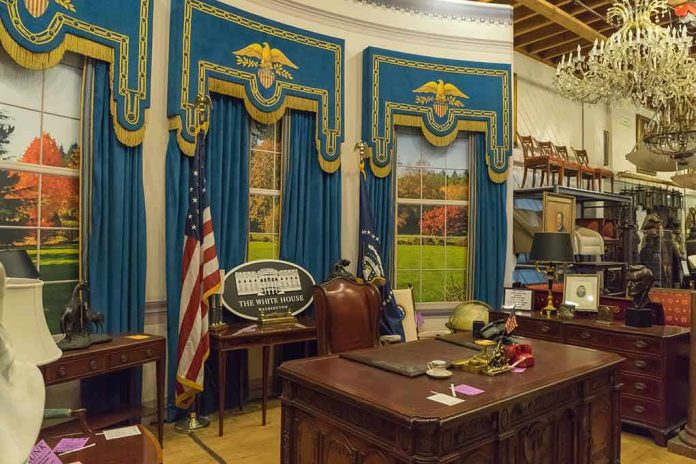
The constitutional fight over a White House ballroom is not about décor; it is a textbook separation‑of‑powers dispute that reasserts a durable American rule: presidents are temporary custodians of federal property, and large, irreversible alterations to the People’s House require Congress’s say‑so.
At a Glance
- Federal courts have held that constructing a massive new White House ballroom—after demolishing the East Wing—requires explicit congressional authorization, not unilateral executive action.
- The D.C. Circuit anchored its ruling in Congress’s Property Clause authority and found no statute that delegates power to the president to reshape the White House at this scale.
- The administration’s national‑security rationale has not persuaded the courts to dispense with statutory limits; judges called it no “blank check.”
- The Supreme Court has been asked to lift the injunction; until Congress authorizes otherwise, above‑ground construction remains blocked while limited security work below grade is treated separately.
What the courts have actually decided—and why it matters
Two courts have now converged on a straightforward proposition: Congress, not the executive, controls the terms on which federal property is altered, and nothing in current law lets a president unilaterally demolish and rebuild major portions of the White House. The district court first enjoined the project, and a divided D.C. Circuit panel upheld the core of that order, stressing that “each President is a temporary tenant, not the owner, of the White House,” and that large structural changes require statutory authorization. The panel located the controlling principle in the Constitution’s Property Clause and examined the cited statutes; none “comes close” to delegating power for a project of this magnitude absent congressional assent.
That framing does two important things. First, it separates routine upkeep—repair, maintenance, refurnishing—from capital works that change the building’s footprint and function. Second, it rejects the view that executive branch control over security operations automatically carries with it the power to re‑design federal property to serve those operations, at least when the redesign is sweeping and permanent. In short, courts are channeling a familiar constitutional instinct: large, durable commitments of public assets belong to the legislature unless clearly delegated.
The administration’s case: national security and executive control
The administration has cast the ballroom as a national‑security facility—an “integrated military complex” with a secure assembly space and even a roof “drone port”—and argues that halting construction imperils readiness. In an emergency application to the Supreme Court, government lawyers present the injunction as judicial interference with the president’s duty to protect the seat of government, describing work already underway and warning of operational gaps if the project pauses.
That argument asks the judiciary to treat physical alterations to the White House as inseparable from ongoing security operations. It is not frivolous; presidents do command security posture, and modern protective doctrine emphasizes hardened, redundant, quickly scalable spaces for massed personnel. Yet courts are drawing a boundary: security judgments do not dissolve Congress’s property and appropriations prerogatives. As the appellate panel put it, the Constitution does not convert “national security” into a self‑executing spending or building power; if the project is as vital as claimed, the remedy is to persuade Congress to authorize it.
The statutes in play: what they allow—and what they don’t
Every modern president benefits from standing appropriations for the care and upkeep of the Executive Residence—line items that cover maintenance, refurnishing, utilities, and minor alterations. Those provisions grease the machinery of everyday stewardship but were never a blank invitation to re‑site walls or erase wings. The D.C. Circuit’s analysis emphasized precisely that distinction: statutes such as 3 U.S.C. § 105(d) (and cognate appropriations riders) contemplate incremental work, not the unilateral substitution of a 90,000‑square‑foot ballroom for the East Wing.
Equally important, long‑standing practice has presidents, even when legally exempt from some preservation review, voluntarily submit plans to federal design and planning bodies. That custom does not itself create law, but it illuminates constitutional sensibility: when a proposed change becomes large, public, and permanent, presidents have treated Congress and its designees as partners, not afterthoughts. The East Wing demolition, pressed ahead of those processes, broke with that tradition and helped trigger the litigation that produced today’s injunctions.
Precedent, practice, and why history cuts against unilateralism
White House alterations have often been ambitious—Theodore Roosevelt’s reconfiguration, the Truman reconstruction, mechanical overhauls across administrations—but they were authorized through statute or appropriations pathways that put Congress on record. Courts in this fight explicitly underscored novelty: they could identify no instance in which a president, relying on executive discretion and non‑specific maintenance statutes, razed and rebuilt taxpayer‑funded portions of the White House or its grounds. That absence matters in constitutional law; when practice is unbroken, it can harden into a guidepost. Here, it points away from unilateral construction and toward formal authorization for major projects.
There is a second historical thread: the White House is both residence and national symbol, but it is also federal property managed in part by the National Park Service. That duality routinely invites tension—every first family renovates; every administration tweaks grounds security—yet the line between stewardship and redesign has been policed by Congress’s control of purse and plan. When courts insist on congressional participation, they are less intruding on executive function than reaffirming that public architecture is a constitutional commons.
Where the genuine disagreement lies
The dispute does not turn on whether presidents may improve security; they must. It turns on whether a president can bootstrap that duty into the power to substantially reconfigure federal property without a statute that clearly says so. The administration argues a functionalist view: if security demands it, and the commander in chief certifies the need, law should not force delay. The courts have replied with a structural view: necessity claims must run through Article I channels when they entail permanent, capital‑intensive re‑design of public assets. A dissenting judge would have credited executive determinations more fully and questioned whether the plaintiffs had standing, but the majority held firm to the Property Clause logic and the absence of a clear delegation.
Funding is a related fault line. The administration has, at different times, described a mix of private donations and executive‑branch funds. Even if every dollar were private, that would not cure the constitutional defect; private money cannot substitute for statutory permission to alter federal property. Congress’s control is about authorization and design as much as about who writes the check.
Security needs without a blank check: how to square the circle
Courts have not second‑guessed below‑grade or interim security work that can be cabined within existing authority; several orders have tailored relief to halt above‑ground, irreversible construction while allowing limited sub‑surface or protective upgrades to continue. That judicial posture attempts to preserve safety without allowing the executive to manufacture leverage by creating a half‑built fait accompli. In effect, judges are saying: pursue urgent, reversible measures under standing authority; seek Congress’s blessing for the rest.
For any White House modernization—ballroom or otherwise—the workable path looks familiar. First, narrow the security case to concrete, testable requirements: occupancy loads for continuity of government, blast standoff assumptions, egress and shelter standards. Second, present a design that meets those requirements with the least permanent impact consistent with safety. Third, bring it to Congress with transparency on cost, funding sources, and governance for any privately contributed dollars. That is how you turn a contested build into a bipartisan asset rather than a judicial emergency.
Trump just took the White House Ballroom fight nuclear… accusing the network behind the lawsuit of exposing top military secrets after being warned the ballroom, hardened facilities and rooftop DronePort form one integrated security structure…
Follow the chain… a National… https://t.co/8JB4gAh7bs
— Observing Consciousness (@holonabove) August 15, 2026
What this means going forward
Three consequences flow from the rulings. Constitutionally, the opinions fortify a clean line: expansive executive claims over federal property will be read narrowly absent explicit delegation. Administratively, agencies that manage the White House precinct—Park Service, GSA, protective services—will calibrate their playbooks to ensure that large physical changes ride on unmistakable statutory rails. Politically, any president who wants to leave a mark that outlasts a term has every incentive to recruit Congress early; the alternative is litigation, delay, and partial demolition without a path to completion.
The Supreme Court could still refine the doctrine, but unless it discovers a delegation that lower courts missed or expands emergency deference in ways that would surprise most separation‑of‑powers scholars, the durable baseline will remain: major redesigns of the People’s House require the people’s legislature to speak. That is not congressional vanity; it is constitutional hygiene. Presidents direct the government. They do not own it.
Sources:
cbsnews.com, fortune.com, politico.com, bbc.com, cnbc.com