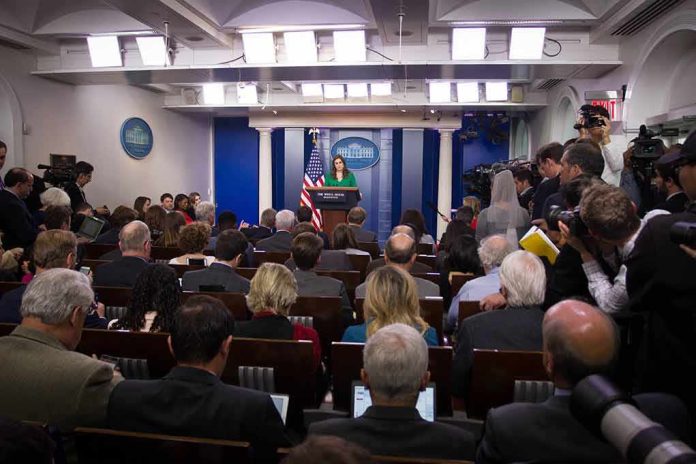
Personnel moves tell you how a White House manages loyalty, continuity, and public message; President Trump’s sendoff for Karoline Leavitt made that visible in one stroke—praise heavy enough to honor her tenure, paired with a clear lane to continue influencing his political project from the outside.
The Short Version
- President Trump announced Press Secretary Karoline Leavitt would depart at month’s end, citing her decision to prioritize family.
- He lauded her performance as among the best to hold the office and emphasized she remains a trusted ally.
- Leavitt’s own statement matched the family rationale, underscoring the demands of the job and motherhood.
- The sendoff framed continuity: Leavitt shifts to a top outside advisor role rather than exiting Trump’s orbit.
What Happened: A Public Sendoff That Doubled as a Continuity Signal
On August 12, 2026, President Trump publicly announced that White House Press Secretary Karoline Leavitt would step down at the end of the month to spend more time with her young children and family. His message was explicit in its respect—he called Leavitt a trusted aide, praised her tenure as one of the best in the history of the office, and made clear she would continue as a top outside advisor and an influential voice in the Republican Party. The announcement ran across major outlets within hours, reflecting a straightforward personnel change whose contours were set by Trump’s own words and amplified by standard wire and network coverage.
Leavitt’s explanation aligned precisely with the president’s framing: she said the press secretary role’s all-consuming demands were incompatible with being the mother she intends to be to two young children. That symmetry—principal and aide telling the same story—matters in this portfolio. It curbs speculation and projects stability while acknowledging the human calculus behind top-tier communications roles, which are relentless by design.
How the Role Works: Why Press Secretaries Burn Out Fast
The White House press secretary is the president’s chief public interlocutor—part spokesperson, part explainer, part combatant—tasked with shaping the daily narrative ex ante and limiting damage ex post. The job compresses long-lead strategy into hourly execution: rapid policy digestion, briefing choreography, stakeholder signaling, and a reflexive defense of the president’s priorities under bright lights. Even in placid administrations, turnover has been high across decades; under Trump, both terms were characterized by particularly brisk reshuffles, making every exit legible against a history of churn.
That pattern is not accidental. The president’s media-centric governance style, coupled with an aggressive news cycle, imposes unusual intensity on comms roles. The professional burden compounds when family obligations grow—especially for a principal who prizes message velocity and personal loyalty. Structurally, then, a family-based departure fits the job’s well-known stress profile while allowing both sides to preserve alignment. The research literature on White House staffing underscores that press secretaries rarely serve entire presidential tenures; in modern times, multi-year runs are the exception, not the norm.
The Sendoff’s Message Discipline: Loyalty In, Role Out
Trump’s language did more than mark the calendar; it curated the narrative. Praising Leavitt as a trusted aide and “one of the best” elevates her status, and by immediately designating her a top outside advisor, the president closed the interpretive gap that often invites speculation about rifts. Reuters captured that construction crisply, quoting the praise and the plan for her continued involvement as the administration heads toward the midterms.
This is a familiar Trump-era pattern. When key communicators exit, the public script prioritizes loyalty maintenance. The incentives are obvious: sustaining a bench of credible surrogates, minimizing the optics of loss, and telegraphing operational continuity to allies and media. For the aide, the benefits are symmetrical—preserved standing inside the coalition and latitude to rebalance work and family without the reputational drag associated with a forced departure. In that sense, the sendoff is less a goodbye than a portfolio rebalance.
Why the Family Rationale Landed: Alignment Between Principle and Practice
Leavitt’s own statement—she could not be the mother her children deserve while meeting the press secretary’s constant demands—provided an uncontestable human anchor for the exit and matched the president’s rationale word for word in its core claim. Alignment of this kind is not mere optics; it is a practical shield. It heads off narratives about inner-circle instability at precisely the moment a White House needs clarity, and it spares the departing principal from being defined by speculation rather than choice. Major outlets, including ABC News and others, reported the announcement in that straightforward frame, because the facts were uncomplicated and on the record.
It also reflects a broader conversation about how senior roles accommodate parenthood. The press secretary portfolio is structurally unforgiving: early calls; late prep; constant reactive posture. The calculus for any parent is particularly stark when the household adds a newborn. The clean articulation of the tradeoff—family over pace—will read as credible to anyone who has watched the job up close.
Context: Turnover, Tenure, and Trump’s Communications Bench
Across modern administrations, communications shops experience the sharpest turnover after the first year and as election cycles ramp. The Trump years amplified those cycles, yielding a record-breaking pace of senior staff change that researchers at Brookings and others tracked in detail; communications roles were among the most volatile, which is unsurprising given the centrality of the president’s media strategy. In that landscape, formalizing Leavitt’s continued advisory role functions as risk management: it de-risks a high-visibility exit by keeping institutional memory and presidential rapport inside the tent, even if off the payroll or away from the podium.
This is also why the unanswered personnel question—who briefs next, who edits talking points, who quarterback’s day-to-day press strategy—is less important on announcement day than the signal that the message architecture remains intact. Wire copy noted the transition without naming a successor, because naming successors lags; what mattered in the moment was that the principal said the operation continues with Leavitt still in the orbit that matters for campaign-season messaging.
She can go directly to hell, she can pass go, but do report yo jail you evil lying war-mongering bitch!
Read "‘Decided to Save Herself’: Karoline Leavitt Gets a Savage Sendoff — as Wild Trump Theory About Her Replacement Takes Off" on SmartNews: https://t.co/cau9UTh37S #SmartNews— hates cheetos pedo (@jeffc_RN) August 16, 2026
What It Means Going Forward
Expect two practical consequences. First, the press office will likely distribute podium time among senior communicators and allied principals while a successor is formalized; that is standard practice when a well-known face departs in the run-up to a campaign push. Second, you will see Leavitt’s influence shift from daily briefing execution to strategic surrogacy—targeted media hits, party messaging, and adviser-level input on lines of attack and defense. That is the logic of the sendoff Trump engineered: celebrate the tenure, protect the relationship, and keep the asset.
Sources:
redstate.com, abcnews.com, washingtonpost.com, facebook.com