
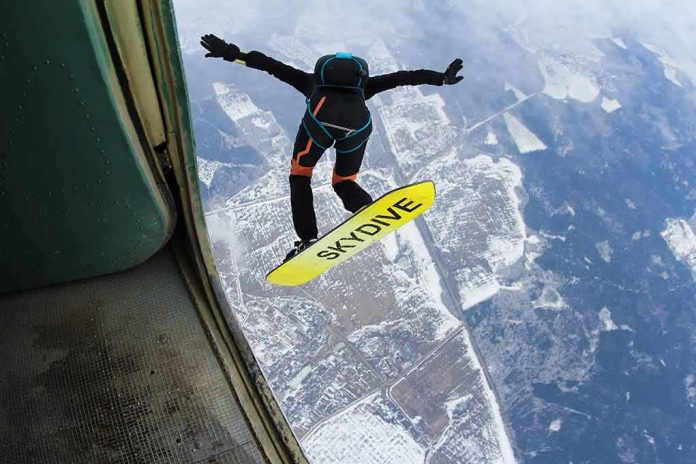
Surviving a freefall without a deployed parachute is not magic; it’s physics, probability, and dumb luck aligning with just enough deceleration from the environment to keep vital organs within survivable g-limits—and, in this rare case, a stand of trees likely made the difference between a miracle and a fatality.
At a Glance
- An experienced skydiver fell roughly 10,000 feet after being knocked unconscious midair and did not deploy a parachute; she lived, with trees reportedly absorbing the impact energy.
- Comparable incidents have been documented: main-parachute malfunctions, reserve complications, and canopy collisions are known failure modes in the sport.
- Survival without a functioning canopy hinges on “stopping distance”—the medium you land in—and is vanishingly rare but mechanically plausible.
- Despite sensational outliers, skydiving’s fatality rate has trended low and downward with modern gear and training—well under 1 per 100,000 jumps in large datasets.
What Happens When the Parachute Never Really Saves You
Contemporaneous reporting has chronicled cases where a jumper—rendered unconscious in a midair collision or trapped in a malfunction sequence—descended from approximately 10,000 feet without a controlled canopy and survived when trees, soft earth, or other forgiving terrain extended the deceleration window. The narrative sounds implausible until you isolate the true killer in any high fall: not velocity itself but the instantaneous deceleration on impact. A body in belly-to-earth freefall reaches terminal velocity in the neighborhood of 120 mph; if that speed is shed over inches on hard ground, deceleration can exceed human tolerance. If it’s shed over many feet—through branches, yielding snow, or a net—the forces can drop into the survivable range, with horrific injuries still likely but life possible.
In the incident at hand, reporting points to an experienced jumper knocked unconscious and therefore unable to deploy—a scenario that fits a known class of accidents: midair strikes, out-of-sequence emergency procedures, or reserve entanglements can all remove decision-making from the equation. The divergence between tragedy and survival is then dictated by physics and terrain, not heroics.
Mechanism: Why Trees, Snow, and Nets Change the Odds
Engineers and trauma physicians converge on a simple principle: survivable impacts require time and distance to dissipate kinetic energy. Branches that break progressively, a deep snowpack, thick brush, even angled surfaces that deflect and slide the body—all lengthen the stopping distance, reducing peak g-loads on the brain, aorta, and spine. The handful of rigorously documented “no-parachute” survivals—from air disasters to wartime ejections—share this trait: a layered or deformable medium that absorbed energy in stages, often while the survivor was incapacitated and unable to optimize body position.
Skydiving adds nuance. A partially inflated or fouled canopy can still alter body attitude and speed vector just enough to matter; clothing drag, spread-eagle posture, and tumbling vs. stable descent all influence terminal velocity and impact angle. None of this guarantees survival; it only opens a narrow window that, if paired with a compliant landing medium, can keep peak forces under lethal thresholds.
Known Failure Modes in Skydiving: Where Things Go Wrong
Accidents that echo this case usually begin with one of three triggers. First, a main-canopy malfunction—line twists, slider hang-ups, or asymmetric inflations—can put a jumper into a high-rate spin with severe g-forces and reduced consciousness. Second, a collision or entanglement during freefall or canopy flight can knock a jumper out or disable deployment. Third, reserve complications—rare but real—can arise when the reserve is deployed into an entanglement, burbles behind the jumper, or is fired at a poor body angle. These are not mysteries in the sport; incident summaries and operator accounts have long cataloged them, and historical reporting has captured exactly such sequences ending in uncontrolled descents.
The accident chain often has multiple weak links: altitude awareness lost in the spin, an automatic activation device (AAD) either absent or unable to cut through an entanglement, and finally an unforgiving landing surface. Occasionally, a single link breaks in the survivor’s favor—trees instead of tarmac—and the outcome flips.
The Outlier Within a Safer-Than-You-Think Sport
Skydiving’s risk profile is counterintuitive: headline-grabbing catastrophes are statistically rare outliers atop a sport whose risks, while nontrivial, have been driven down by gear design, instructor standards, and training doctrine. Large-scale epidemiology places fatalities in the band of roughly 0.3–1.2 per 100,000 jumps across various datasets and eras, with modern programs repeatedly reporting sub–1 per 100,000 rates; serious injuries requiring hospitalization are on the order of a few per 10,000 jumps. In the U.S., recent annual tallies show a marked downward trend, with single-digit fatalities in a year out of nearly four million jumps—an all-time low in the rate index.
What changed over decades are the safeguards: ram-air canopy reliability, reserves rigorously packed by certified riggers, and AADs that autonomously fire a reserve when the jumper is still in freefall near ground level. Even so, no system can fully neutralize the corner cases—high-speed entanglements, canopy collisions close to the ground, or blunt-force landings off-field—where physics outpaces procedure.
Skydiver survives 10,000ft fall after being knocked UNCONSCIOUS in mid-air https://t.co/rqu2HXkYnk
— Jeff Thompson (@jeffjthompson) September 6, 2026
What This Survival Does—and Does Not—Teach
Calling this outcome a miracle is emotionally honest but technically incomplete. It teaches three durable lessons. First, redundancy and standards matter: two parachutes, disciplined packing, and altitude-aware devices curb the majority of catastrophic sequences before they mature. Second, terrain is destiny in uncontrolled descents: the same fall ending on asphalt is unsurvivable, while layered tree canopies or soft ground can create a survivable deceleration curve. Third, rare survivals do not redefine the base rate; they illuminate the boundaries of human tolerance, not the norm within the sport. The statistical context remains: millions of jumps, very few deaths, with most serious harm concentrated in canopy-phase mistakes, hard landings, and high-performance maneuvers rather than freefall itself.
For Practitioners and the Cautiously Curious
If you skydive, the implications are concrete. Maintain conservative wing loading until canopy skills are baked in. Treat formation skydiving and high-traffic landings as risk multipliers; brief collision protocols, practice emergency procedures until they are reflexive, and fly predictable patterns. Keep your AAD in service. For first-timers, tandem remains the safest on-ramp: an expert handles aircraft egress, body position, deployment, and landing, within an environment engineered for margin.
This survivor’s story sits at the intersection of preparation and chance. The industry’s steady safety gains lower the likelihood you ever need that last line of defense. If fate pushes you past it, only the physics of the landing surface remains. On most days, that’s enough to keep skydiving an adventure rather than an obituary.
Sources:
mirror.co.uk, bbc.com, sportschosun.com, telegraph.co.uk, nypost.com, vice.com