When a private venue draws a bright line against “hate speech,” it doesn’t settle a free-speech fight in culture—it relocates it to the loading dock, where leverage, policy, and brand risk decide who gets the stage.
The Short Version
- Robert Kraft said Gillette Stadium would not host Macklemore after the rapper’s recent “Free Palestine” messaging and related show materials, citing a venue standard against providing a platform for hate speech.
- Kraft framed the call as content-based safety and inclusion policy, not an effort to suppress Palestinian advocacy or deny Palestinian suffering.
- Multiple outlets reported the same contemporaneous rationale from Kraft, indicating a stable public explanation anchored in venue discretion.
- Macklemore alleges Kraft pressured Ed Sheeran and other stadium owners to force him off the tour; as yet, those coordination details lack independent documentary corroboration.
What Kraft asserted—and why it matters
Kraft’s statement did two things at once: it invoked a long-standing venue responsibility to maintain a “welcoming environment” and it characterized Macklemore’s recent stage messaging—paired with what Kraft called a broader history of antisemitic rhetoric and imagery—as crossing a hate-speech line. That framing gives the decision institutional footing. Stadium operators routinely reserve rights to respond to content they judge likely to jeopardize safety, violate house rules, or alienate sponsor and ticket-holder segments. Here, Kraft also added an explicit disclaimer: the move was not, he said, an attempt to diminish the suffering of Palestinians or to block advocacy on their behalf—a line intended to separate pro-Palestinian speech from antisemitism and to place the ban within a neutral rule set rather than viewpoint discrimination.
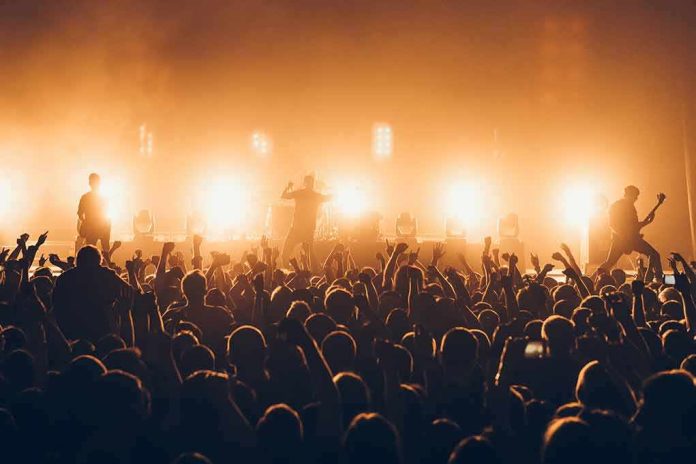
The timing tracks: Macklemore had used his opening set on Ed Sheeran’s tour to say “Free Palestine” and reportedly displayed Gaza-related imagery during New Jersey shows; Kraft then announced Macklemore would not perform at Gillette on the upcoming dates. ESPN, WCVB/WHDH and other outlets ran the same core explanation from Kraft on the same day, suggesting the rationale was not a retroactive patch but the live logic of the call.
Venue discretion versus artistic speech: the mechanism in play
Big stadiums operate under layered constraints: private property rights, public accommodation expectations, insurance conditions, security posture, sponsor relations, and reputational calculus. Contracts and venue manuals—rarely public—typically include morality, safety, or conduct clauses vesting management with discretion to pull or condition performances. That’s the quiet power center in touring: an artist may be free to say almost anything, but not every stage is obliged to host it. When owners invoke “no hate speech,” they are often operationalizing a blend of risk management and brand stewardship in a highly polarized information environment. The First Amendment protects speech from government punishment; it does not compel a private stadium to rent its platform to messages it deems beyond bounds.
That is why these conflicts keep recurring at universities, municipal arenas, and private theaters. Institutions defend exclusions as neutral enforcement against bigotry or incitement; critics argue they are punishing a viewpoint under the thinnest of pretexts. Courts and commentators have underscored that much of the contested Israel–Palestine speech is protected when government is the censor; but private venues keep broad latitude to curate their stages, which is where allegations of “heckler’s veto” slide into the business realities of booking, security, and cancellation risk.
What’s contested—and what isn’t
There are two separate questions here. First: did Gillette Stadium, under Kraft’s control, have the right to refuse Macklemore’s performance? On the public record and standard industry practice, yes; owners typically reserve this discretion. Second: was the decision actually about antisemitic content, or was it suppression of pro-Palestinian advocacy dressed up in policy language? On that, the record is murkier. Kraft’s statement cites “recent actions,” “material shared from the stage,” and a “broader history of antisemitic rhetoric and imagery,” but it does not itemize specific lyrics, visuals, or statements that meet a defined threshold. Absent published venue policies or cited exhibits from the New Jersey sets, outsiders cannot test the characterization.
Macklemore’s counterclaim raises the stakes: he says Ed Sheeran told him Kraft not only barred him from Gillette but also coordinated with other stadium owners to force a tour-wide ultimatum—keep Macklemore and lose the venues. That, if documented, would shift the narrative from a single-property content decision to an industry pressure campaign. But there is, at present, no independent corroboration from Sheeran’s camp, promoter records, or other venue owners released into the public domain to validate that chain of coordination. The allegation is clear; the receipts are not.
The stable parts of the timeline
Three facts are firmly established on the published record. First, Macklemore used high-visibility tour sets to say “Free Palestine” and to display Gaza-focused imagery. Second, Kraft publicly announced that Macklemore would not perform at Gillette, tying the venue’s refusal to a “no platform for hate speech” standard and rejecting the idea that the call was meant to deny Palestinian suffering. Third, major outlets contemporaneously quoted that same rationale, which positions Kraft’s move as a venue-level exercise of discretion rather than a denial crafted after backlash.
What is not established: the specifics of the allegedly antisemitic material; the exact language of the Gillette policy as applied; and any documentary record of cross-venue coordination. Those are knowable with the right artifacts—emails, riders, security and insurance memos, production decks from the New Jersey shows—but they are not yet public. Until then, the debate floats on competing inferences anchored to undisputed speech (“Free Palestine”) and undisclosed interpretations.
How this fits the larger pattern
We have seen this movie before. In disputes over artists accused of antisemitism or anti-Israel rhetoric, institutions justify cancellations or bans as safety and anti-hate decisions; opposing voices call it censorship of protected political advocacy. The legal bottom line has stayed steady: most courts treat pro-Palestinian slogans as protected speech when the government is the censor, but private venues retain wide editorial control over their platforms. That’s why outcomes hinge less on constitutional doctrine and more on contract leverage and the owner’s appetite to weather reputational blowback. The Gaza war’s moral intensity ensures any restriction on pro-Palestinian messaging will be read by many as suppression, even when a decision-maker insists the target is antisemitism, not advocacy.
Kraft’s own profile—he founded a foundation to combat antisemitism—cuts both ways in public reception. To some, it bolsters credibility that his objection was about bigotry rather than politics; to others, it renders the hate-speech label suspect, a mission-driven lens that might overread criticism of Israel as antisemitic. The stable evidence shows only that Kraft applied a familiar owner’s prerogative under a stated policy frame; whether that frame was neutrally applied to specific, identifiable content remains the unresolved question.
🚨 ROBERT KRAFT’S ROLE IN THE MACKLEMORE STORY DESERVES A MUCH CLOSER LOOK.
Kraft founded the Foundation to Combat Antisemitism, whose headquarters and Command Center sit at Gillette Stadium. FCAS says the center monitors hundreds of millions of online sources and social posts… pic.twitter.com/49Rz86RMbJ
— Mr. Gerald Wayne (@MisterWayne) September 15, 2026
What would settle the facts—and what it means either way
The path to clarity is straightforward: tour communications among Sheeran’s team, Gillette Stadium, and other venues; the relevant clauses from the venue manual and booking agreements; and a granular inventory of the disputed New Jersey set materials. If the paper trail shows a content-based, venue-specific call at Gillette alone, Kraft’s explanation holds on its own terms. If it reveals a coordinated venue threat aimed at silencing “Free Palestine” messaging as such, the episode becomes a case study in industry-wide viewpoint suppression by private gatekeepers. Either outcome would still illustrate the core reality of modern touring: the decisive power over expression on a given night usually sits not with the headliner or the opener, but with the landlord, the contract, and the risk model.
Sources:
facebook.com, aljazeera.com, espn.com, yahoo.com, thegrio.com, reddit.com