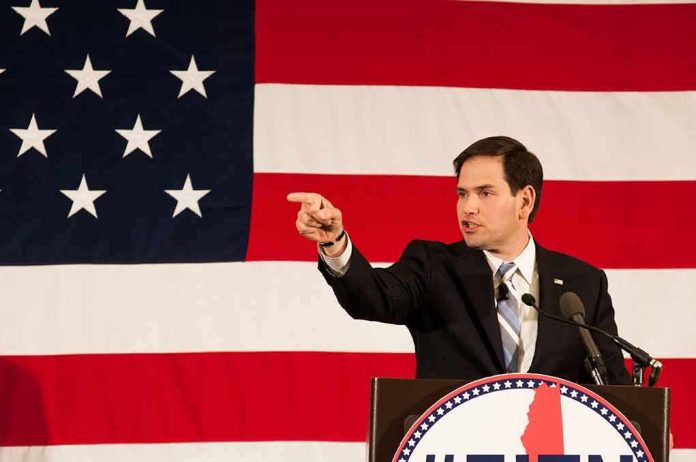
When a sitting U.S. Secretary of State stands on the Pnyx — the very hill where Athenian citizens once voted directly on war, peace, and exile — and tells the assembled world that loyalty to one’s own nation is neither selfish nor shameful, he is not merely giving a speech. He is staking a claim to a 2,500-year-old vocabulary and bending it toward a very current argument.
Key Points
- Secretary of State Marco Rubio delivered a major address from the Pnyx in Athens on October 7, 2026, explicitly linking ancient Greek civic virtues to the Trump administration’s “America First” doctrine.
- Rubio argued that national loyalty and prioritizing one’s own country’s interests are not moral failings but values the ancient Greeks themselves embraced and modern leaders have wrongly abandoned.
- The speech was delivered against the backdrop of a broader U.S.-Greece “strategic dialogue” covering energy, defense, and economic cooperation.
- Commentators noted the speech emphasized competition, honor, and national power far more than the democratic and egalitarian themes usually associated with the Acropolis and Pnyx.
- The address fits a long diplomatic tradition of using historically resonant sites to elevate a policy agenda into civilizational language.
What Rubio Said and Where
Rubio’s remarks, previewed by the State Department and delivered on the evening of October 7, 2026, were staged deliberately: not at a lectern in a conference room, but atop the Pnyx, the rocky outcrop west of the Acropolis where the Athenian ekklesia, the citizen assembly, once gathered to debate and vote directly on matters of state. Reuters reported Rubio’s prepared text held that the ancients “knew that there was nothing selfish or wrong about loyalty to your nation, nor in fighting to defend its interests above all else”. The Associated Press described the broader address as a call for Western nations to “return to their civilizational roots” and recover the values AP said had driven Europe and North America’s centuries of global dominance.
The visit was not purely rhetorical theater. Rubio’s Athens stop coincided with a U.S.-Greece strategic dialogue covering energy security, defense cooperation, and economic ties, with Rubio calling Greece “a very important US ally” in remarks to reporters beforehand. The speech, in other words, was layered atop substantive diplomacy — a pattern typical of how modern foreign policy often uses symbolic staging to carry a working alliance conversation into a louder, more durable public narrative.
The Argument: Loyalty as Virtue, Not Vice
The philosophical core of the speech was a direct rebuttal to what Rubio characterized as a fashionable orthodoxy in foreign policy circles: that enlightened statecraft requires subordinating national interest to the needs of a “global community.” Excerpts distributed by the State Department and reported by ABC News quoted him arguing the opposite — that elevating one’s own people above abstract global obligations was precisely the ethic the ancient Greeks modeled, and one the modern West had unwisely discarded. AFP reported the broader thrust extended to a warning that the West must embrace “national power” and technological innovation or risk terminal decline, with Rubio reportedly framing the moment starkly: “Either we choose to act now, or lose the choice to act at all”.
This is, functionally, the “America First” doctrine translated into classical register. Rubio’s team was explicit that the goal was continuity, not novelty — placing President Trump’s foreign policy within what the Washington Post described as “a broader Western tradition of national ambition and reinvention” rather than treating it as a break from historical norms.
Borrowing the Pnyx: Why Location and Symbolism Matter
Diplomats have long understood that geography carries argument. A speech on democratic renewal delivered from a government building persuades through policy detail; the same speech delivered from the birthplace of direct democracy persuades through inheritance — it implies the speaker is not proposing something new but reclaiming something owed. Greek City Times reported the address was billed in advance as a call for “a great renewal of the Western spirit,” with the Acropolis itself serving as backdrop. That staging choice does real rhetorical work: it recruits the authority of the ruins themselves, inviting the audience to hear policy as heritage rather than as one administration’s preference among several.
This technique is neither new nor unique to this administration. Leaders across the ideological spectrum have long reached for antiquity, scripture, or founding-era texts to launder a contemporary position in the authority of the past. What distinguishes this instance is the specificity of the borrowing — not generic references to “Western values” but a pointed selection of Greek civic concepts: heroism, honor, duty, and the defense of one’s own polis above competing loyalties.
Selective History — the Interpretive Fault Line
Where genuine interpretive disagreement exists is not over what Rubio said, but over which strands of Athenian civic life he chose to amplify. CBS News observed that the history Rubio presented emphasized competition, national loyalty, and risk-taking, while spending comparatively little time on democracy or political equality — concepts closely tied to the very site where he spoke. That is a fair observation about selective emphasis rather than a factual dispute; Athens produced both the martial ethos of Thucydides’ Pericles and the egalitarian machinery of the assembly, and any speaker invoking the city necessarily chooses which half to foreground. Scholarship on nationalism and cosmopolitanism similarly treats these traditions as overlapping rather than cleanly opposed, noting that national loyalty and broader global commitments are frequently reconciled, not mutually exclusive, in actual policy practice.
What It Means Going Forward
The lasting significance of the Athens address lies less in any single line than in what it signals about how this administration intends to argue for its priorities on the world stage: not as pragmatic policy choices subject to revision, but as the recovery of civilizational first principles. That framing raises the rhetorical stakes considerably — it invites allies and rivals alike to judge “America First” not as one administration’s preference, but as a claim about what the West has always, at its best, believed. Whether that claim persuades European partners already navigating their own debates over sovereignty, migration, and alliance commitments will shape how durable this particular vocabulary proves to be.
Sources:
cbsnews.com, reuters.com, apnews.com, washingtonexaminer.com, afp.com, greekcitytimes.com, forth.news