

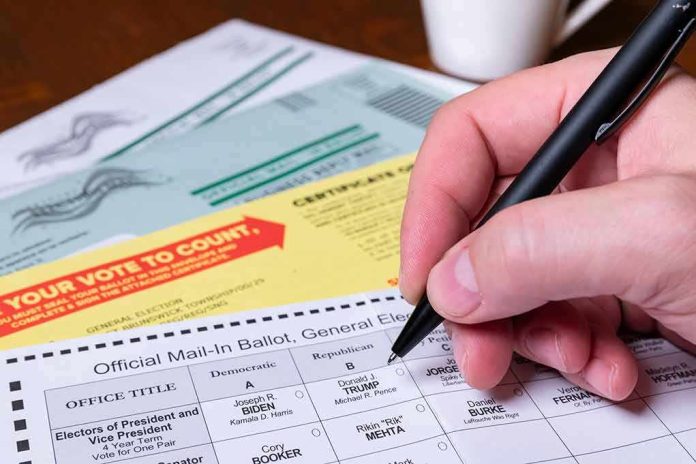
Federal power can and sometimes should police election deception—but using the Justice Department to preemptively condition a state’s certification on a favored outcome is an extraordinary remedy that collides with bedrock principles of state election administration, ballot secrecy, and the limits of what courts can reconstruct after votes are cast.
At a Glance
- The Justice Department sued in federal court to block Alaska from certifying its U.S. Senate race if the Republican incumbent, Sen. Dan S. Sullivan, loses, citing alleged voter confusion from another candidate with the same name.
- President Trump publicly took credit for directing the DOJ action; the suit argues the second Dan J. Sullivan’s “sole purpose” was to siphon votes from the incumbent.
- Alaska’s Supreme Court had already allowed the namesake candidate on the ballot with distinguishing labels, underscoring courts’ preference for pre-election fixes over post-election reassignments of votes.
- Ballot design and name-recognition effects are real, but election law offers narrow tools after voting; investigating intent behind secret ballots is typically unworkable and legally fraught.
What the DOJ did—and why it is extraordinary
The Justice Department filed a lawsuit in the U.S. District Court for the District of Alaska seeking to halt certification of the state’s Senate election if Democrat Mary Peltola prevails over incumbent Republican Sen. Dan S. Sullivan and if the margin is narrower than the votes cast for Daniel J. Sullivan, a lesser-known candidate sharing the same first and last name. The complaint contends the second candidacy existed to confuse voters and alter the outcome, and it asks a federal court to order Alaska not to certify until an inquiry resolves whether ballots were miscast due to that confusion. President Trump said he directed the filing, framing it as necessary to prevent a manipulated loss for the incumbent.
Federal litigation to stop a state from certifying results—prospectively and contingent on who wins—is rare. Certification is a state function; federal courts traditionally require a clear federal-law hook and evidence of a concrete violation. Here, the government posits voter deception via a near-identical name as the federal interest. That allegation is serious on its face. But the requested remedy—hold certification and somehow determine which secret ballots reflect “true” intent—pushes the edge of what courts can or should do post-election.
How Alaska addressed the “two Sullivans” before DOJ intervened
This is not a brand-new controversy. Months before the DOJ suit, Alaska election officials and courts grappled with whether the namesake challenger should appear on the ballot. The Alaska Supreme Court ultimately allowed Daniel J. Sullivan to remain, instructing officials to reduce confusion through ballot design: use middle initials, mark the incumbent, and withhold the GOP label from the non-incumbent namesake. That posture reflects a standard election-law instinct—resolve eligibility and labeling disputes before ballots are printed and votes are cast, not afterward. Once voting occurs, remedies necessarily narrow because the ballot is secret and the chain of voter intent is effectively unrecoverable.
The DOJ’s complaint arrives after those state-level guardrails were deployed. Alaska uses ranked-choice voting, which also allows voters to support both “Dan Sullivans” at different ranks if they wish, further complicating any inference that a vote for the other namesake must have been an error. In short, the state acted preemptively to mitigate confusion; the federal suit asks a court to do something elections are not designed to permit—reverse-engineer intent from anonymous marks after the fact.
Do similar names actually sway outcomes? What research says—and what it cannot do
Social science validates that ballot architecture, name order, and adjacency effects can move marginal votes. Studies have shown statistically significant advantages for candidates listed first and measurable spillovers when a minor candidate’s name sits close to a major one; name recognition itself can shape support even absent policy knowledge. Administered poorly, ballots can misdirect voter choices—Florida’s 2000 “butterfly ballot” remains the canonical cautionary tale.
Those findings justify robust pre-election design choices—clear labeling, middle initials, incumbency tags—to minimize error. They do not, however, yield a judicial technique for reallocating votes cast under a secret-ballot regime. The core problem is not whether confusion is plausible; it is whether the law supplies a neutral, practicable method to identify and correct it after votes are mixed, counted, and anonymized. Research diagnoses risk; it does not authorize retroactive reattribution of ballots one voter at a time.
The legal architecture: state primacy, federal limits, and the timing trap
American election law prizes timely, pre-election remedies. Courts routinely admonish litigants to bring eligibility and ballot-format disputes before voting; challenges filed after ballots are cast face laches concerns, institutional reluctance, and a narrow suite of possible orders—chiefly recounts and, in egregious cases, new elections. Federal-court practice similarly disfavors last-minute changes that upend settled rules or delay certification absent clear statutory command and concrete violations.
That is the timing trap at the heart of this episode. If a namesake candidacy is a sham, the cleanest fix is exclusion or unambiguous labeling before Election Day. Alaska tried to resolve the issue in that window and landed on labeling rather than exclusion, which its high court endorsed. Post-election, the DOJ proposes to halt certification and investigate voter intent. Yet with secret ballots and ranked-choice tabulation, there is no forensic process that can reliably sort sincere votes from misfires at scale without invading privacy or adopting speculative proxies—an approach courts are rightly hesitant to bless.
Competing claims and the evidence on the table
According to press accounts of the federal complaint, DOJ alleges Daniel J. Sullivan ran to confuse voters and benefit Peltola; the agency characterizes that motive as the candidacy’s “sole purpose.” For his part, Daniel J. Sullivan has publicly denied any coordination or intent to deceive, citing dissatisfaction with the incumbent’s record as his reason for running. Meanwhile, Alaska’s prior litigation record shows state courts declined to find fraud and instead required distinguishing labels on the ballot.
Analysts have also questioned the suit’s legal basis, including reported reliance on laws focused on voter registration list maintenance rather than certification. More practically, even the August primary arithmetic—Peltola ahead, the incumbent trailing, the other Sullivan capturing a small share—does not deliver an easy counterfactual to reassign votes without guesswork. None of that eliminates the possibility that identical names could confuse some voters; it does underscore that the DOJ’s after-the-fact cure rests on premises courts rarely accept in election cases: that an institutional process can reconstruct aggregated voter intent from a secret ballot and then condition certification on that reconstruction.
🗳️ Trump says he personally ordered the Justice Department lawsuit that could stop Alaska from certifying its Senate race if Sen. Dan Sullivan loses. The reason is a second Dan Sullivan on the ballot. https://t.co/UGbWtoY4Gf
— Thomas Jones (@Thomas_JonesX) October 23, 2026
What a durable fix looks like
There is a principled path that addresses genuine confusion risks without conscripting courts into retroactive divination. The toolkit is administrative and front-loaded: enforce transparent candidate disclosures; scrutinize qualifying paperwork for misrepresentation; design ballots with disambiguators that voters actually notice—middle initials, incumbency flags, photos where permitted, and unambiguous party identifiers; pilot-test layouts with real voters; and publicize sample ballots well before early voting opens. These measures operationalize what research has told us for decades: small design choices shift outcomes at the margins, and the right time to mitigate that is before a single vote is cast.
The bottom line
The government is right that ballot confusion can distort outcomes. It is wrong to think courts can reliably unscramble the egg after votes are cast and counted. Alaska’s courts opted for labeling and voter clarity over disqualification; the DOJ’s lawsuit asks a federal judge to suspend certification and probe the electorate’s subjective intent under a secret-ballot system. That is an extraordinary ask with thin legal footing and no administrable method to execute. The durable lesson is not that confusion never matters—it does—but that the remedy belongs to design, timing, and administration, not to post-election litigation conditioned on who wins.
Sources:
youtube.com, cnbc.com, politico.com, cnn.com, alaskapublic.org, upi.com, adn.com, abcnews.com, usatoday.com, denverpost.com, rawstory.com, alaskasnewssource.com, elections.alaska.gov, thehill.com