

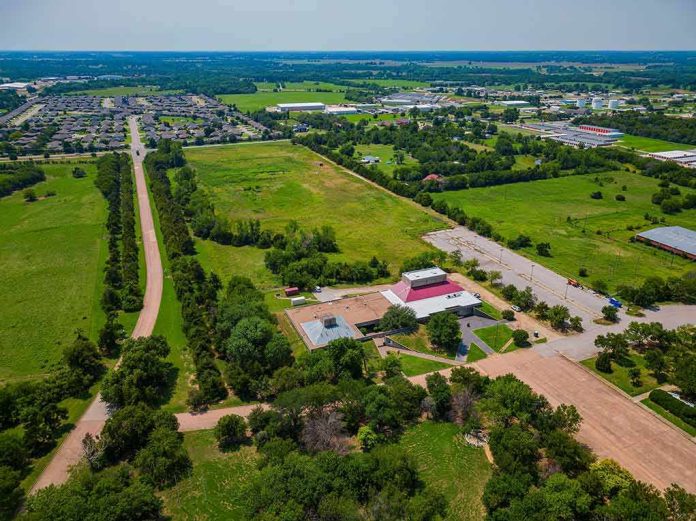
When communities say no to data centers, they are not rejecting technology; they are rejecting being treated as an externality. The Landover fight crystallizes the core trade: a long-vacant 90-acre grayfield offered up for a multibillion-dollar server campus with promised tax receipts versus a neighborhood’s demand for proof about noise, heat, water, grid load, traffic, and property impacts—backed, unusually, by enough organization to force new rules and a reset of the approval process.
At a Glance
- Opposition scaled beyond NIMBY: a 25,000-plus signature campaign organized around concrete siting and impact concerns.
- Government didn’t shrug: the county convened a task force, enacted a moratorium, and closed a legislative loophole to require new approvals.
- Developers touted large investment and recurring public revenues—but with projections that vary across sources and depend on policy choices.
- The site itself—a vacant former mall—made the choice legible: any decision would shape a 90-acre anchor for decades.
How a vacant mall became a referendum on the costs of “the cloud”
The Landover Mall site, roughly 90 acres and idle for decades, was pitched as Brightseat Tech Park: a data center campus estimated around $5 billion in capital investment and marketed as a fiscal engine for Prince George’s County. Supporters highlighted the opportunity to transform a long-vacant grayfield into a productive asset and to capture substantial commercial tax revenue with comparatively light demands on schools and peak-hour traffic, a case local economic development officials have advanced for years. Against that, residents near the site organized around a sharper question: before the county swaps an eyesore for an industrial-scale digital utility, what will it mean on the ground—on power reliability and rates, noise from cooling and backup generation, heat and water use, lighting, truck trips, and property values?
That argument moved beyond social media complaint. A petition spearheaded by a resident living less than a mile from the parcel amassed more than 25,000 signatures, focused on specific neighborhood and environmental impacts rather than generic anti-growth rhetoric. It helped catalyze formal action: the county convened a data-center task force, paused approvals with a moratorium while it overhauled siting and zoning standards, and then enacted legislation requiring this proposal—once eligible to proceed under a 2021 framework—to return for new council approval. The through line is unmistakable: process changed because the substantive questions were not answered to constituents’ satisfaction.
What data centers promise—and what communities insist on seeing first
Developers and economic development agencies generally argue that data centers are modern tax bases with minimal “collateral” burdens compared with housing or office—few students in classrooms, limited daily trip generation once operational, and material personal property on which to levy taxes. In Landover’s case, public-facing numbers varied by source: a business journal account relayed projections of $53.5 million in annual local revenue at buildout and $88.6 million for the state, while other reporting cited roughly $13.7 million for the county. The spread underscores a critical point for any jurisdiction: topline revenue is a function of assumptions—assessment methodology, depreciation schedules for equipment, negotiated incentives, and the pace of multi-phase buildouts. Without the underlying tax model, consensus about fiscal yield is aspirational, not analytic.
Communities, meanwhile, have converged on a fairly consistent dossier of due diligence. Independent academic and policy work catalogues the local externalities that must be quantified: very high electricity demand with localized grid impacts, noise and air emissions from backup generation, significant heat rejection and, depending on the cooling technology, nontrivial water consumption; plus nighttime lighting, security traffic, and construction logistics. Across the country, these unanswered siting questions have driven a wave of moratoriums and bans—at least 76 local governments have attempted such measures, most successfully—precisely to force this analysis before entitlements lock in.
Why the Landover opposition gained institutional traction
Three ingredients made the Landover campaign unusually potent. First, proximity: leadership came from within the impact radius, which sharpened credibility and focus on site-specific harms rather than abstract ideology. Second, specificity: the petition framed concrete effects on the visual landscape and neighborhood conditions, and demanded proper consultation, rather than a blanket “no.” Third, a procedural opening: a prior approval pathway from 2021 existed, but council action later required this project to come back for another vote, and a moratorium froze momentum while new standards were drafted. Even coverage characterizing the project as “on hold, not dead” effectively conceded that automatic advancement was over; the burden of proof shifted back to the proponent to satisfy updated criteria and politics.
It also mattered that the site was a blank slate large enough to accommodate many futures. A 90-acre redevelopment at an urban edge is not just a land deal; it is a long-term definition of place. In those contexts, process legitimacy and transparent modeling carry more weight than in-fill projects. The trampoline-park refrain that colored some commentary was a rhetorical flourish, not a plan; there is no identified operator, pro forma, or zoning path to remake ninety acres around that use. The real alternative set is broader—mixed-use, logistics, housing, civic anchors—and the way to choose among them is comparative analysis, not viral contrasts.
Sorting the numbers from the narrative
Both sides pointed to numbers; only one side’s numbers were embedded in binding public analysis. The development case relied on investment and tax projections relayed through media and advocacy channels, alongside a generalized strategy from the county’s economic development arm to pursue “technology-driven” growth. The opposition supplied scale—a verified petition count and sustained attendance—and translated that into formal review. Neither side, in the publicly surfaced record, delivered the complete set of technical exhibits the decision ultimately requires: peak and average megawatt demand and interconnection upgrades; generator count, fuel type, and modeled noise and emissions; cooling method with associated water draw and discharge; traffic generation by phase; and the full fiscal model with incentive assumptions. In practice, the county’s task force and reset rules are a tacit admission that those exhibits must precede approval, not follow it.
Seen against the national landscape, Landover is not an outlier but an exemplar. Research out of Harvard finds residents routinely less supportive of data center siting than local officials, largely because the distribution of costs and benefits is opaque at the neighborhood scale; that gap, not broad technophobia, drives friction. National reporting similarly shows local electorates increasingly willing to vote down data center measures until siting standards catch up. Local officials can still land these projects—but only with front-loaded transparency and conditions tied to enforceable performance.
🚨 CHINA-LINKED MARXIST GROUP HELPED ORGANIZE CAMPAIGN AGAINST $5 BILLION MARYLAND DATA CENTER
A campaign credited with helping stall a massive private investment at the abandoned Landover Mall had substantial organizing support from a Marxist-Leninist organization linked to a…
— MDBayNews (@MDBayNews) November 12, 2026
What a rigorous path forward looks like
For jurisdictions weighing a large campus on an urban-edge grayfield, the template is clear. Require an integrated technical dossier before discretionary approvals: grid impact study with utility concurrence and cost allocation; acoustical, air, heat, lighting, and traffic modeling to operational thresholds with mitigation commitments; water source and reuse plans where applicable; and a comparative fiscal model that discloses incentives, depreciation assumptions, and phase timing. Pair that with community benefits that map to documented risks—noise walls, vegetative buffers, restricted generator testing hours, heat-recovery or district energy options, dark-sky lighting, truck routing—and with clawbacks if promised phases or taxes do not materialize.
Bottom line
The Landover campaign did not “kill” the cloud; it insisted that a 90-acre neighborhood anchor earn its place with facts. Developers can meet that bar—and many will, as capital seeks predictable jurisdictions—but the era of hand-waving around megawatts and “jobs and taxes” headlines is over. Where residents organize around specific, testable claims and lawmakers respond with structured review, the outcome is not obstruction; it is competent siting.
Sources:
twitchy.com, wjla.com, bizpacreview.com, theroot.com, compute-atlas.com, blackexplosionnews.com, bizjournals.com, dbknews.com, newsweek.com, news.harvard.edu, detroitnews.com