

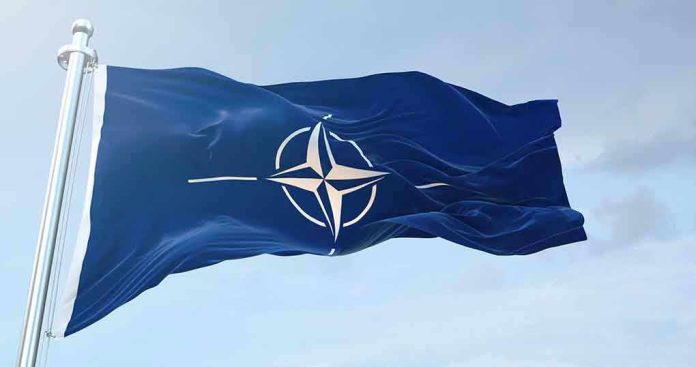
President Trump’s threat to withdraw from NATO over allies’ refusal to join the Iran war exposes how the seventy-year-old alliance has become a liability when America needs partners most, leaving U.S. troops bleeding in the Middle East while European bureaucrats hide behind excuses.
Story Snapshot
- Trump labels NATO a “paper tiger” after allies refused to join the U.S.-Israeli military campaign against Iran, despite providing logistical support through bases and air defenses.
- The Iran war has cost American lives—15 soldiers killed and over 520 wounded—while NATO members sit on the sidelines, exposing deep fractures within the alliance.
- Trump’s prediction of a three-day war has turned into a prolonged conflict with no resolution in sight, fueling MAGA frustration over another endless Middle East engagement.
- NATO’s upcoming July 2026 summit in Ankara faces existential questions about the alliance’s purpose as European nations accelerate efforts to reduce military dependency on the United States.
Alliance Abandons America in Combat
The U.S. and Israel launched military operations against Iran on February 28, 2026, without NATO consultation or participation from alliance members. President Trump expressed disgust at what he characterized as NATO’s failure to support America, threatening to pull the United States from the alliance entirely. Individual NATO countries allowed U.S. access to bases in the UK, France, Germany, Greece, Italy, and Portugal, though Spain refused. This half-measure approach—providing logistical support while avoiding combat commitment—exemplifies the alliance’s dysfunction when American servicemembers face danger. NATO members proved willing to benefit from U.S. protection for decades but unwilling to stand alongside America when called upon.
American Blood Spilled While Allies Watch
At least 17 U.S. military sites in the Middle East have sustained damage totaling $800 million in losses. Fifteen American soldiers have been killed and more than 520 military personnel wounded as Iran responded with missile and drone strikes across the region and closed the Strait of Hormuz, disrupting global trade. U.S. and Israeli forces achieved significant military success, degrading Iran’s missile capabilities by 90 percent within the first week and eliminating over 250 Iranian leaders, including Supreme Leader Ali Khamenei. Yet this tactical victory came at American expense alone, while NATO allies contributed nothing but use of airfields and interception of Iranian missiles threatening Turkey with NATO-supplied air defenses—defending their own territory, not American interests.
Trump’s Three-Day Promise Becomes Endless Quagmire
Trump told the UK Prime Minister the war would end “in three days,” but by early April 2026, the conflict continues with no resolution visible. This broken timeline mirrors the pattern MAGA supporters voted against—another Middle East engagement stretching beyond initial promises, draining American resources and lives. Strategic analysis from CSIS indicates that while U.S. and Israeli forces perform well militarily, strikes fall short of achieving ambitious goals, and Iran retains capacity to rebuild military capabilities over time. Mediation efforts have proven ineffective, with both sides expressing interest in negotiations but facing significant obstacles. The mounting casualties and protracted timeline directly contradict Trump’s campaign promises to keep America out of new wars, fracturing support among his base.
NATO’s Identity Crisis Threatens Alliance Survival
NATO Secretary General Mark Rutte claimed in mid-February the alliance was “the strongest it has been since the fall of the Berlin Wall,” yet the Iran conflict immediately exposed this assessment as fantasy. The alliance withdrew its training mission from Iraq and redirected U.S. F-35s from NATO exercises in Norway to the Gulf, disrupting alliance activities. Rutte now claims allies will emerge “more united, not less,” despite Trump’s explicit threats to withdraw and characterization of NATO as worthless. European nations accelerated efforts to reduce military dependency on the United States and increased defense spending commitments, revealing their recognition that American security guarantees cannot be assumed indefinitely. The upcoming NATO summit scheduled for July 2026 in Ankara faces fundamental questions about whether the alliance serves any purpose beyond bureaucratic self-preservation.
The conflict reveals NATO’s core dysfunction: European members expect American protection but refuse reciprocal support when U.S. interests require assistance. This one-sided arrangement undermines the alliance’s founding principle of collective defense and validates conservative skepticism about entangling alliances that benefit partners at American expense. NATO members demonstrated they will accept U.S. military presence, intelligence sharing, and security guarantees while avoiding the costs and risks of actual partnership. For MAGA supporters already frustrated with globalist institutions draining American resources, NATO’s performance in the Iran crisis confirms the alliance has become an expensive relic serving European interests rather than American security needs.
Sources:
CBS News – Iran War: Trump NATO Tehran Threatens US Tech Companies Strait of Hormuz
UK in a Changing Europe – Not Our War: NATO and the Iran Crisis
Atlantic Council – Twenty Questions and Expert Answers About the Iran War
Brookings Institution – After the Strike: The Danger of War in Iran
CSIS – Who is Winning the Iran War