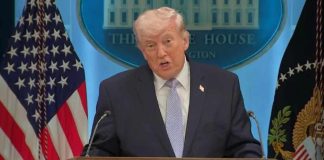

President Trump has accused CNN of spreading fraudulent claims about U.S. military operations against Iran, igniting a fierce battle over who controls the narrative of America’s latest Middle East conflict.
Story Snapshot
- White House officially refutes CNN’s claim that Pentagon failed to plan for Iran’s potential closure of Strait of Hormuz during Operation Epic Fury
- Republican Senators Tom Cotton and Tim Sheehy publicly deny CNN’s reporting about classified briefings, stating contingency plans existed for decades
- Trump alleges criminal investigation underway into CNN’s reporting, though administration has not confirmed formal probe launch
- Operation Epic Fury reportedly obliterated Iran’s naval and missile capabilities, neutralizing threats to critical global shipping lanes
White House Challenges CNN’s Military Coverage
The Trump administration issued an official rebuke in March 2026 after CNN reported that Pentagon and National Security Council officials “did not plan” for Iran’s potential closure of the Strait of Hormuz. Press Secretary Karoline Leavitt branded the network’s claims as lies designed to undermine what the White House characterizes as the “crushing success” of Operation Epic Fury. The administration contends CNN relied on unnamed sources spreading misinformation to sabotage public support for U.S. military achievements against Iranian forces. This confrontation represents another chapter in the ongoing tension between Trump and major media outlets over coverage of his administration’s foreign policy.
Senators Contradict Network’s Briefing Claims
Intelligence Committee Chair Senator Tom Cotton publicly challenged CNN’s reporting, stating the network’s sources “lied” about what lawmakers heard in classified briefings. Senator Tim Sheehy corroborated Cotton’s account, confirming that briefings clearly outlined Strait of Hormuz contingency plans developed over decades. The senatorial pushback directly contradicts CNN’s assertion that “top Trump officials” admitted to lacking such preparations. Cotton urged CNN to implement better fact-checking protocols before publishing stories based on anonymous leaks. The senators’ statements raise questions about whether CNN’s sources intentionally misrepresented briefing contents or whether the network failed to verify claims before publication, a pattern that undermines media credibility when Americans need trustworthy information.
Operation Epic Fury’s Strategic Objectives
Operation Epic Fury targeted Iran’s naval forces, missile systems, drone capabilities, and ballistic arsenal in a comprehensive campaign aimed at neutralizing threats to international shipping and regional stability. Trump has emphasized that Iran’s navy and air force have been effectively destroyed, with U.S. aircraft operating freely over Tehran. The administration argues these decisive military victories secured the Strait of Hormuz without the catastrophic scenarios CNN suggested were unplanned for. U.S. energy dominance has reduced American dependence on Persian Gulf oil routes, though the strait remains critical for global commerce. The operation’s success in degrading Iranian military capabilities demonstrates that thorough planning existed contrary to media narratives suggesting strategic failures or unpreparedness.
Pattern of Media Corrections on Iran Coverage
This controversy follows previous instances where CNN corrected its Iran-related reporting after initial claims proved inaccurate. The network previously echoed Iranian government denials of U.S.-initiated diplomatic outreach, only to backtrack when Iranian sources later confirmed Trump’s administration had indeed initiated communications. CNN analysts expressed confusion over apparent disconnects within the administration’s Iran policy, attributing mixed messages to coordination failures. These repeated corrections fuel conservative skepticism about mainstream media’s willingness to fairly cover Trump’s foreign policy achievements. Critics argue major outlets prioritize narratives that portray the administration negatively over factual accuracy, undermining journalism’s essential role in holding government accountable while informing citizens truthfully about national security matters affecting their lives.
Implications for Government Accountability and Media Trust
Trump’s fraud allegations against CNN, whether a formal criminal investigation materializes or not, reflect deeper frustrations shared across the political spectrum about institutional failures. Conservatives see biased media coverage designed to undermine legitimate military successes and presidential authority. Many Americans regardless of political affiliation question whether journalists serve the public interest or advance partisan agendas through selective reporting and anonymous sourcing. The absence of transparent verification processes erodes trust in both media institutions and government officials who leak information. This episode highlights how information warfare shapes public perception of actual warfare, with Americans left uncertain whom to believe. When senators directly contradict published reports and networks stand by anonymous sources over named officials, citizens struggle to discern truth from propaganda in matters of national security and international conflict.
Sources:
CNN is Lying to Undermine Operation Epic Fury’s Crushing Success – White House Release