

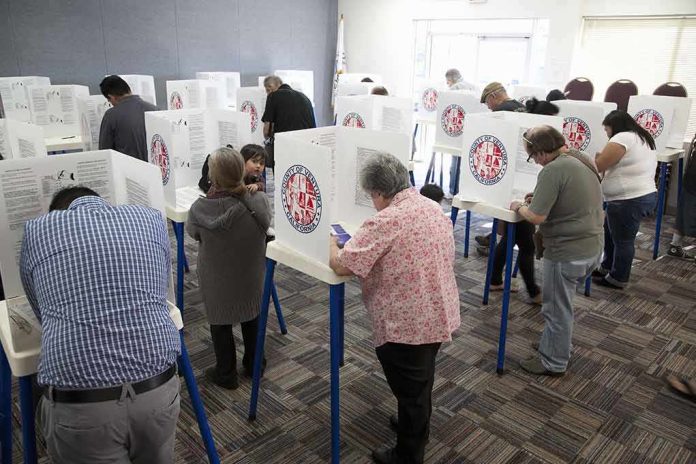
Names on a ballot are not mere labels; when operatives try to engineer names, they are trying to engineer voters’ perceptions—and, potentially, outcomes.
At a Glance
- The Alaska Senate race became a test of whether recruiting a namesake candidate is hardball politics or voter deception.
- Reporting cited texts, documents, and interviews describing efforts by Democratic-aligned staff to recruit a second “Dan Sullivan.”
- The Justice Department filed a pre-certification lawsuit focused on voter confusion and potential outcome effects.
- Mary Peltola and Daniel J. Sullivan deny coordination; Alaska’s governor initiated a state investigation.
What the “Decoy Dan” fight is fundamentally about
The controversy centers on whether recruiting a candidate who shares an opponent’s name is merely a sharp-elbowed tactic or an attempt to mislead voters. In Alaska’s 2026 Senate contest, a second Daniel J. Sullivan appeared on the same ranked-choice ballot as incumbent Senator Dan S. Sullivan. The allegation, reported by major outlets, is that Democratic-aligned aides and operatives helped place the namesake on the ballot to capture stray first-choice rankings or disrupt lower-round transfers in the ranked-choice count. The counter is straightforward: the candidate denies being recruited, and Mary Peltola, the Democratic challenger, denies knowledge or involvement. There is no adjudicated ruling resolving intent. That is why this episode matters beyond one race—it illuminates the increasingly fine line between lawful gamesmanship and manipulation that corrodes trust.
Mechanically, the supposed value of a namesake candidate is not ideological persuasion but cognitive friction. In a ranked-choice system, where voters number preferences and votes can transfer, even a modest fraction of misdirected first choices or exhausted ballots can change margins at later rounds. Empirically demonstrating such diversion is hard after the fact; litigating intent is harder still. Yet the architecture of the incentive is plain: if a segment of voters relies on name recognition rather than close attention to party labels, incumbency cues, or biographies, a same-name entrant can skim support at the margins—especially among casual voters or during early voting before saturation coverage clarifies the duplication.
What the evidence shows, and what it doesn’t
The core allegation arose from a New York Times investigation describing twelve sources, text messages, and documents pointing to participation by Peltola campaign aides, campaign lawyers, and Democratic Senatorial Campaign Committee staff in efforts to encourage Daniel J. Sullivan’s run. Secondary outlets recapped those claims and the purported communications trail, which—if authenticated—would move the case from rumor to coordinated action. At the same time, the summaries available publicly do not reproduce message chains, metadata, or document identifiers; absent those, outside readers cannot independently distinguish between authorization, awareness, or parallel political activity. This is why the institutional posture of the federal government matters: the Justice Department filed a suit to prevent certification if the incumbent lost and confusion proved outcome-determinative, embedding the allegation in a legal forum rather than cable-digital discourse alone.
On the other side of the ledger are categorical denials. Mary Peltola has said she knew of only herself and the incumbent on the ballot and rejected any intent to trick voters. Daniel J. Sullivan has said he had “zero” contact with her campaign. The Peltola campaign and the DSCC publicly denied involvement in either Sullivan campaign and said only the candidate could know his reasons for filing. These statements do not, by themselves, rebut documentary records if those records exist and are authenticated; they do, however, set a clear on-the-record position that any coordination story must overcome.
How the mechanism would operate under ranked-choice voting
Ranked-choice voting (RCV) asks voters to list candidates in order of preference; if no one wins a majority of first-choice votes, the last-place candidate is eliminated and ballots transfer based on next preferences until someone surpasses 50 percent. In that environment, a namesake candidacy can function in two ways. First, by siphoning initial rankings from inattentive or low-information voters who select a familiar name but the wrong person. Second, by increasing ballot mismarks or truncation—some voters rank only their first choice—thereby affecting later-round transfers. Research on RCV mismarking rates varies by jurisdiction and voter education, but the general point stands: complexity amplifies the cost of confusion. Whether that occurred in Alaska’s 2026 race is an empirical question that requires precinct-level and transfer data, not conjecture.
Ballot design mitigates some risk. Alaska’s ballot presents party labels and “Incumbent” next to the sitting senator’s name, which should help attentive voters distinguish candidates; still, design is not a panacea for voters who cue on names under time pressure. The Justice Department’s conditional remedy—intervening only if the incumbent lost and confusion mattered—implicitly acknowledges that the legal gravamen turns on measurable effect, not just bad optics.
History: same-name gambits recur, but law focuses on intent
American elections have seen episodic attempts to exploit name similarity. In Washington State’s 2024 attorney-general race, two additional “Bob Fergusons” briefly entered; a state law specifically barring candidacies intended to “confuse and mislead” voters—and swift legal pressure—ended the ploy. Earlier instances, including the 1930s Nebraska episode featuring a second George W. Norris, tended to be resolved on filing technicalities or case-specific rulings rather than broad constitutional pronouncements. The through-line is consistent: mere coincidence of names is not illegal; demonstrable intent to deceive, supported by recruitment, financing, messaging, or sham campaign behavior, is the fulcrum for legal sanctions where statutes exist. Alaska’s dispute squarely tests that boundary.
Where the genuine dispute lies
Three questions decide whether this is a political sin, a legal violation, or a misunderstanding. First, provenance: do the texts, emails, contracts, and payment records—if produced in litigation or investigation—show that partisan actors intentionally recruited a namesake to induce confusion rather than to support a bona fide candidacy? Second, effect: can analysts identify measurable misdirection or transfer distortion attributable to the second Sullivan’s presence, beyond normal RCV dynamics? Third, authorization: does any authenticated record tie Peltola personally to the recruitment or approval decision, contra her denials? To date, publicly available summaries describe such materials and denials in parallel; they do not furnish the forensic detail—timestamps, device logs, custodians, sworn attestations—needed to resolve authorization and intent conclusively.
What responsible systems—and voters—can do next
Election systems can narrow this gray zone without suppressing candidate choice. Several jurisdictions already permit disambiguators on ballots—incumbency, occupation, city of residence, or middle initials—which Alaska uses in part. States can go further with mandatory candidate statements of identity, standardized candidate photos vetted for authenticity, and prominent “not the incumbent” indicators for same-name races. More muscular options include statutes, like Washington’s, that specifically criminalize candidacies undertaken with the intent to confuse voters, paired with expedited pre-election hearings when same-name challenges arise. These are content-neutral guardrails: they regulate deception, not ideology.
For voters, two behaviors defeat the tactic. First, read the full ballot line—party, status, and, where present, occupational descriptors—before ranking. Second, use the ranks. RCV only cushions against confusion if voters complete their preferences; a truncated ballot magnifies any initial miscue. In close contests, that diligence is not pedantry; it is decisive.
Bottom line
The Alaska episode underscores a durable truth about modern campaigns: when margins are narrow and voting systems are more complex than single-mark, the low-cost manipulations are not grand conspiracies but cognitive nudges—names, labels, and defaults—deployed at scale. Whether the “Decoy Dan” effort crossed from cynical to unlawful turns on authenticable records and measurable effect, questions that legal processes in Alaska and federal court were built to answer. Until those answers are on the record, one judgment is safe: if your strategy depends on voters not paying attention, you’re not contesting ideas—you’re arbitraging confusion.
Sources:
pjmedia.com, nytimes.com, cnbc.com, poynter.org, adn.com, abcnews.com, newsnationnow.com, washingtonexaminer.com, bbc.com, nbcnews.com