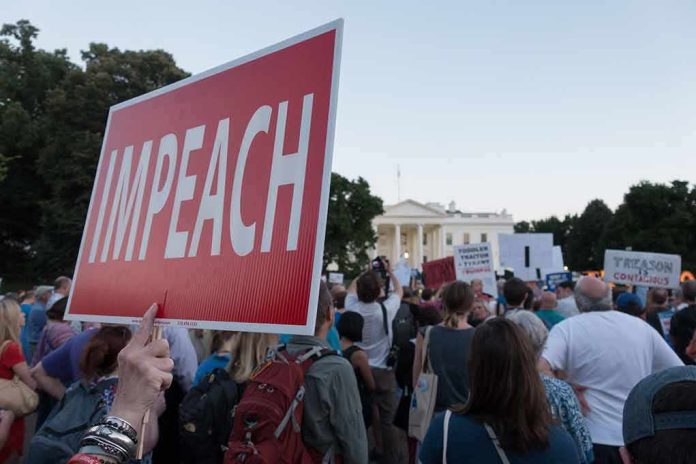
Impeachment has always done two different jobs at once — it is both a constitutional remedy for removing a president and a political instrument for making a public record of grievance — and the tension between those two functions is exactly what Kamala Harris surfaced when she told Democrats, bluntly, to leave it alone.
Key Points
- Harris told MeidasTouch’s Aaron Parnas that pursuing impeachment against President Trump is “not a good idea” and urged Democrats to redirect energy toward investigations and accountability instead
- Her reasoning rests on simple arithmetic: Senate conviction requires 67 votes, a threshold no modern impeachment has come close to clearing
- The House has already tested the proposition — a resolution from Representative Al Green was tabled 237-140, with Democrats themselves divided
- A faction of House Democrats, including Al Green, Yassamin Ansari, and Delia Ramirez, argue accountability demands impeachment regardless of the Senate math
- Hakeem Jeffries has kept the door open rhetorically, calling impeachment “not off the table” even while prioritizing oversight ahead of it
What Harris Actually Said, and Why It Carries Weight
In her conversation with Parnas, Harris did not hedge. “I think that going in the direction of impeachment is not a good idea, just to be honest with you,” she said, adding that “the energy and the resources need to be put into accountability, need to be put into investigations”. That is a strategist’s argument, not a moralist’s — it concedes that Trump’s conduct may well warrant scrutiny while insisting that the formal remedy of impeachment is the wrong vehicle for delivering it. Her stated reason is specific: even a successful House impeachment vote would not produce “67 votes for a conviction” in the Senate. That is not a hunch. It is the operative constitutional threshold, and it has defeated every presidential impeachment in American history.
The two-thirds requirement in Article I is not a procedural technicality; it is the framers’ deliberate firewall against using impeachment as a routine partisan weapon. No president has ever been convicted by the Senate — Andrew Johnson, Bill Clinton, and Trump himself in his first term all survived acquittal votes that fell well short of 67. That history is the quiet backdrop to Harris’s calculation: without a supermajority, impeachment produces headlines and a House vote tally, but not removal. If the goal is consequence rather than symbolism, she argues, the resources belong elsewhere — in subpoenas, hearings, and documented findings that outlast a single news cycle.
The House Already Ran the Experiment
Harris’s prediction was not purely theoretical by the time it circulated. The House voted 237-140 to table an impeachment resolution brought by Representative Al Green, with Republicans supplying the bulk of the votes to kill it and Democrats themselves splitting between opposing the motion to table and voting present. That outcome is instructive on two levels. First, it confirms that a Republican-controlled chamber will not even let such a resolution reach serious floor debate, let alone a Senate trial. Second, and more tellingly, it shows Democratic leadership was unwilling to force a unified caucus position — Politico’s reporting characterized the advancing of impeachment as politically risky for vulnerable members and functionally dead on arrival in the Senate. A single floor vote does not prove every future effort would fail identically, but it is concrete, recent evidence that the coalition math Harris describes is not hypothetical.
The Counter-Case: Accountability as a Moral Obligation, Not a Vote Count
The strongest pushback against Harris’s position does not dispute her arithmetic — it rejects the premise that arithmetic should govern the decision at all. Al Green has made this argument for years, dating back to his articles of impeachment during Trump’s first term, when he said plainly: “It isn’t about symbolism or whether we will have the votes or if the Senate will actually remove President Trump from office… We cannot allow political expediency to trump moral imperative”. He has since filed a fresh resolution, H.Res.1486, pressing the same claim that Trump’s conduct constitutes impeachable high crimes. Representative Yassamin Ansari has echoed the stakes in starker terms, warning that failing to impose consequences risks normalizing the behavior: “there could easily be another Donald Trump… if we don’t show that there are consequences, then people also just won’t trust government”. Delia Ramirez has added a procedural caveat to that moral case, insisting impeachment “can’t just be a political messaging strategy” — a reminder that the pro-impeachment camp is not united on tactics even as it agrees on principle.
Hakeem Jeffries occupies the pragmatic middle ground that most closely resembles Harris’s own framing. He has said impeachment of Trump and Cabinet officials is “not off the table,” while directing immediate energy toward oversight of alleged corruption and misused public resources — sequencing investigation before any formal impeachment push rather than ruling it out entirely. That is closer to Harris’s position than to Green’s: both treat impeachment as a possible endpoint of investigation, not a substitute for it.
Why the Disagreement Is Genuine, Not Cosmetic
Academic research on impeachment sponsorship offers a useful frame for understanding why this split persists. A study examining every House impeachment resolution filed against a sitting president from 1973 through 2019 found that sponsorship correlates strongly with ideology, partisanship, and the scale of the underlying scandal — and that members use these resolutions as much for public position-taking as for genuine removal attempts. That finding does not discredit either side of the current debate; it explains it. Green, Ansari, and allies are not wrong that a filed resolution creates a durable public record regardless of its Senate fate. Harris and Jeffries are not wrong that spending finite legislative capital on an effort with no plausible path to conviction can crowd out investigations that might otherwise produce prosecutable, documented findings. Both camps are making rational bets about where accountability actually lives — in a dramatic vote, or in a slower paper trail.
What This Means Heading Into the Next Election Cycle
The practical stakes of this argument will only grow sharper as midterm control of the House remains contested. If Democrats retake the chamber, the investigation-first strategy Harris described becomes immediately testable: committees would gain subpoena power, and the accountability record she called for would either materialize in indictable, documented form or it would not. Until then, the debate functions as a preview of how a future Democratic majority would govern oversight — cautiously, through hearings and paper, or aggressively, through formal articles that leadership itself concedes are unlikely to convict. Both paths carry risk. A quiet, investigation-heavy approach can look to the public like inaction; a symbolic impeachment vote that fails in the Senate can look like a self-inflicted defeat. Harris’s wager is that the first risk is smaller than the second.