
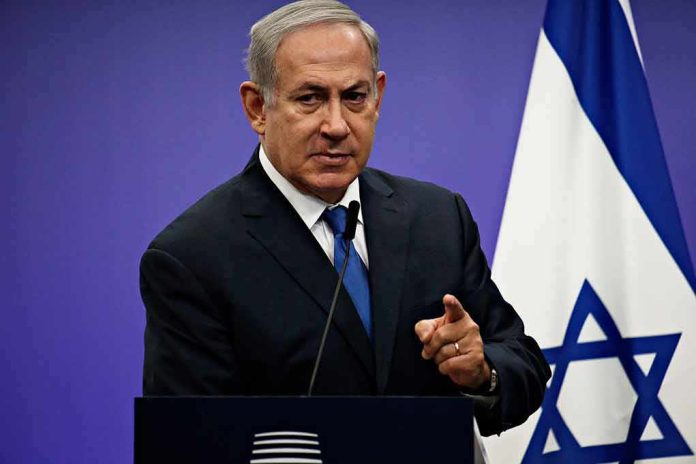
The fiercest fights in modern war are waged over legal labels as much as territory; Benjamin Netanyahu’s United Nations address distilled that reality into a single proposition: Israel’s campaign is self-defense against existential enemies, not genocide—and he staked his case on intent, method, and necessity.
At a Glance
- Netanyahu’s UN argument rested on self-defense: Iran and its proxies pose an existential threat, and striking them—militarily and in rhetoric—is a necessity, not a choice.
- He rejected genocide allegations outright, casting them as an inversion of reality and asserting Israel’s measures to reduce civilian harm in Gaza.
- Delegations staged walkouts; critics, including New York City’s mayor, accused Netanyahu of lying and pointed to UN inquiries and NGOs that frame Israel’s actions as genocide.
- The core dispute turns on the legal element of intent: whether Israel’s conduct manifests a genocidal purpose or a brutal, contested campaign within the outer bounds of self-defense.
What Netanyahu argued at the UN and why it matters
From the UN rostrum, Netanyahu offered a maximalist defense: Iran’s nuclear and regional networks constitute a systemic threat, Hamas’s Oct. 7 massacre set the current war in motion, and Israel’s strikes—whether in Gaza or against Iranian capabilities—fit squarely within the state’s right to self-defense. He framed the decision to hit Iran as straightforward in that light and dismissed genocide claims as “the biggest lie of the century,” a line reported consistently across outlets that covered the address. The political theater was unmistakable—dozens of delegates walked out as he began—but the legal core was not theater. He was litigating intent.
In international criminal law, genocide requires proof of specific intent to destroy a protected group, in whole or in part. Netanyahu’s speech trained the argument on that element. He asserted that Israel warned civilians at scale, targeted combatants embedded among civilians, and fought adversaries employing human shields. He argued this pattern of conduct, though devastating in effect, evidences military necessity rather than group-destruction purpose. Reuters captured the formulation: “Israel didn’t commit genocide. Israel prevented genocide”.
The counter-case: public condemnation and the contest over intent
Critics put the same facts to a different legal use. They point to the scale of death and deprivation, to statements by Israeli officials, and to the cumulative effect of military operations to argue that genocidal intent can be inferred. A growing ensemble of human rights organizations and UN-linked inquiries has characterized Israel’s Gaza campaign as genocide or as plausibly engaging the genocide convention—claims widely reported in mainstream coverage. The political rebuttal was immediate and local as well: New York City’s mayor accused Netanyahu of using “baseless lies” to sanitize a genocide, highlighting the degree to which this legal fight now inhabits municipal podiums as well as international ones.
Do the counter-claims rest on “specific, named, sourced” contradictions of Netanyahu’s factual backbone? They document a competing legal assessment rather than a simple factual refutation. Delegation walkouts happened; Netanyahu did deny genocide allegations and asserted self-defense; and he tied the campaign to threats from Iran and regional proxies—these are not in dispute. The real disagreement is the legal inference drawn from conduct and consequence: whether catastrophic civilian harm, siege conditions, and rhetoric from some officials suffice to establish genocidal purpose—or whether, as some jurists argue, the evidence does not clear the intent threshold.
How to parse “self-defense versus genocide” in law and practice
Three distinctions help serious readers keep the frame straight. First, legality of resort to force (jus ad bellum) is distinct from legality of conduct in war (jus in bello). A state can lawfully defend itself yet still commit atrocity crimes if its means and methods satisfy those elements. Second, genocide is narrower than war crimes or crimes against humanity: it turns on intent to destroy a protected group, not simply on disproportionate strikes or unlawful targeting. Third, intent is rarely proven by direct orders; tribunals infer it from patterns of acts, statements, and policies over time. That is why both sides zero in on signaling and method—warnings, evacuation corridors, humanitarian access versus blockade effects, displacement patterns, and public rhetoric by commanders and senior officials.
This is also why the debate metastasizes beyond the battlefield. Netanyahu emphasizes mass warning regimes, deconfliction hotlines, and claims of unprecedented precautions, invoking military experts to argue comparative restraint. His opponents catalog the body count, infrastructure destruction, and life-threatening deprivation to argue that whatever the stated aim, the foreseeable and sustained effects reveal the requisite intent. UN-linked inquiries and multiple NGOs have aligned with that latter view; others, including some international law scholars, have argued the opposite—acknowledging grave harm but disputing that the specific-intent element has been established.
The Iran vector and Netanyahu’s strategy of necessity
Netanyahu’s argument is inseparable from the Iran file. By situating Gaza, Hezbollah, the Houthis, and Iraqi and Syrian militias under a single Iranian umbrella, he extends Israel’s self-defense claim across theaters and time. That yields two strategic effects. It reframes high-risk strikes on Iranian assets as preemptive containment rather than escalation, and it recasts the Gaza war as one pincer in a regional deterrence campaign rather than a discrete punitive operation. His formulation that striking Iran was “one of the easiest decisions” underscores how decisively he ranks existential prevention over diplomatic accommodation. For supporters, this is prudence against a proximate nuclear and proxy threat; for detractors, it is a doctrine that normalizes perpetual emergency and its attendant civilian costs.
Netanyahu Speech Triggers Mass Walkout At UN | Novara Live https://t.co/G0bpC8PUkW via @YouTube
— Bernd Schulz (@b_schulz1726) September 25, 2026
Where the genuine disagreement lies—and what to watch next
Strip away the slogans and the argument reduces to two testable questions. First, intent: do statements, operational patterns, and the treatment of civilians and critical infrastructure cumulatively demonstrate a purpose to destroy Gazans as a protected group, or do they evidence a maximalist counterinsurgency inside a dense urban battlespace? Second, mitigation: were the precautions and humanitarian arrangements, taken as a whole and over time, genuine and effective or largely performative against the scale of harm? The walkouts, the dueling podiums, even the sharpest lines in Netanyahu’s speech are proxies for those two tests.
Expect the legal record—not the UN floor show—to decide the long arc. Investigative files, command-chain documentation, and judicial assessments of specific incidents will weigh more than set-piece speeches or open letters. Between now and then, the signals that matter are operational: evacuation feasibility versus entrapment; aid volume and access versus engineered scarcity; targeting choices against dual-use infrastructure; and the rhetoric of senior officials in Hebrew and English alike. On those axes, the evidence will harden. Until it does, Netanyahu’s case is as clear as it is contested: Israel fights to prevent a greater catastrophe and has no choice but to win. His critics argue the catastrophe is already the crime. Both can’t be right—and the law’s hardest element, intent, will decide which argument endures.
Sources:
pjmedia.com, apnews.com, nbcnews.com, pbs.org, aljazeera.com, abc.net.au, theguardian.com, lto.de, tandfonline.com