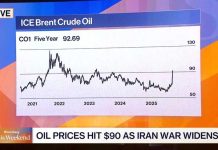
One presidential promise of a faster end to the Iran fight just knocked oil down about 10%—but the same chokepoints and retaliation risks that spiked prices toward $120 are still sitting there like a tripwire.
Quick Take
- Crude surged close to $120 a barrel during escalating U.S.-Israel operations and Iranian retaliation, then slid after President Trump said the conflict could end “soon.”
- Even after the pullback, oil has stayed far above late-February levels, signaling markets still doubt the timeline and fear supply disruptions.
- The Strait of Hormuz remains the central vulnerability, carrying roughly one-fifth of global oil shipments and forcing contingency planning.
- The White House says the spike is a “short-term disruption,” citing steps like tanker risk insurance and potential Navy escorts to keep energy flowing.
Trump’s “Soon” Comment Calms Prices—For Now
President Donald Trump’s public message that the Iran conflict could end “soon” was enough to cool a market that had been pricing in worst-case disruption. Reports tracking the moves show crude had raced toward roughly $120 a barrel before retreating back toward the $90 range after Trump suggested prices would fall once military operations conclude. The immediate drop reflects sentiment more than new supply, which is why volatility remains the story.
Price context matters for American households still sensitive to fuel costs after years of inflation and policy-driven uncertainty. Brent and WTI were substantially lower in late February—around the low-to-mid $70s for Brent and high $60s for WTI in the reporting cited—before the latest military escalation. When oil snaps from those levels to $90-plus in days, it filters through shipping, diesel, and eventually groceries, even if gasoline lags.
What Drove the Spike: Escalation and the Hormuz Chokepoint
Reporting on the timeline describes coordinated U.S. and Israeli strikes on Iran followed by Iranian “sweeping barrages” aimed at U.S. regional assets and multiple Israeli cities, with threats tied to maritime transit. Markets reacted because the Strait of Hormuz is not an abstract talking point; it is a physical bottleneck where roughly 20% of global oil shipments pass. Any credible threat there forces traders to price in delays, rerouting, and higher insurance.
The price action also shows how fast “war premium” can appear and disappear without a clean resolution. Oil jumped sharply after the early March escalation, tested higher levels amid Hormuz-related threats, and then later climbed near $120 before falling back. That kind of whipsaw matters to truckers, manufacturers, and retirees on fixed incomes because it encourages companies to build in extra cost buffers—often before the situation is actually settled on the ground.
White House Response: “Short-Term Disruption,” Energy Dominance Messaging
White House Press Secretary Karoline Leavitt publicly framed the surge as a temporary cost for longer-term stability and said the administration is taking immediate steps to stabilize markets. Measures cited in reporting include political risk insurance for cargo vessels and oil tankers operating near Hormuz and readiness for U.S. Navy escorts if needed. The administration also referenced efforts to boost supply through alternatives, including faster access to Venezuelan oil after the Maduro regime’s collapse.
Those steps are aimed at preserving freedom of navigation and preventing a sustained supply shock—an approach many conservatives will recognize as the difference between projecting strength and simply absorbing pain. Still, some key claims remain unverified in the available reporting, including the extent of Iran’s degraded missile-launch capacity and the precise operational end-date implied by “soon.” Markets appear to be pricing that uncertainty, given that crude remains elevated versus pre-conflict levels.
Why the Chaos Could Continue Despite the Dip
The conflict’s core risk is structural: the same shipping lane vulnerability exists even if fighting slows, and the same region can re-ignite with little notice. Reporting also reflects allied concern, with Germany’s chancellor warning about economic damage from higher oil and gas prices. Meanwhile, financial coverage noted that stocks recovered as oil retreated, reinforcing how closely broader markets now hinge on energy stability—and how quickly that optimism could reverse if Hormuz disruptions escalate.
Oil plunges 10% on Trump's Iran comments, but the chaos could continue https://t.co/FguqnlsQpV
— Jazz Drummer (@jazzdrummer420) March 10, 2026
For U.S. consumers, the immediate takeaway is simple: a 10% drop from a spike is not the same as “back to normal.” Crude around $90 is still far above the high-$60s to low-$70s seen before the escalation described in the reporting. Trump’s warning that Iran would face a much harsher response if it tries to disrupt global supply may deter escalation, but the market will likely keep charging a risk premium until the military and shipping picture is clearly stable.
Sources:
Trump acknowledges spike in oil prices from Iran war, promises prices are going to drop
White House says oil price spike temporary as Trump pushes energy dominance amid Iran war
Fox Business video: 6390325526112