A long-delayed arrest in the January 6 pipe bomb case is raising fresh questions about security, political narratives, and civil liberties in the post-Biden era.
Story Highlights
- Federal agents have finally arrested and charged a Virginia man for allegedly planting pipe bombs near the RNC and DNC on January 5, 2021.
- The devices were treated as viable explosives that could have caused mass casualties and diverted police resources as protests unfolded at the Capitol.
- The case relied heavily on digital, financial, and surveillance forensics, fueling ongoing concerns about government overreach and privacy.
- Both parties’ headquarters were targeted, complicating partisan narratives about January 6 and raising deeper questions about political violence.
Arrest in a long‑running pipe bomb mystery
Federal authorities have arrested a Virginia man, identified in reporting as Brian Cole, on federal felony charges for allegedly placing two pipe bombs near the Republican and Democratic National Committee headquarters in Washington, D.C., on the night of January 5, 2021, just hours before the Capitol was breached. The Justice Department’s move ends nearly five years of public uncertainty over one of the most disturbing unanswered questions linked to January 6 and closes a case that had frustrated investigators and citizens alike.
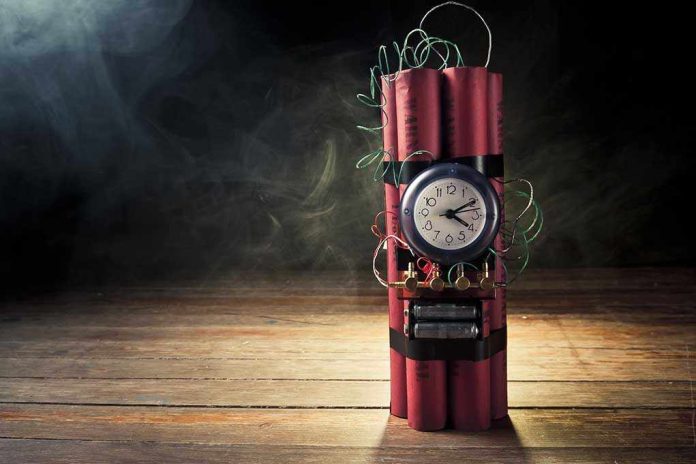
Law enforcement officials have long maintained that the devices were real improvised explosive devices capable of detonating and causing serious injury or death to anyone nearby, especially staff and visitors at both national party headquarters. The bombs were discovered on January 6 and safely neutralized, but their presence forced emergency responses and evacuations at a time when police and federal agents were already stretched thin by the massive demonstrations and subsequent riot at the U.S. Capitol complex a short distance away.
How investigators say they built the case
Investigators spent years piecing together cell‑site data, surveillance footage, financial records, and forensic analysis of the bomb components to narrow in on a suspect whose identity remained hidden despite widely publicized images of a masked figure. This kind of investigative approach demonstrates how powerful modern surveillance and data‑matching tools have become, and it will likely be touted by federal officials as proof that no one can evade justice forever. At the same time, it reinforces conservative concerns about expansive data tracking.
Reports indicate that the charges involve typical federal statutes used in domestic bomb plots, including laws governing possession or use of destructive devices and explosives related to crimes of violence. Those kinds of counts can carry decades in prison, particularly if terrorism‑related enhancements are applied at sentencing. For many readers, the sheer weight of potential penalties underscores how seriously the government treats any explosive device near political or government targets, even when no detonation actually occurs and no casualties result from the incident.
January 6 context and political fallout
The bombs were placed the night before Congress met to certify the 2020 election results, at a moment when Washington was already riven by distrust, accusations of fraud, and anger over what many on the Right saw as a rigged system. Their discovery on January 6 diverted bomb squads and officers away from the Capitol area, contributing to questions about how security resources were allocated as the crowd there escalated into a full breach. That dynamic continues to matter in debates about what really went wrong that day and who bears responsibility for the failures.
Because both the RNC and DNC were targeted, the case does not fit the simplistic storyline that only one side of the political aisle was under threat. Instead, it highlights a deeper problem of rising political violence and contempt for institutions across the spectrum, something that should concern anyone who cares about stable elections and peaceful transfers of power. For conservatives, the dual targeting also undercuts past insinuations that one party might have secretly used the bombs to gain political advantage, though it does not answer every lingering question.
Security, civil liberties, and government power
Federal agencies will likely portray this arrest as a success story justifying aggressive surveillance powers, including extensive use of phone metadata, transaction tracing, and video analytics to reconstruct a suspect’s movements years after the fact. That reality leaves many constitution‑minded Americans uneasy, because tools deployed first for high‑profile terrorism or bombing cases often migrate into more routine policing. Conservatives who fought Biden‑era abuses know that once government gains a new capability, it rarely gives it back without explicit legal pushback or reform.
At the same time, the case illustrates the government’s core duty to protect citizens and critical political infrastructure from real threats like bombs, not imaginary dangers like offensive speech or lawful gun ownership. The Trump administration’s renewed emphasis on law and order, border security, and restraint of bureaucratic overreach comes against this backdrop of earlier failures and politicized investigations. Many on the Right will insist that any continued use of powerful surveillance tools be tightly constrained, transparently overseen, and never weaponized again against peaceful protesters, parents at school boards, or religious conservatives.
Going forward, the prosecution of the accused bomber will test how much of the government’s case rests on solid, documentable evidence versus inference and technical modeling that ordinary jurors may struggle to evaluate. It will also influence whether Congress or state lawmakers revisit the balance between strong investigative powers and robust Fourth Amendment protections in an age when nearly every American carries a trackable device. For a conservative audience, the challenge is holding dangerous actors fully accountable while refusing to accept permanent expansions of surveillance justified by a single high‑profile case.
Sources:
FBI makes arrest in D.C. pipe bombs case targeting RNC and DNC headquarters
Questions linger about suspect arrested in 2021 D.C. pipe bombs case