

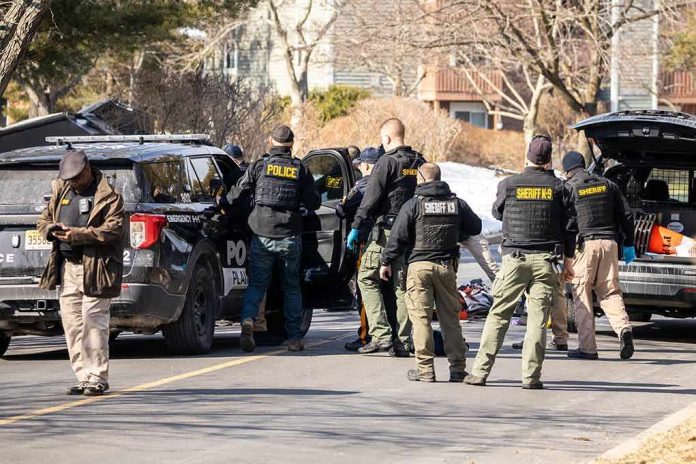
Domestic-violence calls compress rescue urgency and tactical risk into the same doorway; in Spokane County, that collision left four people dead after deputies were met with gunfire during an exigent entry to reach a wounded victim.
At a Glance
- Deputies responding to a domestic-violence shooting near Spangle initiated an exigent SWAT entry to rescue a wounded woman; they were fired upon from inside the residence.
- Two Spokane County deputies were critically wounded; one later died and the other remained on life support, not expected to survive.
- Four people were found dead in total: one deputy, two civilian victims, and the suspected shooter.
- The incident’s sequence — initial call, SWAT activation, breach attempt, and return fire — is anchored by official county and sheriff’s statements.
What Happened on South Smythe Road
Spokane County deputies were dispatched at about 2:25 p.m. to the 18700 block of South Smythe Road after an adult woman, reported to have fled to a neighbor, said she had been shot. With a confirmed gunshot victim and uncertainty about additional occupants, the Sheriff’s Office activated its SWAT Team and began what it described as an exigent entry — a rapid breach designed to reach and stabilize a person believed to be in immediate danger. As SWAT members and deputies approached the door around 3:15 p.m. and attempted to breach it, shots were fired from within the residence, critically injuring two deputies.
Sheriff John Nowels later summarized the contact at the threshold succinctly: the team moved to breach and “were met with gunfire.” Additional law enforcement elements converged, returned fire, and worked to secure the scene. Investigators and command staff described a sprawling rural property and a dynamic, still-dangerous interior, necessitating deliberate clearing before medics could fully operate.
Confirmed Casualties and Scene Findings
By the time the scene was stabilized, four people were dead. Outside, deputies located one deceased individual in the yard; inside, they found another person dead, along with the suspected shooter, also deceased. The two deputies shot during the initial breach remained in critical condition; one later died of his wounds, and the other was placed on life support with officials indicating he was not expected to survive. This grim accounting — one deputy among the dead alongside two civilian victims and the suspect — was corroborated across official releases and contemporaneous reporting that tracked the developing toll as medical outcomes changed.
Authorities identified the incident as a domestic-violence shooting at a private residence in a rural area near Spangle, south of Spokane. The county’s official news flash provided the operational backbone: the location, the initial 2:25 p.m. response time, the 3:15 p.m. exigent entry, the volley from inside, and the immediate critical injuries to two deputies.
Why Deputies Went In Fast: The Logic of an Exigent Entry
In patrol and SWAT practice, “exigent entry” describes a forced entry without a warrant to prevent death or serious bodily harm — particularly when a known victim is bleeding out or additional victims may be trapped inside. The legal and tactical threshold is high but straightforward: when minutes matter, officers move. Here, officials say the team had both triggers — a confirmed shooting victim and the possibility that others were still in the home — and made the decision to breach to rescue, rather than contain and negotiate while injuries worsened out of reach. As they advanced to the door, the defenders inside held the positional advantage: concealment, fields of fire, and the ability to dictate the first shots. That asymmetry is why entries are tightly choreographed and why domestic scenes are so volatile.
District commanders weigh this decision against variables that never resolve cleanly in real time: the victim’s condition and location, the likelihood of armed resistance, the house’s layout and construction, and the distance to advanced medical care. In Spokane County, the calculus produced a rescue-first approach — the correct doctrine when a victim’s survival window is closing — with tragic consequences once gunfire erupted at the threshold.
Domestic Calls and Officer Risk: The Pattern Behind the Headlines
Domestic-disturbance responses are disproportionately dangerous for officers because they combine weapons prevalence, heightened emotion, and confined spaces that favor the defender. A CDC-indexed analysis documented 116 law-enforcement homicides during domestic-disturbance responses; ninety-five percent involved firearms, and multiple-officer casualties were more likely in these calls compared with other categories. Other scholarship estimates that roughly 15% of felonious officer homicides over a 1996–2010 period occurred during domestic-disturbance calls, with a substantial share tied to intimate-partner violence specifically.
Those data points frame the Spokane incident as part of a known risk profile. Labels like “ambush” can accurately describe the tactical experience — being fired upon unexpectedly while approaching a breach — without implying elaborate premeditation. What is operationally clear in this case is that the first volley came from inside as deputies moved to force entry, a dynamic consistent with the inherent risks of entering a defended structure on a domestic-violence rescue.
Investigation, Accountability, and What Comes Next
Washington’s independent critical-incident process places the investigation with a multi-agency team led by the Washington State Patrol, with findings ultimately referred to the Spokane County Prosecutor. That structure is designed to separate the fact-finding from the involved agency and produce a coherent timeline, forensic matches where possible, and a legal assessment of the force used by responding officers. As with any large, multi-scene event, early casualty counts evolved as medical conditions changed; officials updated the public as confirmations came in, and reporters tracked those updates across the evening and into the next day.
For communities, several takeaways endure beyond the breaking-news cycle. First, prompt access to lifesaving care for domestic-violence victims depends on decisive entry in specific circumstances; the doctrine exists because delaying for a warrant can cost lives. Second, missions that blend rescue and apprehension demand layered resources — ballistic shields, breaching tools, immediate tactical medicine — and realistic training for the moment the first rounds come through a door. Finally, clear, timely public communication from a single operational timeline reduces confusion when outcomes change as patients are moved, treated, and, in the worst cases, succumb to their injuries. Spokane County’s published sequence provides that backbone here, even as broader investigative work continues.
Sources:
foxnews.com, cbsnews.com, fox13seattle.com, abcnews.com, spokanecounty.gov, lmtribune.com, seattletimes.com, idahonews.com, mynorthwest.com