The shortest press-secretary tenure in modern White House history is not just a curiosity; it spotlights how unforgiving the job has become in an era when message discipline, personal biography, and presidential communication style must align perfectly—and instantly—or the floor gives way.
At a Glance
- Katie Zacharia served five days as White House press secretary before departing, making hers the briefest tenure on record.
- The White House had formally presented her as the 37th press secretary, with video of her inaugural briefing underscoring the official capacity.
- Her exit followed immediate scrutiny of her qualifications and first briefing performance, with multiple outlets reporting the decision to remove or transition her out.
- Historically, abrupt changes in this role are rare and usually tied to moments of intense political strain; five days is without precedent.
What happened: a five-day tenure, formally conferred and abruptly ended
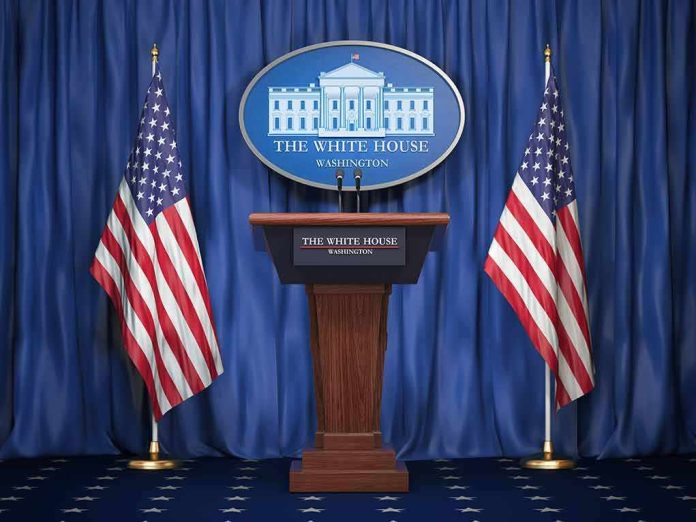
Katie Zacharia entered the job in the most public way possible—identified by the White House as the 37th press secretary and introduced through an inaugural briefing in the James S. Brady Press Briefing Room. The administration’s own release chronicled that debut, asserting a strong opening and framing her as the president’s lead spokesperson going forward. A White House–produced video from the same day shows her performing core duties at the podium, leaving no doubt that she held the role in an official capacity. Within five days, however, senior officials were telling national outlets that she was out—variously described as dismissed or transitioning out—ending the shortest press-secretary stint on record.
The immediate sequence is clear enough: formal elevation, inaugural briefing, intense coverage and questioning about her background and presentation, and then a rapid personnel reversal confirmed to multiple news organizations by named or clearly sourced White House officials. This is not a case of shadowy rumor; it is a straightforward, documented rise-and-exit compressed into a single workweek.
How the press secretary’s job works—and why mismatches surface fast
The modern press secretary is the hinge between a presidency and the outside world, responsible for translating policy, signaling priorities, absorbing heat, and, at times, setting the narrative arc of an administration’s day. That makes the role unusually sensitive to three frictions. First, presidential voice: in administrations where the president is his own principal communicator, the press secretary’s craft shifts from long-form exposition to orchestration—setting context, managing timing, and choosing when to defer. Second, pace: the job rewards rapid fact-mastery and error-free recall under sustained cross-examination. Third, biography and credibility: any mismatch between résumé claims and the public record becomes part of the message itself, because the spokesperson’s authority rests as much on personal standing as institutional role.
All three frictions were in play. Zacharia’s inaugural appearance stressed that President Trump is his own best spokesperson and would lead the way, a candid acknowledgment of a communications ecosystem where the principal talks often and directly. Her performance simultaneously had to establish subject-matter command, calibrate deference to the president’s voice, and absorb immediate scrutiny of her professional background—pressures that, if not managed flawlessly from day one, can cascade into a calling question the job cannot carry for long.
The inaugural briefing as the fulcrum
Because the job’s legitimacy is earned in front of cameras, first briefings tend to set reputational trajectories. Zacharia’s initial briefing was not a generic overview; she delivered a policy-dense set of claims—economic figures, energy and industrial investment totals, fraud-recovery tallies, border and fentanyl metrics, and even references to geopolitical arrangements—all while taking questions on sensitive topics, including U.S. intelligence-sharing and personnel changes. The White House’s account cast the event as commanding, and the official video establishes her execution of the role. Yet the very density of the presentation heightened the chance that a single imprecise answer, or any unresolved question about credentials, would dominate post-brief coverage. That is exactly what happened: her qualifications, particularly around legal training and licensure, swiftly became part of the story, and within days officials were confirming her departure to multiple outlets.
In a communications environment where precision is table stakes, a spokesperson cannot afford biographical controversy that compels defensive airtime. Once the conversation shifts from the president’s agenda to the spokesperson’s credibility, the administration’s calculus is brutally simple: reset the messenger or lose the message.
Historical context: five days against a long arc of the office
The White House press secretary is a relatively modern invention, professionalized across the twentieth century and now a fixture of executive governance. Tenure lengths vary with political conditions, presidential preference, and personal capacity, but sub-two-month tenures are exceptional. Jerald terHorst’s 1974 resignation after roughly a month during President Ford’s pardon of Richard Nixon remains a canonical case of principled, abrupt departure. Acting stints have been brief—Stephen Early’s two-week return in 1950 is often cited—but those are by design. Against this record, five days stands alone; major outlets and compendia list Zacharia’s tenure as the shortest in the role’s history.
Why does this matter? Because the office exists to provide continuity of message amid discontinuity elsewhere. When the post itself becomes a site of volatility, observers infer strain in the broader communications apparatus—be it vetting, expectation-setting, or the day-to-day integration of policy teams with the press operation. One five-day tenure does not, by itself, indict a system. It does, however, demonstrate what happens when the skill-and-fit equation breaks at the precise moment it must hold.
Where the reporting converges—and what it does not claim
Across mainstream coverage, the points of consensus are straightforward: Zacharia held the title, briefed from the podium, and exited after five days. NBC News, Politico, and CNBC each attributed confirmation of her departure to senior White House officials, offering parallel accounts of timing and rationale framed around performance scrutiny. International outlets and roundups echoed the same bottom line, often emphasizing the historical shortness of the stint. The reporting establishes the what and when. The exact administrative form—resignation, dismissal, reassignment—matters less to the historical record than the fact of the five-day arc, and the research base here does not hinge on litigating that distinction.
For readers weighing the contested edge cases: this is not one. The White House conferred the role publicly; contemporaneous video documents its exercise; multiple outlets, citing administration officials, confirm the rapid exit; and historical references consistently mark the five-day record.
Lessons for presidential communications going forward
Three durable takeaways emerge. First, the velocity of modern presidential communication leaves no runway for onboarding; a press secretary must be fully fluent in policy substance, institutional process, and the president’s rhetorical cadence from minute one. Second, biography is not background—it is part of the message. Any unresolved credential question will migrate from opposition research to the front row of the briefing room in hours, not weeks. Third, internal alignment beats showmanship. When the president is the primary messenger, the press secretary’s comparative advantage is synthesis: translating complex policy into defensible lines, knowing what to table for later, and keeping the focus on outcomes rather than personalities.
Zacharia’s week underscores a hard truth veteran practitioners understand: the job is less about voice than about ballast. Done well, it steadies the ship’s heading through rough seas. Done poorly—or simply misaligned—it becomes another wave the ship must ride. Five days is a wave. The institution’s task is to ensure the next press secretary functions as ballast again.
Trump White House Responds to Media Reports That Chief of Staff Susie Wiles Ordered 'Sanctioned Hit' on Katie Zacharia to Get Her Ousted as Press Secretary https://t.co/hSYNDxHtKn
— BREAKING NEWZ Alert (@MustReadNewz) October 17, 2026
What to watch next
The White House will fill the role again; it always does. The signals to watch are process signals: a clearer demonstration of policy fluency in early briefings, sharper delineation between presidential voice and press-office scaffolding, and preemptive clearing of biographical underbrush that can otherwise become the story. Historical experience suggests that once the right match is made—on competence, chemistry with the president, and credibility with the press corps—tenure length normalizes quickly. Until then, the position will remain a proxy for the administration’s ability to control its own narrative in a communications climate that rarely forgives second acts.
Sources:
theamericanconservative.com, nbcnews.com, whitehouse.gov, politico.com, bbc.com, cnbc.com, wisn.com, businessinsider.com