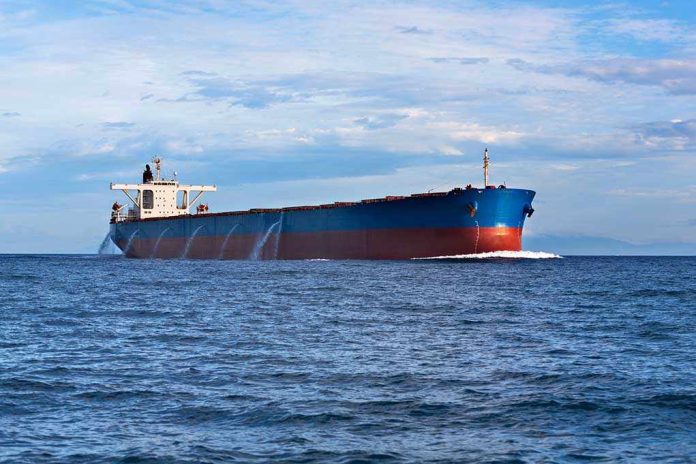
The most important fact about the Black Sea drone strike that sank a merchant ship in Bulgaria’s exclusive economic zone is not only where it happened, but how: a coordinated sea-and-air attack against commercial shipping in NATO waters, executed in a battlespace where attribution is technically difficult and politically explosive.
At a Glance
- Two merchant vessels were struck by sea and aerial drones in Bulgaria’s Black Sea exclusive economic zone; one sank and crew were reported missing.
- Ukraine’s President Volodymyr Zelenskyy publicly blamed Russia; Bulgarian leaders condemned the attack but withheld attribution pending evidence.
- The strike fits a broader pattern of contested drone attacks on Black Sea shipping since the full-scale war began, where proof often lags narrative.
- Forensics, radar tracks, and debris analysis are decisive in such cases; absent public release, claims harden faster than confirmations.
What happened and why the method matters
Before dawn, two merchant ships operating in Bulgaria’s exclusive economic zone (EEZ) were hit by a combination of uncrewed surface vessels (USVs, or “sea drones”) and aerial drones; one vessel sank and another burned before its crew abandoned ship and were rescued by a ferry. Bulgaria’s prime minister denounced the incident as a flagrant breach of maritime and international law. Early accounts from Bulgarian authorities and international outlets converged on core facts: multiple drones, dual-domain vectors (sea and air), and an attack zone roughly off the coastal town of Byala—inside a NATO member’s EEZ, though outside territorial waters. The tactical profile matters. Coordinated USV/UAV strikes are designed to overwhelm watchstanders and defensive countermeasures; they also diffuse evidence across the water column and sky, complicating rapid forensic recovery and reliable public attribution.
Ukraine’s President Volodymyr Zelenskyy said his navy had liaised with Bulgarian counterparts and concluded the strike was a combined Russian operation using both maritime and aerial drones. That claim aligns with the broader record of Black Sea attacks attributed to Russia against shipping and port infrastructure; it does not, however, substitute for disclosed technical proof. Bulgarian officials, for their part, stated plainly that the origin of the drones had not yet been established and emphasized the need to recover wreckage before assigning responsibility. In war-at-sea incidents, that evidentiary caution is not just procedural prudence—it is the only path to conclusions that stand up over time.
The Black Sea pattern: observable effects, delayed attribution
This strike did not emerge from a vacuum. Since 2022, the Black Sea has become a laboratory for long-range, low-cost, uncrewed systems employed for coercion and interdiction. Shipping transits have been harassed or struck, port facilities cratered, and insurance premia see-sawed as risks shifted. The pattern is structurally consistent: attacks are usually visible—the fireball, the smoke plume, the ship listing or limping—but definitive responsibility is harder to pin down in the open domain. Early reporting often distinguishes between “unidentified” perpetrators and claims or accusations from belligerents, with verified technical attribution arriving weeks later, if ever. In this episode, the immediate record reflects exactly that: simultaneous acknowledgment of a drone strike against commercial ships and explicit official statements that the drones’ origin was unknown at the time.
That uncertainty is not mere fog-of-war rhetoric. It flows from the mechanics of uncrewed attacks. Aerial drones can be commercially derived and modified; sea drones are often custom-built. Guidance, telemetry, and navigation modules can be off-the-shelf, obscuring provenance. Serial numbers can be scrubbed. Absent captured hardware, investigators lean on sensor data—coastal radars, NATO ISR tracks, AIS anomalies, thermal signatures—and comparative signature analysis, matching damage profiles and fragments to known families of munitions. Until some of that record is released, attribution in public remains an inference, even if it is a well-grounded one.
Competing claims and what the evidence supports today
Zelenskyy’s assertion that Russia executed a combined drone strike tracks with Russia’s previous attacks on Black Sea shipping and Ukraine’s allegation set; some reportage even cites sources who are “certain” the drones were Russian. Those are not trivial signals. Yet Bulgaria’s head of government did not accuse Russia in his initial remarks and later framed the attack as clearly either Russian or Ukrainian while underscoring that the origin remained unconfirmed; the defense minister reinforced that no wreckage or claims of responsibility had been obtained and that the type and origin could not be verified at that time. On evidentiary grounds, the Bulgarian position carries more weight right now: named officials, on record, conditioning attribution on recoveries and analysis. That does not invalidate Ukraine’s claim; it situates it as an allegation awaiting corroboration.
Prudent analysis separates three layers. Layer one: uncontested facts—the attack happened; drones from sea and air were used; a ship sank; lives were lost or missing. Layer two: narrative claims—the operation was Russian, as Ukraine argues, and consistent with an established Russian modus operandi. Layer three: proof—sensor data, wreckage, telemetry, and chain-of-custody forensics that bridge from pattern to specific culpability. As of now, the public record robustly supports layer one, permits reasonable hypotheses in layer two, and remains thin on layer three.
Why international law and insurance markets care
Attacking commercial vessels in an EEZ—where the coastal state has resource rights but not full territorial sovereignty—still engages a web of legal regimes: the UN Convention on the Law of the Sea (UNCLOS), rules on armed conflict at sea, and peacetime norms of navigation. Bulgaria’s condemnation as a “flagrant” violation is not diplomatic boilerplate; insurance and chartering markets price risk based on exactly these episodes. Underwriters will adjust war risk premia, routing may shift to longer corridors, and smaller operators without state guarantees can be priced out. A handful of spectacular attacks can reset the actuarial baseline for an entire basin.
Practically, the strike also tests NATO’s crisis-management muscle in the maritime periphery. An attack in a member’s EEZ is not automatically an Article 5 event, but it is not geopolitically neutral. The alliance’s credibility rests partly on its ability to illuminate the battlespace—fusing coastal radars, AWACS, P-8 patrol tracks, and satellite feeds—and to share enough of that picture, promptly, to deter repetition. Even a carefully sanitized release of sensor chronologies can raise the cost of deniable attacks without disclosing sensitive sources and methods.
What would settle attribution
Three evidence families typically close the loop. First, debris forensics: explosive residue analysis, fragment metallography, and board-level scrutiny of control electronics, with photographed custody and serial registries that map to known production runs. Second, integrated sensor timelines: coastal and shipborne radar hits correlated with AIS gaps, EO/IR imagery, and any RF geolocation or datalink captures. Third, testimony: synchronized statements from crews, rescuers, and coastal authorities that cross-validate headings, bearings, and impact sequences. Bulgaria’s leadership has already pointed to debris recovery as prerequisite; until some portion of these materials is made public—or shared with trusted third parties—analytical humility is warranted.
It is also useful to compare signatures. Russia has employed Shahed-derived one-way attack UAVs and various USV designs in the theater; Ukraine has fielded Magura V5 and other maritime drones in its own campaign. Distinguishing features—warhead configuration, propulsion acoustics, control surfaces—can be discerned from high-resolution imagery and fragments. Comparative analysis is not courtroom proof by itself, but when paired with sensor timing it can be highly probative.
THE RUSSIA-UKRAINE WAR IS MOVING CLOSER TO EUROPE
October 7, 2026
Two commercial vessels were targeted by drone attacks in Bulgaria’s exclusive economic zone in the Black Sea, extending the security and economic risks of the Russia-Ukraine war further into commercial shipping… pic.twitter.com/jJaOuZwSsm
— Esen Ermiş Ertürk (@EsenErmisErturk) October 7, 2026
The strategic throughline
Viewed in context, this attack is part of a contest to impose costs on the adversary’s logistics by making the sea itself feel unsafe. Drones make that strategy cheaper and more scalable; a handful of operators, a skiff, and a garage-worth of parts can threaten a hull worth tens of millions. That inverted cost curve is now the central fact of maritime security in the northern Black Sea. The policy response that matters is not rhetorical escalation; it is illumination. Establish shared, near-real-time maritime awareness; codify evidence-sharing protocols that allow timely, credible public attribution; and harden commercial hulls and routes with practical defenses—LRADs, EO/IR watch, maneuver doctrine, and cooperative escort where warranted. States can argue narratives. Evidence changes behavior.
Sources:
afp.com, bgnes.com, usnews.com, euronews.com, ilfoglio.it