

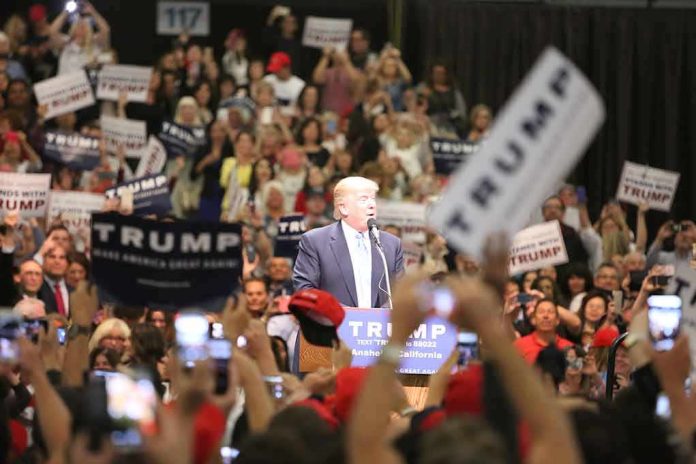
When a party builds a campaign around one figure, the question isn’t whether the spectacle lands on TV; it’s whether that concentration of attention can be converted into votes where it counts. The GOP’s first-ever midterm convention answered how Republicans intend to try: center President Trump, keep him on stage, and ask voters to treat November as a referendum on him and his agenda.
The Short Version
- Republicans staged an unprecedented, two-night national midterm convention in Dallas, headlined by President Trump, who closed the event.
- Trump’s keynote stretched to rally length and framed the midterms as a personal referendum, urging supporters to “pretend that I’m on the ballot.”
- The format institutionalized what has long powered GOP mobilization: Trump’s star power as message, messenger, and turnout engine.
- Political science and past experiments suggest conventions can move opinion locally and conditionally, but broad turnout effects are uneven—especially outside host media markets.
What the GOP actually built in Dallas
Republicans did something modern national parties almost never do: they convened a full-scale, two-night convention in a midterm year and handed the marquee to the president both nights. The Associated Press preview captured the design plainly—Vice President JD Vance would headline one night and President Trump the other, with Trump appearing both nights and closing the convention in the final primetime slot. The point was not subtle: make the midterms a Trump-centered event, on Trump’s stage, at Trump’s pace.
Contemporaneous reporting and live coverage reinforced the structure: more than a hundred speakers and segments across two nights funneled attention toward Trump’s closing keynote, delivered in Dallas before a large in-person audience and a national media feed. The Texas Tribune’s accounts described Trump as the final speaker, capping the affair with a rally-length talk that blended candidate boosts, humor, and a pledge-to-vote ritual—vintage Trump, calibrated to turn spectators into participants.
Trump’s message architecture: referendum politics and a voter pledge
Trump’s midterm script leaned on two devices that have defined his political method. First, the referendum frame: he told supporters to behave as if he were on the ballot, transposing a diffuse legislative election into a single, high-salience choice about his presidency and program. That personalization simplifies mobilization; it also risks making every down-ballot race bear his brand—good where he is popular, costly where he isn’t.
Second, the participatory cue: the raised-hand voting pledge late in the speech. Behavioral research consistently finds that public commitments can increase follow-through; campaigns have long used pledge cards and relational reminders for that reason. Trump’s live pledge—performed on camera with a crowd—turns a passive audience into a cohort that has promised action, then broadcasts that moment to supporters at home as a social norm to join. It’s a mass version of the oldest field tactic there is.
Why an unprecedented midterm convention—and why now
The Republican National Committee cleared procedural space for a “special ceremonial convention” between presidential cycles specifically to mount this experiment. The rationale, stated plainly by party leaders and echoed by outside analysts, is to “defy history”: incumbent parties typically lose ground in midterms. By formalizing a Trump-centric show, Republicans aimed to tighten message discipline, compress attention, and energize base voters heading into early voting.
Unprecedented does not mean unimaginable. Democrats flirted with midterm gatherings decades ago; their brief experiment suggested that such events can become “places for mischief” when factional disputes spill into national view. The GOP’s choice to concentrate the microphone in a single, dominant figure is a hedge against that risk—and a bet that unity of voice beats the dangers of intraparty airing.
What political science says about effects (and limits)
Will a midterm convention shift votes or turnout? The best research on convention exposure and campaign events points to effects that are real but contingent: they tend to be larger near the event, within the host media market, and conditioned by local partisan composition. Studies find that such exposure can alter vote shares in specific counties but show little evidence of broad, national turnout surges from spectacle alone. Translation: a Dallas-centered media blast may help on the margins in Texas and adjacent markets; its potency declines with distance and partisan saturation.
The broader lesson is that high-salience political rituals are most effective when they fuse message, messenger, and mobilization infrastructure—field operations, digital follow-up, ballot chase. A two-night convention without downstream targeting is theater; with it, the pledge-taking moment becomes a seed list, the applause lines become microtargeted clips, and local surrogates carry the frame into early vote windows. The Dallas event was built to be clipped, repackaged, and redeployed.
The deliberate choice to center the presidency in a midterm
Trump’s presence on both nights and his closing slot were not aesthetic choices. They make the midterms a referendum on governance—on agenda promises such as the touted “dividend” concept, on border and inflation messaging, on judicial appointments. That focus sharpens contrasts and can simplify persuasion in swing districts where undecided voters respond to concrete benefits or executive performance frames. But it also nationalizes races that down-ballot incumbents might otherwise localize. The trade is strategic clarity for local flexibility, and the party chose clarity.
Critics framed the Dallas production as “Trumpist pageantry,” arguing that the spectacle rallies the base while risking backlash in competitive suburbs. That diagnosis is not so much a rebuttal as a description of the gamble: base intensity is the GOP’s prized asset, and pageantry is the delivery system. The party’s move formalizes a dynamic that has defined Republican politics for a decade—Trump is not merely an endorser; he is the organizing principle.
How to judge what this means beyond the arena
Don’t mistake applause for votes; treat Dallas as a mechanism, not a finish line. If the convention’s energy feeds a post-event cadence—follow-up pledges by text, county-level surrogates repeating the referendum frame, targeted ad buys in host and spillover markets—then the event will have served its function as a catalyst. If it remains a two-night highlight reel, the research record suggests its vote-moving power will be narrow and geographically bounded.
Bottom line
The GOP designed a midterm instrument fit to its era: two nights that place President Trump at the center, capped by a rally-length closing keynote that turns spectators into committed voters. The history of campaign events tells us this can matter—locally, conditionally, and especially where the media blast meets receptive audiences. The rest depends on the ground game that follows and whether a referendum frame helps or hurts where the majority will be decided. As a statement of strategy, though, Dallas left no ambiguity: the Republican midterms are, by design, the Trump midterms.
Sources:
aljazeera.com, youtube.com, texastribune.org, politico.com, fox4news.com


