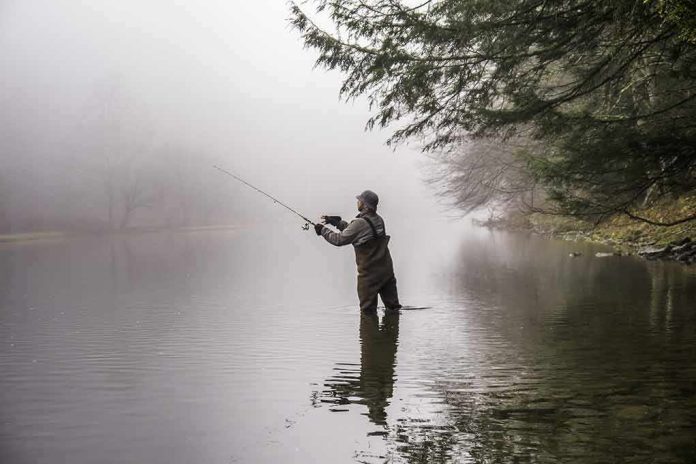
A 71-year-old man fishing along the edge of a Central Florida lake in Winter Garden pre serves as a grim but statistically rare reminder of what can happen when an 11-plus-foot apex predator and a person share six feet of shoreline for even a moment.
Key Points
- Steven Hamilton, 71, of Winter Garden, was killed by an alligator while fishing at Dr. Bradford Memorial Park near Lake Apopka on Friday, October 16, 2026.
- Emergency crews responded to a 911 call around 5:20 p.m.; Hamilton’s body was recovered roughly two hours later, a search complicated by the presence of other alligators.
- An alligator measuring approximately 11.8 feet was trapped and killed following the attack, according to Winter Garden police.
- Florida Fish and Wildlife Conservation Commission data show fatal alligator attacks remain rare — 32 deaths out of roughly 500 documented unprovoked bites since 1948.
- The incident was the second fatal Florida alligator attack of the year, following one on June 28.
What happened at Dr. Bradford Memorial Park
Hamilton was fishing from the shoreline of the park, which sits on or near Lake Apopka in Winter Garden, Florida’s Orange County, when an alligator seized him and pulled him into the water. The attack occurred Friday afternoon, October 16, 2026, with most contemporaneous reports placing it around 5:00 p.m. Officials attributed Hamilton’s death to injuries sustained in the attack; he died at the scene. Winter Garden Fire Chief Jose Gainza said emergency crews were dispatched after a 911 call came in at approximately 5:20 p.m., a timeline consistent with a rapid, violent encounter rather than a prolonged struggle.
Lake Apopka is one of Florida’s largest lakes and sits within a landscape of connected ponds, canals, and retention basins typical of Central Florida parkland — a geography that explains why some accounts describe the attack site as the lake itself and others as an adjacent pond within the park. Both descriptions point to the same body of water system, and the distinction has no bearing on what happened to Hamilton or on the response that followed.
The emergency response and recovery
Recovering Hamilton’s body proved difficult. Chief Gainza said crews pulled him from the water around 7:00 p.m., nearly two hours after the initial call, with the operation slowed by the presence of additional alligators in the immediate area. That detail is not incidental — Lake Apopka and its surrounding wetlands support a substantial resident alligator population, and search-and-recovery teams in these conditions routinely have to manage the animals themselves as an active hazard before they can safely retrieve a victim.
Winter Garden police and the FWC worked the incident jointly, a standard arrangement in Florida where local law enforcement handles the human-casualty response while the state wildlife agency has statutory authority over trapping and disposing of a dangerous alligator. Captain Michael Mason confirmed that an alligator believed responsible for the attack, measured at roughly 11.8 feet, was trapped and killed in the hours afterward. Florida’s nuisance-alligator protocol calls for exactly this outcome whenever an alligator is implicated in a serious human injury or death: the animal is removed from the population rather than relocated, both because large alligators are highly territorial and rarely thrive after relocation and because public safety takes precedence once an animal has demonstrated predatory behavior toward a person.
How common — and how severe — these attacks actually are
It is tempting, in the aftermath of a death this visceral, to imagine Florida’s lakes as uniquely perilous. The state’s own data argue otherwise, within limits. The FWC has tracked unprovoked alligator bites since 1948 and counts approximately 500 total incidents over that 78-year span, of which 32 proved fatal. That works out to an average of roughly five unprovoked bites a year statewide — a figure dwarfed by the millions of recreational hours Floridians and tourists spend fishing, boating, and wading near freshwater each year. Annual totals do fluctuate: 2023 produced 23 bites, the highest single-year count in over a decade, while 2024 recorded 11 bites and no deaths before 2025 brought the toll back up with 13 attacks and two fatalities. Hamilton’s death marked the second fatal attack in Florida since late June, when a swimmer died in a separate Seminole County incident.
The FWC itself was blunt in its public statement following the Winter Garden attack, noting that “serious injuries caused by alligators are rare in Florida,” even as the agency reiterated that public safety remains its highest priority when a dangerous animal has been identified. That framing matters: a fatal attack is newsworthy precisely because it is an outlier against a backdrop of enormous, mostly uneventful human-alligator coexistence across thousands of Florida lakes, canals, and retention ponds.
Winter Garden, Florida: Steven Hamilton, 71, was admiring a fish he caught, when a nearly 12-foot alligator grabbed his leg, dragged him into Lake Apopka, and killed him.
Hamilton was posing for a pic when the attack occurred, said an eyewitness. https://t.co/F5kPxVvSsl
— Timothy Fitz (@TimothyFitzNews) October 17, 2026
Why this keeps happening — and what it means for anyone near Florida water
Alligators are ambush predators built for exactly the scenario that played out at Dr. Bradford Memorial Park: a still, low target near the water’s edge, within striking distance of a creature that can launch its entire body length in a fraction of a second. Fishermen are disproportionately represented among attack victims nationally because the activity places people at the shoreline, often crouched or kneeling, for extended stretches — precisely the posture an alligator is evolved to exploit. The FWC’s safety guidance is unglamorous but effective: stay back from the water’s edge in any Florida lake or canal, never dangle feet or hands near the surface, and treat any alligator over four feet as capable of serious injury regardless of how placid it appears sunning on a bank.
The deeper lesson of this case is not that Lake Apopka or Winter Garden’s parks are unusually dangerous, but that the risk calculus for recreating near Florida’s freshwater is permanent and structural: the state hosts an estimated 1.3 million alligators, and no amount of individual caution reduces that population to zero. What authorities can and did do — trap and remove the animal implicated in a fatal attack — addresses the immediate threat. It does not, and cannot, eliminate the underlying reality that shares these lakes with every angler who steps up to the bank at dusk, the hour when alligators are most active and most likely to be hunting.
Sources:
washingtontimes.com, nytimes.com, wistv.com, wtsp.com, yahoo.com, sacbee.com, the-express.com