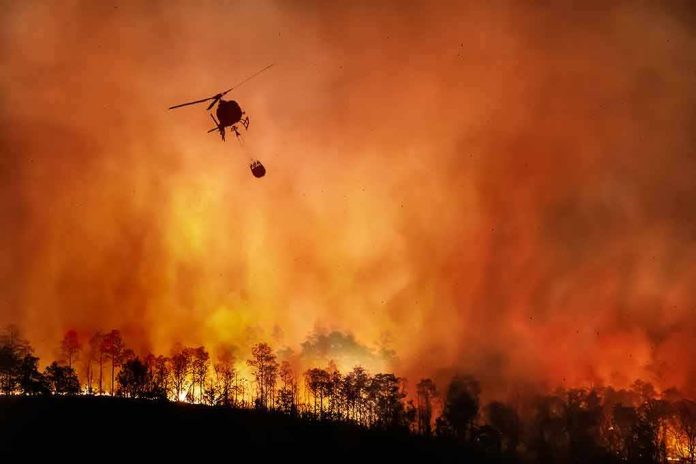
Three federal wildland firefighters died in a sudden burnover on the Snyder Fire as hurricane‑force gusts over dry terrain pushed multiple Colorado blazes into fast, deadly growth.
Story Highlights
- Three firefighters were killed and two injured on the Snyder Fire during a burnover incident.
- Snyder Fire reached about 28,000 acres with zero containment, prompting evacuation warnings.
- Evacuations ordered near Turquoise Lake and in parts of Ouray County as other fires spread.
- Governor Jared Polis declared an emergency and activated the National Guard.
Confirmed Fatalities Underscore Extreme Fire Behavior
Officials said three federal wildland firefighters died and two were hurt after a burnover on the Snyder Fire near the Colorado–Utah border. A burnover happens when flames or superheated gases overrun crews. The report came as winds and very low humidity turned spot fires into racing fronts. National reporters described the Snyder Fire as fast moving and deadly. The agency did not immediately release names, pending family notice, which is standard in line‑of‑duty deaths.
State updates placed the Snyder Fire at about 28,000 acres with zero containment. That size at zero hold shows how quickly grass, brush, and timber can ignite when wind drives embers ahead of the main line. Crews often focus on life safety and evacuations when a fire runs like this. That can delay building containment lines. Accuracy on acreage can lag during wind storms because flight mapping and ground checks are risky in heavy smoke.
Evacuations Expand Across Western Slope Communities
Local sheriffs ordered or warned evacuations in several areas as new ignitions flared. Lake County officials directed people near Turquoise Lake to leave because of the Willow Fire. Ouray County leaders issued orders between Peck’s Trailer Park and Cedar Hill Cemetery for the Gold Mountain Fire. North of Dolores, reports said the Ferris Fire grew into a single large blaze over 10,000 to 16,000 acres, with roads closed and neighborhoods told to go or get ready.
Residents described fast changes as winds shifted. Emergency managers urged people to pack go‑bags, charge phones, and keep cars fueled. Orders used local landmarks rather than precise street grids, which is common in mountain terrain. That can cause confusion for visitors or short‑term renters. Officials advised people to follow county alert systems, not social media rumors. Confusion grows when multiple fires light up in the same region on the same windy day.
Weather Warning Reached the Highest Danger Level
The National Weather Service issued a “particularly dangerous situation” fire weather warning, its highest level. Forecasters cited winds up to about 40 miles per hour and very low humidity. Those conditions dry fine fuels and push embers far ahead of the front. That turns spot fires into new heads. Firefighters call this plume‑driven behavior. Under those skies, air support can be grounded by turbulence and smoke, which limits retardant drops and mapping flights.
When weather drives the event, even the best crews can only do so much. Command posts shift to life safety: evacuate people, protect homes where possible, and keep firefighters out of dead‑end canyons. That risk calculus can feel slow to residents, but it saves lives. The burnover on Snyder is a stark example. The decision chain in those minutes is now part of a line‑of‑duty investigation, which follows after any fatal incident.
State Emergency: Guard Activation and Resource Gaps
Governor Jared Polis declared a state emergency that activated the Colorado National Guard and the state emergency operations center. The order covered Snyder, Gold Mountain, and Ferris among others. Guard units support traffic control, aerial mapping when safe, and logistics. State activation also speeds mutual aid and funding for overtime and equipment. That matters when rural departments face multiple starts and long shifts with thin staff and aging engines.
Wildfires are forcing evacuations across Colorado as strong winds help flames spread quickly through dry terrain. pic.twitter.com/hTcsIJHlPp
— AccuWeather (@accuweather) June 30, 2026
Large, fast fires fit a pattern seen in Colorado over recent decades. Research shows that a small share of extreme fires account for a big share of acres burned, and many of the state’s largest fires have occurred since 2012. This trend reflects drier fuels, prior growth in the wildland‑urban mix, and more wind‑driven events. The Snyder Fire’s sudden scale at zero containment is not unique in that record, but it is an acute test of readiness and coordination.
What We Know, What We Do Not, and Why It Matters
Facts now: three firefighters died on Snyder; two were injured; Snyder is large with no containment; several communities face evacuation orders or warnings; winds and dry air set the stage; the state emergency is active. Gaps remain: officials have not released the names or agencies of the fallen; Ferris Fire acreage ranges by source, reflecting fast changes and limited mapping windows. Those limits are normal during red flag days and will tighten as verified reports arrive.
For families on both the left and right, the stakes feel familiar. People see rising risk, slow infrastructure fixes, and agencies stretched thin. They hear big promises, then meet busy signals when they need maps, shelters, and clear alerts. That gap feeds distrust in “the system.” Concrete steps help: push accurate alerts to phones, publish simple evacuation maps, surge crews and engines early on wind days, and explain decisions in plain language after every shift change.
How Communities Can Reduce the Next Burnover Risk
Local actions cut danger even when the wind howls. Homeowners can clear five feet around structures, clean gutters, screen vents, and stack wood away from walls. Towns can widen escape lanes and trim corridors. Counties can harden cell sites and run drills before peak season. State leaders can pre‑position crews and aircraft on forecast wind days. These moves do not stop every fire, but they can stop embers from turning one home into a block‑wide loss.