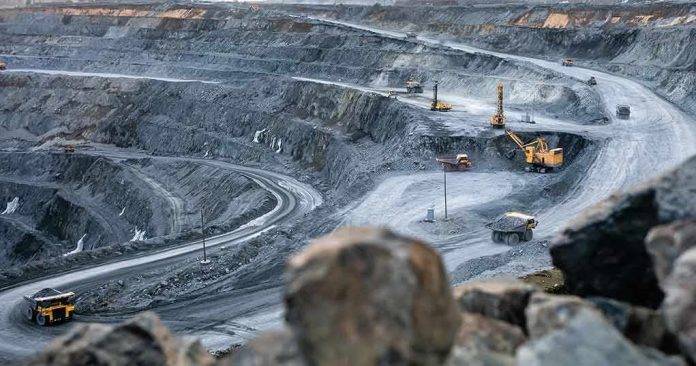
Critical minerals sit at the seam where industrial policy, defense planning, and geopolitical leverage collide; that is why a mining roundtable at the State Department is never just a trade event. It is a window into how President Trump is trying to harden the U.S. supply chain against China, replenish military stockpiles, and accelerate domestic production with the federal government acting as an active market participant.
Intro
- The roundtable was framed around critical minerals needed for defense, energy, and advanced manufacturing, not as a symbolic photo op.
- The policy logic is straightforward: the United States wants more domestic and allied supply, faster permitting, and more resilient processing capacity.
- The military angle is central. Reuters reported the White House wanted minerals to replenish weapons stockpiles depleted during the Iran conflict and reduce dependence on Chinese supply chains.
- The broader Trump approach already includes stockpiling, equity stakes, procurement limits, and permitting acceleration, making the meeting part of a larger industrial strategy rather than an isolated gesture.
What this roundtable was really for
The immediate purpose of the State Department gathering was to bring President Trump into the same room with mining executives, educators, and investors while the administration presses a broader critical-minerals campaign. Reuters described the meeting as a State Department-hosted roundtable with top mining executives, and subsequent coverage said Trump would convene some of the world’s largest mining companies as his administration intensified efforts to secure domestic and allied supplies of critical minerals. That is the core fact pattern. The meeting was not about ornamental diplomacy; it was about supply security in a sector that the administration treats as strategically analogous to oil, with the added urgency that the minerals in question feed both civilian industry and weapons systems.
The mineral list matters because it explains the policy temperature. Rare earths, tungsten, germanium, and scandium are not generic commodities; they are inputs for precision-guided missiles, fighter aircraft, armored vehicles, infrared sensors, batteries, semiconductors, and magnet systems. When a government says it needs those materials, it is not speaking in abstractions. It is talking about industrial bottlenecks, weapons availability, and the ability of defense contractors to source without passing through Chinese-controlled chokepoints. That is why the roundtable drew mining firms, defense planners, and officials who increasingly see upstream minerals policy as national-security infrastructure rather than conventional resource regulation.
The policy architecture behind the meeting
The roundtable makes sense only against the machinery already built around it. In 2025 and 2026, Trump used executive and trade authorities to push domestic minerals production, including efforts to accelerate permitting, tighten supply-chain controls, and coordinate with allies and the private sector. Reuters also reported a separate push to site metals refining on Pentagon bases, an unusually direct attempt to use federal land and military infrastructure to reduce China’s role in processing. Read together, these moves show a government trying to intervene at multiple points in the chain: extraction, refining, stockpiling, financing, and procurement.
The stockpile effort is especially revealing. Reuters, CNBC, and E&E News all described Project Vault, a $12 billion critical-minerals reserve backed by public and private capital, as part of the administration’s answer to supply shocks and Chinese leverage. That concept is not a sideshow. A stockpile changes bargaining power. It gives Washington a buffer against embargoes, price spikes, and sudden wartime demand. It also signals to miners and processors that the federal government intends to be a buyer, a financier, and a market shaper. Once that line is crossed, roundtables stop being purely consultative; they become coordination points for policy implementation.
Why defense planners care so much
The defense logic is stronger than the politics. Reuters reported that the White House needed critical minerals to replenish weapons stockpiles depleted during the Iran conflict, and that these materials are essential to precision-guided missiles, fighter aircraft, armored vehicles, and infrared sensors. That is a sober description of supply risk, not rhetorical flourish. In a prolonged conflict, the constraint is often not the design of a weapon but the availability of the minerals embedded inside its components. If the supply of rare earths or tungsten tightens, the bottleneck migrates from the battlefield to the mine, the refinery, or the shipping lane.
This is why the administration’s focus on domestic and allied supply is more than a nationalist slogan. Critical-minerals dependence is a classic strategic vulnerability: production is geographically concentrated, refining capacity is often even more concentrated, and China has dominated large portions of the processing chain for years. The Trump model tries to reduce that concentration by pulling every available lever at once. The roundtable, then, is less important as a single event than as a visible node in a larger campaign to convert minerals policy into defense readiness.
⚡️ ALERT
Trump asks a mining roundtable to wrap up quickly, joking “we have a war to prosecute, that’s my excuse to leave a little bit early”. pic.twitter.com/YJewHRLv43
— DC_Global_News (@DC_Global_News) August 7, 2026
The real dispute: industrial strategy or regulatory capture
The strongest criticism of this agenda is not that critical minerals are unimportant. They plainly are. The criticism is that repeated industry-government forums can drift into preferential access for large incumbents, with the language of national security masking subsidy, protectionism, and regulatory favoritism. That concern appears in the broader context sources, which note that these meetings often sit at the intersection of industrial policy and capture, where critics worry that incumbent firms receive expedited permitting, financing, and public backing while the public bears the downside if the projects underperform. The critique is serious because it reflects how modern resource policy works: state power is often deployed to de-risk private investment.
Still, the evidence here weighs more heavily toward the administration’s stated national-security rationale than toward any documented quid pro quo. The research package contains repeated Reuters reporting, a White House fact sheet, CSIS analysis, and Reuters-backed follow-up coverage that all point in the same direction: faster domestic production, allied coordination, and defense resilience. What is missing is a primary-source contradiction showing that the roundtable was actually about something else, or that the policy frame was invented after the fact. The cleaner reading is that Trump is using a familiar presidential toolset—roundtables, executive orders, procurement signals, and stockpiling—to compress timelines in a sector he views as strategically essential.
What to watch next
The practical question is not whether the administration wants more minerals; it clearly does. The question is whether the meeting yields concrete follow-through: permitting changes, financing commitments, procurement rules, or new restrictions on sourcing from prohibited foreign suppliers. The early signs suggest an active state, not a passive one. Trump has already tied critical-minerals security to trade negotiations, allied coordination, stockpiling, and direct investment. If those pieces continue to move together, the mining roundtable will look less like a discrete summit and more like a durable governing model for American resource policy.
That model has consequences beyond mining companies. It affects defense readiness, battery supply chains, aerospace manufacturing, and the balance of power between the United States and China. It also reshapes the politics of extraction inside the United States, because any serious attempt to onshore mineral supply runs into permitting disputes, land-use fights, environmental review, and local resistance. The roundtable is therefore best understood as an opening move in a longer contest: not simply over where America gets its minerals, but over how much federal power should be used to guarantee them.
Sources:
youtube.com, investing.com, afr.com, cryptobriefing.com, roic.ai, energynews.oedigital.com, x.com, facebook.com, csis.org, cen.acs.org, whitehouse.gov, pillsburylaw.com