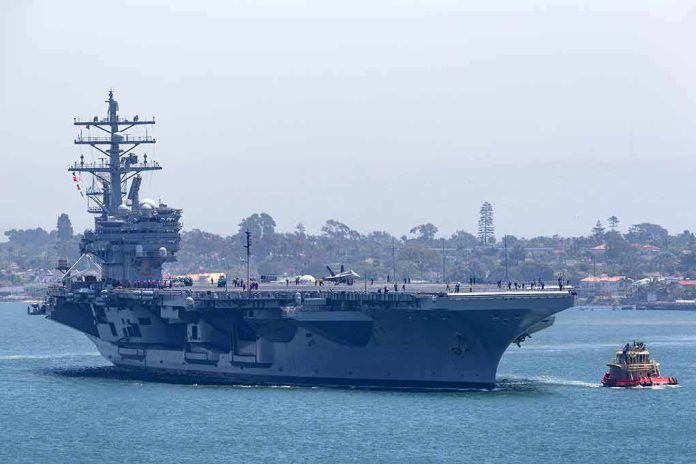
What makes the USS Abraham Lincoln story matter is not a single bad meal or a few broken fixtures; it is the collision of prolonged combat deployment, shipboard habitability, and crew endurance, with families and officials now describing two very different versions of life at sea.
Key Points
- Families of sailors and Marines on the USS Abraham Lincoln say the crew has endured poor living conditions, thin meals, broken sanitation, and shortages of basic toiletries during a long deployment.
- Reporting says the carrier has spent roughly 237 days at sea and about 258 days deployed, with only one port visit, which helps explain the strain.
- The Navy has not accepted the worst allegations; it says the deployment is challenging, but that the ship remains capable and the meals are properly portioned.
- The dispute is therefore less about whether the deployment is hard than about how severe the hardship has become, and whether it crossed from routine wear-and-tear into a welfare problem.
A Deployment Long Enough to Wear Down Any Crew
The Abraham Lincoln’s deployment is the essential fact behind every complaint. By early August, reporting said the carrier had been at sea for 237 days and deployed for 258, with only one port visit after leaving San Diego the previous November. That is not ordinary carrier cycling; it is the kind of sustained tempo that turns inconvenience into a cumulative burden. On a ship, habitability is not a luxury. It is part of combat power, because exhausted people, dirty spaces, and missing basics eventually affect judgment, maintenance, and morale.
That context matters because the Lincoln was not sitting in a quiet rear-area transit. The ship has been operating in a high-risk environment tied to the U.S.-Iran confrontation, and reporting described continuous flight operations and long workdays in that setting. A Naval Forces Central Command statement also confirmed that a sailor aboard the ship was injured during flight operations on March 25, underscoring that the carrier was actively conducting hazardous work while the welfare complaints were being discussed. In other words, the hardship claims were made in the middle of a real operational grind, not in an idle peacetime cruise.
What Families Say the Crew Was Living With
The allegations themselves are specific, which is why they traveled so widely. Families told MS NOW and follow-on outlets that sailors and Marines reported moldy showers, broken toilets, no hot water, laundry outages that lasted for weeks, and long waits at the ship store for toothpaste, soap, and deodorant. The reporting also included complaints about food, including one account of a sailor being served “half a cup of rice and two tortillas,” along with trays described as meager or unappetizing. In naval life, food and hygiene are not side issues. They are the daily machinery of morale.
The descriptions of fatigue were just as important as the sanitation complaints. Families said many crew members were working 12- to 14-hour shifts, often with little or no time off. On a carrier, that tempo is punishing because the work is never merely physical; it is concentration-intensive and safety-sensitive, especially on a flight deck where one mistake can cascade. That is why the family accounts framed the issue not just as discomfort, but as a risk to judgment and operational safety. The claim is not that the ship stopped functioning. It is that the people keeping it functioning were being ground down.
The Navy’s Response Draws a Harder Boundary
The Navy and Defense Department did not simply ignore the story. They drew a line around it. Cmdr. Joseph Hontz, speaking for U.S. 5th Fleet, acknowledged that the deployment is “challenging for the crew and their equipment,” while saying the ship remained ready to accomplish its tasking. That language matters. It concedes strain without conceding breakdown. It also fits the broader military habit of separating welfare concerns from mission status, even when the two are plainly related.
The sharper dispute came over food. Defense Secretary Pete Hegseth publicly pushed back on shortage allegations, and Navy messaging described deployed ships as having “fully portioned, nutritionally balanced meals.” That is a direct contradiction, not a semantic one. So the public record supports two things at once: first, that families and reporting sources described severe shortages and poor living conditions; second, that the Navy rejected the strongest version of the starvation claim and insisted provisioning remained adequate. The result is not a resolved case file. It is a contested account, with the burden now on ship records, inventories, and first-hand testimony to settle how widespread the problems really were.
I have wondered how the military are coping in a constant state of alertness, particularly those cooped up on the USS Abraham Lincoln. If such reports of conditions on board are true, it is honestly, disgraceful.
— Catherine (@Arabella9370) August 8, 2026
Why This Kind of Story Repeats in Long Deployments
This episode fits a durable pattern in military life. Extended deployments compress everything: maintenance cycles stretch, spare parts become precious, laundry and sanitation systems take abuse, and small disruptions become visible because hundreds or thousands of people live in one enclosed machine. Carriers intensify that pressure. They are floating cities, but unlike cities, they cannot simply absorb friction with redundancy. If a galley problem persists or a toilet bank goes down, the crew cannot escape the system; they live inside it.
That is why the reporting about the Lincoln resonates beyond one ship. Even if some of the allegations prove to have been localized, temporary, or exaggerated in transmission from sailor to family to reporter, the underlying conditions still point to a larger truth: prolonged carrier deployments have real human costs, and those costs show up first in the body and the routine. Clean showers, enough food, functioning laundry, decent rest, and access to basic supplies are not cosmetic metrics. They are the baseline that keeps morale from becoming mission risk.
What the Public Record Supports Right Now
The strongest conclusion is straightforward: the USS Abraham Lincoln was on an unusually long, operationally intense deployment, and families of crew members reported serious problems with hygiene, food, supplies, and exhaustion. The Navy acknowledged the deployment was challenging, but it disputed the implication of systemic food failure and maintained that the ship remained fully capable. That leaves a meaningful gap between perception and official portrayal, yet it does not erase the story. It defines it. This is a case of a hard deployment exposing the limits of endurance aboard a warship, with the exact severity still to be pinned down by documents, logs, and corroborated testimony.
Sources:
taskandpurpose.com, forbes.com, independent.co.uk, navy.mil, facebook.com, youtube.com, zeli.app, cusnc.navy.mil