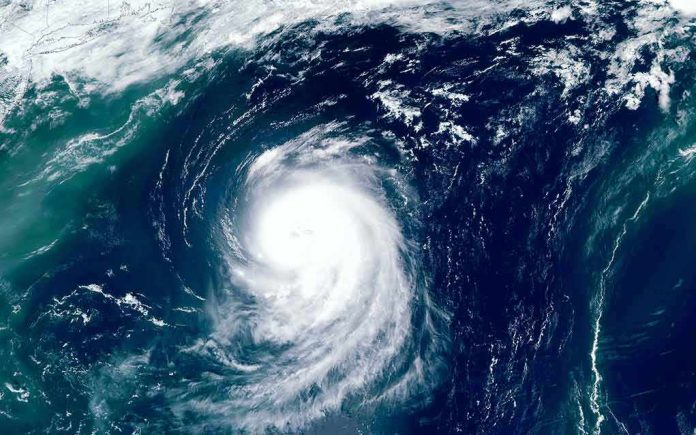
The central fact about Typhoon Dolphin is not merely that it arrived, but that it did so with enough forecast intensity and geographic reach to force a large-scale protective shutdown across eastern China before the full damage picture had time to harden. In typhoon reporting, preparedness is often the first reliable signal of severity; Dolphin fit that pattern exactly.
Intro Header
- Typhoon Dolphin made landfall on China’s eastern coast, with Zhejiang at the center of the immediate impact zone.
- Authorities treated it as a serious storm well before landfall, raising alerts and emergency responses in multiple provinces.
- The practical consequences were immediate: mass evacuations, flight cancellations, ferry suspensions, school closures, and flood warnings.
- The strongest evidence in the public record is about forecast severity and response; the post-landfall damage account is still comparatively thin.
What made Typhoon Dolphin significant
Dolphin was significant because it crossed the line from distant cyclone to landfalling threat in one of China’s most densely populated and economically active coastal corridors. Reuters reported that the storm made landfall near Yuhuan in Zhejiang province with maximum sustained winds of 42 meters per second, or about 151 km/h, while AP placed the peak estimate at about 162 km/h and described the storm as a flooding and landslide threat to Zhejiang and northern Fujian. Those numbers matter because they explain the official response: this was not a marginal tropical disturbance, but a fully serious typhoon capable of disrupting transport, coastal commerce, and inland drainage systems.
The clearest warning sign was not the headline wind speed alone; it was the combination of wind, rainfall, and track. AP said torrential rain was expected across Zhejiang, Shanghai, Fujian, Jiangxi, Anhui, and Jiangsu, while Reuters reported forecast rainfall of 250–500 mm in parts of Zhejiang. Other coverage pushed the upper end even higher, with some forecasts approaching 600 mm in isolated areas. In practical terms, that is the difference between nuisance flooding and a system-wide water-management problem. When rain totals reach that scale over a coastal province, landslides, urban inundation, and transport paralysis become the default expectation, not the exception.
The government response was a signal in itself
China’s response showed how seriously the storm was being treated before landfall. Xinhua reported that Zhejiang and Fujian raised their emergency responses from Level IV to Level III on August 7, as Dolphin approached the coast, and later reporting said the national observatory issued a red alert, the highest level in the typhoon warning system. That escalation is not bureaucratic theater; it is how China’s emergency architecture converts meteorological forecasts into action, triggering evacuations, transport controls, and local shutdowns. The upgrade from warning to response is the institutional fingerprint of an anticipated disaster.
The official language also sharpened the geographic picture. Xinhua said the typhoon was expected to make landfall between Ningbo in Zhejiang and Ningde in Fujian, while CGTN and other outlets placed the likely landfall corridor between Zhejiang and northern Fujian. Reuters later reported landfall near Yuhuan in eastern Zhejiang. The differing place names are not a contradiction so much as a symptom of real-time storm coverage: when a cyclone’s eye wall is broad, and the coastline complex, small differences in phrasing can reflect timing, translation, or the difference between projected and observed landfall points. The broad consensus is what matters: eastern Zhejiang and adjacent Fujian were squarely in the strike zone.
Why the disruption spread far beyond the landfall point
Dolphin did not matter only where it struck. AP said Shanghai was in the storm’s path, and other coverage described heavy precipitation there and in neighboring provinces. That is typical of East China typhoons, which often produce their worst consequences not through one violent hour at the coast, but through a wider swath of wind field, rain bands, and drainage overload extending well inland. Shanghai’s inclusion broadens the event from a provincial coastal hit to a regional systems stress test: airports, freight, commuter rail, ports, schools, and construction all become part of the same vulnerability chain.
The transport numbers show how quickly that chain was activated. Reuters reported that Fujian maritime authorities suspended 55 coastal passenger ferry routes, halted all 115 offshore construction projects, and moved 290 construction vessels to sheltered waters. Euronews said more than 1,000 flights were cancelled, and AP reported that schools and tourist sites were shut. Al Jazeera added that Zhejiang had halted port operations, suspended 162 passenger ferry routes, and ordered school and airport closures in Ningbo. This is the anatomy of a modern typhoon response: once the forecast crosses a certain threshold, the economy stops in pieces, not all at once.
Typhoon Dolphin struck China’s Zhejiang province on Sunday, forcing more than 1 million people from their homes as torrential rain and strong winds swept the eastern coast.
Parts of Zhejiang could receive 250–500 millimetres of rain, while Shanghai cancelled about 1,500 flights…
— Thenationthailand (@Thenationth) August 10, 2026
The evacuation figures show scale, but not yet final loss
The evacuation totals were large enough to confirm that authorities expected meaningful harm. Reuters reported that nearly 99,000 people were evacuated in Fujian, while Euronews and CGTN-related coverage said more than 1 million people were moved to safety across affected areas. Those numbers should be read carefully. They are evidence of severity and preparedness, not proof of ultimate destruction. A large evacuation can mean that the system worked before the worst impact arrived. It can also mean that official planners judged the storm’s track and rainfall threat to be unusually dangerous. In Dolphin’s case, the evacuation scale points to the second explanation just as strongly as the first.
What is less developed in the available record is the quantified post-landfall damage assessment. The reports provided here focus heavily on warnings, forecasts, relocations, cancellations, and emergency posture, but they offer little in the way of consolidated casualty totals, infrastructure-loss surveys, or verified flood-depth mapping after the storm moved inland. That gap does not weaken the core claim that Dolphin hit China’s east coast; it simply means the public narrative is still weighted toward the anticipatory phase of the disaster. That is normal in cyclone coverage, and it is one reason early reporting often feels more complete than it really is.
How to read the competing narratives responsibly
There is no serious sourced counter-case in the material provided that disputes the core fact of landfall in eastern China. The meaningful tension lies elsewhere: between the certainty of the storm’s arrival and the incompleteness of the damage record. Some public-facing coverage, especially platform reposts and live video summaries, is stronger on drama than on verification; state-linked and wire-service reporting is stronger on official alerts and operational disruption than on final forensic accounting. Both streams are useful, but they answer different questions. The first says a storm hit. The second says what people thought the storm might do. The third—still only partly visible here—will say what it actually did.
That distinction matters because typhoon events reward sloppy reading. A million evacuations do not prove catastrophe, and a lack of immediate casualty reporting does not prove the storm was harmless. The correct reading of Dolphin is more disciplined: eastern China faced a legitimately severe typhoon, authorities behaved as if the threat were serious, and the resulting disruption was broad enough to justify that response. What remains underdocumented in the public package is the final ledger of harm. Until that arrives, the strongest conclusion is also the simplest one: Typhoon Dolphin struck, it struck hard enough to trigger major regional precautions, and its most visible consequences were the ones that modern disaster systems expose first—suspension, evacuation, and emergency control.
Sources:
youtube.com, euronews.com, straitstimes.com, facebook.com, aljazeera.com, news.cgtn.com, english.news.cn, asianews.network, bloomberg.com