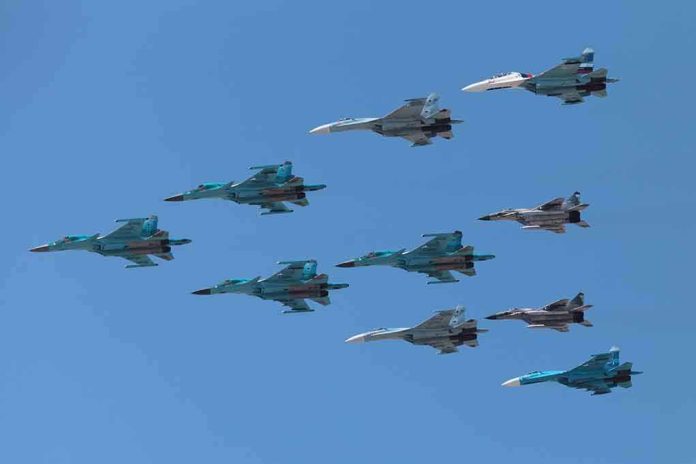
Presidential direction, not Pentagon inertia, set the terms: President Trump instructed Defense Secretary Pete Hegseth to substantially reduce upcoming U.S.–South Korea joint military exercises, explicitly on cost grounds and to avoid what he called a hostile signal to Pyongyang. The decision touches the nerve center of alliance management on the peninsula—where training is never just training, and every adjustment is read simultaneously as readiness math, diplomatic signaling, and deterrence calibration.
At a Glance
- Trump ordered a substantial reduction in joint U.S.–ROK exercises, tying it to cost and signaling concerns toward North Korea.
- The directive landed on the eve of the Ulchi Freedom Shield cycle, a scheduled 11-day exercise package with defined scenarios and troop commitments.
- U.S. and South Korean militaries characterize these drills as readiness-focused; North Korea routinely denounces them as invasion rehearsals.
- Exercise size and scope have long been used as tools of statecraft; scaling back is neither unprecedented nor mechanically determinative of deterrence outcomes.
What the order said and why it matters
President Trump stated publicly that he had instructed Secretary of War Pete Hegseth to substantially reduce the joint exercises with South Korea, emphasizing two rationales: the drills are costly, and they send an inappropriate, hostile signal to North Korea at a moment when he characterized Kim Jong Un as unthreatening and respectful toward the United States during his tenure. Coming when it did—on the cusp of a planned exercise window—this was not a theoretical policy flourish. It targeted discrete, scheduled events in a well-understood training calendar. A presidential instruction at this stage compels planners to modify scenarios, compress timelines, or strip out high-cost, high-visibility components. Those choices cascade into readiness goals, allied optics, and North Korean threat perceptions.
The directive’s significance is twofold. Mechanically, exercise architectures are built months in advance; large late-stage changes demand trade-offs among realism, scale, and logistics. Strategically, exercise modulation is an instrument of diplomacy in Korea as familiar as sanctions or summits. It is used to reduce escalatory friction, to signal restraint while testing interlocutors, or to reserve leverage for future bargaining—without abandoning baseline training. This is why advocates and critics can cite the same history and reach different prescriptions.
What was on the training docket
The order intersected a specific exercise package, not a blank slate. Ulchi Freedom Shield—an annual combined training period—was slated to run over 11 days with an estimated 18,000 South Korean troops and U.S. participation under Combined Forces Command. Planners had integrated counter-drone defense, GPS disruption, and cyberattack response into the scenario set, alongside live-fire precision targeting, wet-gap crossing, and distribution of prepositioned equipment—skill sets tailored to North Korea’s evolving threat profile and contested-electromagnetic environment. These are not cosmetic vignettes; they are the muscle groups of alliance warfighting: command-and-control under pressure, logistics under interdiction, and fires integration across domains. Scaling back can mean reducing live-fire iterations, trimming combined maneuver, limiting force flow, or shifting to simulations—each choice preserves certain competencies while deferring others.
North Korea reliably reads these drills as hostile intent and rehearsals for regime decapitation; state media condemned the cycle in advance, consistent with decades of practice. For U.S. and ROK commanders, however, the drills are defensive readiness events meant to maintain deterrence credibility by proving the alliance can integrate quickly, fight through disruption, and sustain operations—training that is hard to replicate in a purely classroom environment. The gap between those narratives is a structural feature of the peninsula, not a temporary misunderstanding.
Trump’s cost and signaling arguments in historical context
Cost has been a recurring presidential critique of large-scale exercises, particularly when those drills require extensive air and naval movements, surge deployments, and multinational logistics tails. In his statement announcing the reduction, Trump linked cost sensitivity with alliance signaling, arguing there was “no reason” to spend heavily on drills that, in his view, telegraph needless hostility during a period of restraint from Pyongyang. The United States has at times accepted marginal short-term readiness risk to advance diplomatic opportunities; 2018–2019 suspensions and modifications followed that script, while commanders backfilled with simulations and smaller-unit training to keep core competencies warm. Analysts have long documented that exercise size, scope, and timing are adjustable dials rather than on/off switches; militaries can compress some elements, emphasize others, and use simulation to sustain staff proficiency when political space is tight.
Does scaling back undermine deterrence? The research record is mixed because deterrence is conditional. Some studies contend large exercises reassure Seoul more than they deter Pyongyang, with the North’s behavior tied more closely to internal strategy and external leverage cycles than to any single drill iteration. Others argue that visible, large-scale training is an indispensable signal of capability and resolve, especially as North Korea refines missiles, drones, and electronic warfare tools. The consensus, if there is one, is methodological: adjust to context—threats, talks, and crisis cadence—rather than treat exercise volume as an invariant good or ill.
How exercise reductions actually work
Reduction is not synonym for cancellation. In practice, it can mean: fewer live-fire events; smaller maneuver formations; less deployment of strategic assets; tighter geographic bounds; or substitution of computer-assisted command post exercises for field training. Each variant carries a distinct cost and signaling profile. Live-fire and large combined-arms maneuvers are expensive and conspicuous; dialing them down reduces operational friction, logistics burden, and media visibility. Command post simulations maintain headquarters proficiency in planning, multi-domain synchronization, and decision-making under electronic attack, but they cannot fully substitute for unit-level integration under the physical stress of movement and fires. The art is in preserving the alliance’s time-to-fight—the interval from warning to combined combat credibility—while buying the political room leaders want for diplomacy or budget priorities. The U.S.–ROK team has done this before, recoding exercise menus to emphasize “size, scope, volume, and timing” agility without abandoning core functions.
Ulchi Freedom Shield’s own evolution reflects this flex. The exercise lineage—Foal Eagle, Key Resolve, and Ulchi variants—has cycled between expansive field events and headquarters-centric simulations. In periods of heightened diplomacy, planners have prioritized planning drills and distributed problem-sets like counter-drone defense and cyber resilience; when tensions climb, the pendulum swings back toward massed maneuver, integrated fires, and strategic asset demonstrations. North Korea’s rhetoric moves with the pendulum, but its missile testing tempo often tracks its own bargaining calendar as much as allied training choices.
Alliance management: reassurance, risk, and reciprocity
For Seoul, the first-order question is reassurance: does a scaled-back drill still prove that U.S. forces can integrate rapidly and decisively under Combined Forces Command? Reassurance is not only a political commodity; it is a technical claim about interoperability, logistics throughput, and fires deconfliction. Reduced field components put more burden on certifying units through alternative venues—smaller bilateral drills, service-specific events, or multinational exercises elsewhere in Indo-Pacific Command. Washington and Seoul have historically offset visible reductions with other visible signals—rotational strategic assets, trilateral cooperation with Japan, or expanded missile defense exercises—so allies and adversaries alike see capability even if a single event is compressed.
Reciprocity is the other hinge. Scaling back is most effective as statecraft when it is framed as reversible and conditioned on restraint by the other side. The North rarely credits allied restraint publicly; it typically condemns even modest drills and tests missiles on its own schedule. But allied policymakers still use exercise modulation to keep doors open—an option value that buys diplomatic time at the cost of some training intensity. The trade is acceptable only if militaries can backfill proficiency and if the political objective is clear. Without that clarity, reductions can read as concession rather than leverage and may invite demands for deeper cuts without tangible gains.
US President Donald Trump announced the scaling back of annual military drills with South Korea, just a day before they were set to begin. Pyongyang has long condemned these exercises as invasion rehearsals, complicating the diplomatic landscape. #SouthKorea pic.twitter.com/apIQWRJqDK
— WW3 Watchtower (@WW3Watchtower) August 17, 2026
What to watch as the directive is implemented
Three observables will reveal how deep the “substantial” reduction runs. First, the training mix: whether live-fire, large maneuver, or strategic asset participation is trimmed, and whether headquarters exercises expand to compensate. Second, the distribution of training across the calendar: if elements slide into smaller events before or after the Ulchi window, the readiness delta narrows. Third, the allied signaling package: any offsetting deployments, trilateral activities with Japan, or public certification of combined readiness can maintain reassurance while keeping the exercise footprint lighter. North Korea’s reaction will be loud regardless; the more telling indicator will be its operational tempo over several weeks, not a single headline denunciation.
The bottom line is straightforward. The president directed a scale-back of joint drills with South Korea on cost and signaling grounds. The alliance has tools to execute that order without forfeiting core readiness—if planners rebalance intelligently and leaders frame the move as conditional and reversible. On the Korean Peninsula, exercises are levers as much as they are training. Pull them with precision.
Sources:
townhall.com, internazionale.it, reuters.com, pbs.org, axios.com, abcnews.com, bloomberg.com, rand.org, atlanticcouncil.org, stimson.org, military.com, isdp.eu, cambridge.org, 38north.org