

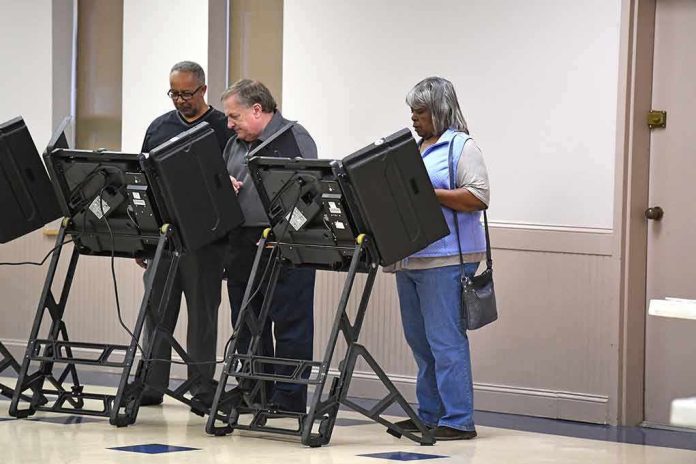
Editorial boards often dress a judgment about electability in the clothes of suitability; the two are not the same, and readers should keep the difference squarely in view when an outlet urges voters to skip a line on their ballot.
The Short Version
- Electability arguments hinge on swing-voter math, not moral fitness; conflating them misleads readers about what polls actually show.
- Michigan’s Senate race was a razor-close contest, with one survey showing a statistical tie and independents tilted more negative on Abdul El-Sayed than on Mike Rogers; that is risk, not disqualification.
- El-Sayed’s coalition broadened beyond a progressive core, including a large, openly critical bloc of Jewish voters who endorsed him as the better institutional counterweight and policy fit despite disagreements.
- Political science research finds newspaper endorsements move opinion modestly, and their influence is conditional on credibility; blanket “leave it blank” guidance rarely decides an election on its own.
What electability claims actually measure — and what they don’t
When an editorial argues that a nominee is the wrong standard-bearer, it typically cites unfavorable ratings among independents or small polling deficits as proof of unfitness. That logic is tidy but unsound. Unfavorability among swing voters is a probabilistic obstacle, not evidence of character, competence, or governing danger. In Michigan’s open-seat Senate race, polling captured a tight contest with independents showing higher negatives for El-Sayed than for Republican Mike Rogers and the topline within the margin of error — a classic “could go either way” picture, not a verdict on merit. Translating that into a call to leave a ballot line blank asks readers to confuse tactical anxiety with principle.
Experts draw this line sharply because the mechanics are different: electability is about expected vote share under uncertainty — name recognition, media environment, out-group bias, resource asymmetries — while suitability is about the substantive demands of the office — judgment, coalition-building, grasp of policy, integrity. Polls can illuminate the former; they cannot, on their own, adjudicate the latter.
The coalition picture: broader, and more conditional, than caricature
El-Sayed’s critics describe a candidate boxed into an ideological cul-de-sac; the record of public endorsements and targeted outreach complicates that picture. More than 500 Jewish Michiganders — later reported as more than 600 — signed an open letter saying they intended to vote for him while explicitly acknowledging serious disagreements with aspects of his approach to Israel. Their rationale was not tribal solidarity or issue alignment on foreign policy; it was a calculus about institutional checks and domestic priorities: health care, voting rights, abortion access, public schools, and social welfare. The letter’s candor matters. Endorsers did not paper over conflict; they weighed it and still opted in, arguing that on balance he was the better choice for their community and for governance.
That judgment was echoed by prominent surrogates. Former Representative Sander Levin — an anchor of Michigan’s Jewish Democratic establishment — endorsed El-Sayed despite what he described as significant disagreement over Israel and urged “Michiganders of conscience” to back him. Former Representative Andy Levin lent his name and time to house-party conversations with undecided Jewish voters, a retail politics signal that the campaign was intent on building bridges beyond its base. These are not dispositive endorsements; they are evidence that coalitions in close races are often conditional, pluralistic, and negotiated in public.
What the polls say — and how to read them like a strategist
One well-publicized statewide survey of likely voters showed a toss-up contest, with Rogers holding a razor-thin edge and independents rating El-Sayed more unfavorably. In a cycle with nationalized messaging, that profile flags exposure to negative advertising and message asymmetry — not unusual when a progressive newcomer faces a Republican with longer federal name ID. Strategists would read that as a path-dependent problem: define before you are defined; inoculate on perceived ideological extremes; leverage validators who cross lines of identity or ideology. In other words, the remedy is campaign work — field, fundraising, disciplined media — not surrender.
Electoral risk, of course, is real. A candidate trailing among independents in early fall is, by definition, less bankable. But risk is not a synonym for doom. In modern statewide races, late movement among low-information voters regularly tracks with ad saturation, third-party spend, and earned media. The same Detroit News ecosystem citing a tight race also covered a record-setting influx of money into the contest, precisely the kind of environment in which late opinion moves are common — and reversible — with message discipline and credible messengers.
Endorsements, editorials, and their actual persuasive power
Do editorial interventions matter? The research consensus is sober rather than sweeping. Rigorous studies find endorsements can shift vote intention and candidate evaluations, but the average effect is modest — often on the order of a point or two — and contingent on the outlet’s credibility with readers and the salience of the race. Endorsements can also tilt subsequent news coverage toward the favored candidate, which amplifies their reach indirectly; yet partisans discount advice from perceived out-group sources, and blowback against the outlet itself is a documented risk when readers detect ideological overreach.
Applied here, a “leave it blank” admonition likely persuades at the margins among habitual readers predisposed to trust the board’s judgment. It is unlikely to reconfigure the race by itself. Voters who treat editorials as one data point among many will still weigh policy, temperament, and coalition signals — which is why competing endorsements from community leaders and issue-aligned groups often matter more in practice than a single institutional voice.
The Detroit News is reporting on a letter that I and over 700 other Michigan physicians gave signed in support of Dr. Abdul El-Sayed for Senate. https://t.co/sKxW0c5uSg
— Ron Chusid (@RonChusid) October 20, 2026
Separating suitability from strategy: how to evaluate the case
If you are the kind of voter who prizes governing agenda and institutional role more than tactical forecasts, start with the platform and the countervailing signals from cross-pressured communities. El-Sayed’s stated focus — Medicare for All, affordable housing, public education, environmental protection, and reducing money’s influence — places him squarely in the party’s progressive lane; supporters outside that lane, particularly the Jewish signatories who went on record despite explicit disagreements, are telling you they find the net policy and oversight value compelling enough to overcome friction. If, instead, you prioritize downside risk in a narrowly divided Senate, treat the independent-voter headwinds as a warning light: a winnable path, but one that requires message hybridization and relentless coalition maintenance to close.
The editorial board’s prerogative is to make a call; your prerogative is to parse the call. When an argument about risk turns into a verdict about worthiness, demand the evidence that bridges that gap. Polls justify caution. They do not, by themselves, justify vacancy.
Sources:
pjmedia.com, detroitnews.com, nbcnews.com, abcnews.com