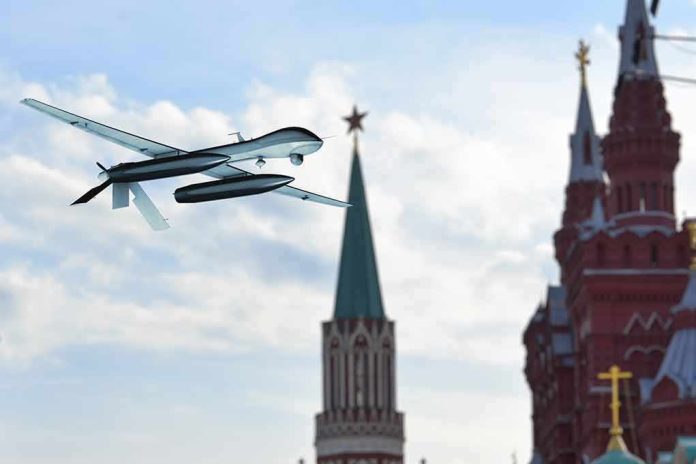
The most consequential fact about Ukraine’s deep-strike drone campaign is not any single night’s body count — it is that Russia’s own officials, in the act of downplaying the damage, keep confirming how far the war has traveled from the trenches of Donbas to the logistics belt ringing Moscow itself.
Key Points
- Ukraine has repeatedly struck Wildberries warehouses and other logistics hubs in the Moscow region, with Russian officials themselves confirming multiple fatalities and major fires across a string of raids since mid-2026.
- The campaign relies on long-range, low-cost drones — notably the Ukrainian-made FP-1 — designed to saturate Russian air defenses rather than defeat them outright.
- Moscow’s own casualty and damage disclosures, offered even as officials tout high interception rates, are the strongest evidence the strikes are landing with real effect.
- Russian statements emphasizing hundreds of drones “destroyed” and Ukrainian claims of strategic disruption are not, on close inspection, in serious conflict — they describe the same events from different vantage points.
- The strategy reflects a broader shift in the war: attacking rear-area supply chains and industrial nodes to raise the cost of sustaining the front, a tactic with precedent in Russia’s own strikes on Ukrainian infrastructure.
How the campaign works: saturation, not surprise
Modern long-range strike drones are not stealth weapons in the classical sense. They win by arithmetic. A single FP-1 drone, built by the Ukrainian firm Fire Point, costs on the order of tens of thousands of dollars and carries a warhead in the 60-kilogram range out to roughly 800 kilometers — deep enough to reach targets far beyond the front line without risking a pilot or a multimillion-dollar aircraft. Russian officials confirmed Fire Point’s FP-1 was used in the August strike on Wildberries’ largest logistics complex, at Koledino south of Moscow, where a 250,000-square-meter warehouse burned. No single drone of this class needs to be unstoppable. The doctrine is to launch dozens or hundreds at once, forcing an air-defense network with finite interceptors, radars, and trained crews to make triage decisions under time pressure — and to accept that some fraction will get through.
That arithmetic explains why Russia’s own public statements, intended to reassure, function as an admission of scale. When Moscow’s mayor announces that 600 drones approached the region overnight and 201 were shot down, the implied remainder — several hundred drones unaccounted for in that tally — is the real story, not the intercept count itself. Sobyanin’s initial statement on one 600-drone night notably reported no damage or casualties at all, only that emergency crews had been sent to debris sites — a formulation that reads less like transparency than like triage of the message.
From frontline harassment to a strategic supply-chain campaign
This did not begin as an assault on Moscow’s suburbs. Ukraine’s long-range drone program evolved out of a mid-2020s shift toward what analysts have called “middle strike” warfare — attacks on targets 20 to 200 kilometers behind the front line, aimed at bridges, fuel depots, and rail junctions supplying Russian forces in the south and east. Open-source monitors tracking this campaign recorded a rapid acceleration, geolocating 55 confirmed strikes on Russian logistics vehicles in one month and 130 the next, a trajectory that has continued climbing since. The extension of that campaign to the Moscow region itself — hundreds of kilometers from any front line — marks a deliberate widening of the target set from military logistics narrowly defined to the broader industrial and commercial infrastructure the Kremlin has folded into its war effort.
Wildberries, Russia’s dominant e-commerce retailer and a private company with no obvious military mission, became a recurring target precisely because Ukrainian and independent analysts allege its distribution network has been used to move sanctioned components and drone parts. Whatever the precise mix of civilian and military cargo moving through any single warehouse, the pattern of strikes — Elektrostal and Kotovsk in July, Chekhov in early August, then Koledino and Domodedovo in mid-August — shows a company, and a supply chain, under sustained and repeated attack rather than incidental damage.
Where the two sides actually diverge — and where they don’t
It would be a mistake to read Russian and Ukrainian accounts as fundamentally contradictory. Kyiv frames the strikes as evidence of growing reach and precision against military-adjacent logistics; Moscow frames the same nights as evidence of an air-defense system successfully intercepting the overwhelming majority of incoming drones. Both claims can be, and largely are, true simultaneously. The genuine point of friction is emphasis: Russian officials lead with interception statistics — 822 drones downed nationwide in one 24-hour period, by the defense ministry’s own count — while independent reporting and even regional governors’ own follow-up statements confirm fatalities, injuries, and warehouse fires in the same window. A Moscow-region governor confirming an 83-year-old man’s death in Podolsk and damage at a second site in Domodedovo, in the same breath as a national tally of hundreds of drones destroyed, is not a contradiction requiring adjudication. It is the normal texture of wartime reporting, in which the defender highlights defense and the record of casualties and fires fills in what the defense missed.
Independent economic assessments lend further weight to the claim that this is more than symbolic harassment. Russian analysts cited in Moscow Times reporting have estimated cumulative damage from the Wildberries strikes alone in the tens of billions of rubles, disrupting a logistics network built to handle over 20 million orders daily. That kind of figure does not emerge from a campaign of minor debris and cosmetic damage.
What the campaign signals about the war’s trajectory
The strategic logic here mirrors, in reverse, tactics Russia has used against Ukrainian energy and industrial infrastructure for years: exhaust an opponent’s air-defense stock, degrade production and distribution capacity, and impose economic cost that compounds over time even without seizing territory. Analysts tracking both campaigns note the same structural vulnerability on each side — interceptor missiles are expensive and finite, cheap drones are not, and the side that can out-produce and out-launch its rival’s defenses gains a persistent, cumulative advantage regardless of any single night’s outcome. Ukraine’s shortage of Patriot interceptors to counter Russian ballistic missiles is the mirror image of Russia’s strained air-defense coverage around Moscow; both wars of attrition are now fought as much in factories and warehouses as in trenches.
For a reader trying to judge whether this escalation is durable or episodic, the honest answer is that the trend line, not any one raid, is the evidence. Strikes that once numbered in the dozens now arrive in waves of 400 to over 800 drones in a single night, a scale unthinkable at the war’s outset and one that both governments’ own statements — however differently framed — confirm is continuing to grow.
Compiled: August 20, 2026 Russian forces struck Kiev and multiple regions overnight in a combined missile and drone attack. Ukrainian monitoring channels report impacts from the Danube ports to Chernigov region, with follow-on vectors still tracked at the time of reporting.
Kiev…
— Zlatti71 (@Zlatti_71) August 20, 2026
Sources:
cnn.com, aljazeera.com, bbc.com, united24media.com, reuters.com, kyivindependent.com, en.wikipedia.org, english.nv.ua, militarnyi.com