China’s new man-made island at Antelope Reef is not just more sand above water; it is physical leverage in the strategic geometry of the South China Sea—an asset whose “civilian” fixtures can, with minimal modification, extend military reach, compress decision time for rivals, and reshape crisis calculations far from the dredgers that built it.
At a Glance
- Beijing frames Antelope Reef’s build-out as civilian development; outside experts overwhelmingly assess it as a dual-use outpost with clear military utility.
- The island’s location in the Paracels, close to Hainan’s naval hub, makes it an ideal forward site for surveillance, air and maritime logistics, and law-enforcement presence.
- Satellite evidence and prior precedent suggest follow-on infrastructure—runways, radars, hardened shelters—typical of China’s earlier militarized features.
- In a Taiwan contingency, South China Sea outposts can complicate and delay external intervention, buying Beijing time and options.
What China Built—and Why the Form Dictates the Function
Antelope Reef sat largely submerged in the Paracels until late 2025, when a surge of dredging and reclamation rapidly raised a substantial landform above the tide line. The geometry of these projects is not accidental. Broad pads and rectilinear embankments stabilize foundations for large-surface infrastructure: airstrips, heliports, radar arrays, fuel and ammunition storage, and quays to receive roll-on/roll-off vessels. Civilian assertions—meteorology, search and rescue, fisheries support—are compatible with these designs but do not exhaust their uses. Analysts and military attaches who have studied successive waves of Chinese construction judge Antelope’s footprint and pace consistent with creating a major dual-use complex, not a niche research site.
Beijing’s official line is familiar. State outlets and spokespeople have described the works as improving living and working conditions and advancing scientific and economic activity—language used throughout China’s earlier South China Sea program. That earlier round, however, culminated in airstrips, shelters for combat aircraft, surface-to-air missiles, and robust surveillance suites on features like Fiery Cross and Subi. The base rate matters: when the same physical forms appear again, the prudent inference is the same functional intent, unless compelling disconfirming evidence emerges. None has.
Where Antelope Reef Sits in the Theater Map
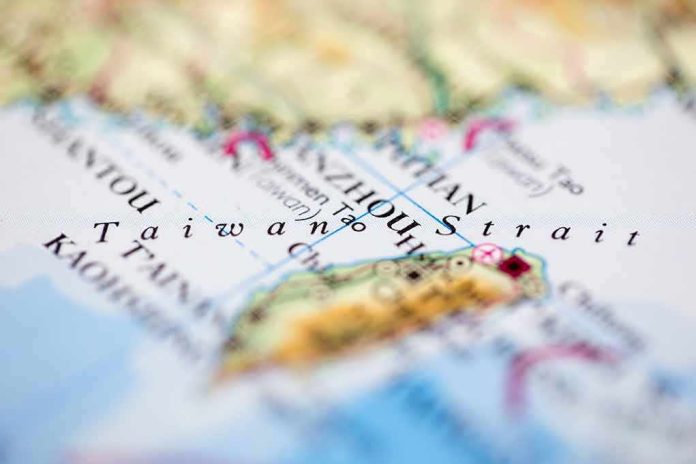
Geography makes Antelope consequential. It lies in the Paracels’ Crescent group, roughly 175 nautical miles southeast of Hainan’s Sanya Naval Base, the southern bastion for the PLA Navy’s South Sea Fleet and a homeport for submarines and major surface combatants. That proximity enables short, protected logistics loops—fuel, munitions, spare parts—from the mainland’s industrial depth. It also lets coast guard and maritime militia units shuttle quickly to contested grounds, shrinking response times relative to Vietnam and the Spratlys. From an operational perspective, a forward pad at Antelope complements Woody Island and other Paracel sites to create overlapping sensor coverage and ready anchorages, strengthening day-to-day presence and crisis surge capacity.
This positioning is not about drawing new legal lines—artificial islands do not generate maritime zones—but about enforcing preferred behavior where lines are disputed. A quay, a helipad, and a long pad for mobile radar can change who arrives first, who sees first, and who can stay longest. Control in practice, not entitlement on paper, is the point.
Dual-Use by Design: How Civilian Fixtures Become Military Enablers
Weather stations and communications masts become targeting-quality sensors when networked to mainland command. Search-and-rescue hangars fit medium transport or anti-submarine helicopters. A “research pier” takes a coast guard cutter as easily as a survey boat. Hardened “storage” buildings are indistinguishable from missile magazines in satellite imagery until doors open. This is why analysts, assessing Antelope’s scale and reclamation pattern, forecast the likely addition of a runway, robust radar, hardened shelters, and pier works—features that China has built before and will rationally replicate to achieve similar effects.
None of this requires overt declarations. The South China Sea portfolio has long relied on plausible deniability at the point of construction, followed by incremental capability accretion. Once the land is there, the marginal cost of up-arming is low and the timeline is short. The strategic logic is durable because it works: presence begets normalcy, normalcy begets deference.
Strategic Payoff: From Daily Patrols to Crisis Leverage
In peacetime, Antelope Reef will help thicken the on-scene mix of Chinese actors: navy, coast guard, and the maritime militia that shadows and shapes foreign behavior short of open conflict. In a crisis—especially one centered on Taiwan—the same nodes complicate U.S. and allied planning. Forward sites in the Paracels can extend radar and electronic-warfare coverage, host helicopters and unmanned systems, and stage interceptors or missile batteries that force expeditionary forces to maneuver, defend, and delay. That time tax matters. A public defense study summarized the effect succinctly: China’s South China Sea outposts can delay and constrain foreign forces during a Taiwan contingency, creating a window for amphibious landings or blockade operations.
Seen this way, Antelope is not a fortress to be held at all costs; it is a lever that shifts the surrounding battlespace in China’s favor. It denies clean intelligence pictures, introduces attrition risks, and narrows the opponent’s menu of low-risk options. Even if never fired in anger, the outpost can do strategic work.
Satellite images from CSIS, a Washington-based security think tank, reveal China has quietly reclaimed 1,458 acres of land at Antelope Reef, launching its largest artificial island buildup in nearly a decade. What Beijing officially claims is a modest civilian weather station is… https://t.co/A0NkhoW0RS pic.twitter.com/DoypZFkkSz
— UnveiledChina (@Unveiled_ChinaX) August 19, 2026
Why the Civilian Narrative Persists—and Why It Convinces Few Outside China
Beijing’s consistent civilian framing is part diplomacy, part lawfare, and part domestic politics. It dampens immediate escalation risks, contests international narratives that cast China as a spoiler, and aligns with a sovereignty story deeply entrenched at home. But credibility hinges on patterns, and the external record is clear: earlier “civilian” features yielded airbases and missile sites; the same construction signatures are visible again at Antelope. That is why mainstream reporting and expert analysis converge on the assessment that Antelope will function as a dual-use base enhancing China’s military posture, regardless of public denials.
This is not unique to China; great powers often wrap hard-power infrastructure in soft-power language. The distinguishing factor here is scale, speed, and the chosen theater—a semi-enclosed sea with dense, overlapping claims where physical faits accomplis are hard to reverse and easy to normalize.
What to Watch Next
Three indicators will reveal Antelope’s trajectory. First, runway grading: sustained linear earthworks of 2,500–3,000 meters would telegraph fixed-wing ambitions. Second, sensor masts and domes: large-aperture radars and satellite communications terminals indicate integration into regional air and maritime surveillance networks. Third, hardened construction: blast-resistant revetments, magazines, and buried fuel lines shift the site from presence to persistence under threat. Any one could be defended as “safety” or “communications,” but in combination they define a military outpost in all but name—and would fit the pattern seen across earlier features.
Sources:
feedpress.me, reuters.com, defensenews.com, nytimes.com, thetrumpet.com, en.wikipedia.org, youtube.com