
Presidential name-changing can bend federal nomenclature and flood a news cycle, but it cannot rewrite a state’s legal identity; the “New America” talk about New Mexico is a symbolic gambit colliding with hard constitutional limits and a state’s deep sense of self.
The Short Version
- Trump publicly signaled support for renaming New Mexico to “New America,” but offered no formal policy or legal pathway.
- New Mexico’s elected leaders rejected the idea outright, framing the name as core to the state’s history and culture.
- Presidents can influence federal naming conventions for features and facilities; they cannot unilaterally change a state’s name.
- The episode fits a broader pattern in which renaming serves as high-visibility symbolism with low immediate legal effect.
What actually happened: a symbolic push, not a legal process
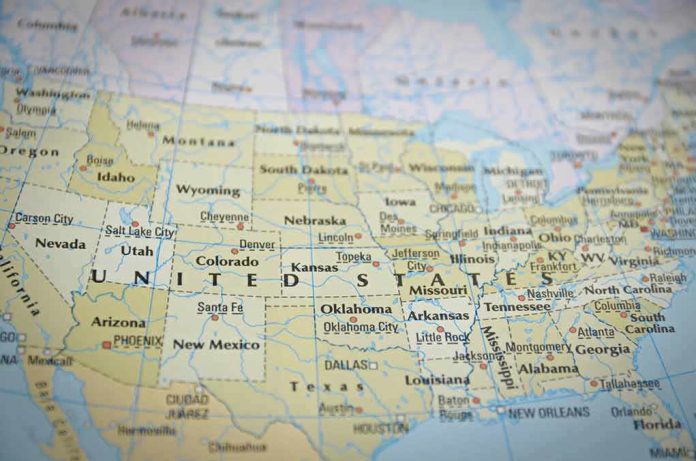
President Trump posted an image of a New Mexico map with “Mexico” crossed out and “America” written in—an unmistakable nod to rebranding the state as “New America.” Subsequent coverage quoted him saying he “loves” the idea, and reporting indicated the White House amplified the map on its official account. That is the factual foundation: a presidential social-media signal and official amplification, not a policy document or rulemaking. None of the reporting showed an executive order, draft bill, or administrative filing to initiate a state-name change; contemporaneous accounts explicitly note there was no formal proposal or explanation from the White House about process or legal authority.
In other words, we have symbolism—deliberate and attention-commanding—but not state action in the legal sense. The distinction matters. Federal nomenclature can be changed inside the executive branch; a state’s name cannot.
The legal boundary: presidents can rebrand federal nomenclature, not state identities
Modern presidents, including Trump in his current term, have leveraged executive directives to steer how federal agencies label geographic features, facilities, and programs. Executive Order 14172, for example, asserted the “Gulf of America” in place of the Gulf of Mexico for federal usage and pushed related changes to federal naming processes. That move had instant salience—maps, signage, agency stylebooks—because executive control reaches the internal language of the federal bureaucracy. Similar attempts surfaced around Lake Ontario, where an order directed federal agencies to use “Lake America;” state and Canadian authorities, however, rejected the renaming on their own maps and communications, underscoring the jurisdictional limit of Washington’s pen over shared or state-managed names.
Those precedents illuminate the New Mexico episode. The U.S. Board on Geographic Names, Interior Department policy, and executive orders can shape federal labels for features; none of that reaches the legal name of a U.S. state. Renaming a state implicates constitutional federalism and would require legislative pathways and state assent; a president cannot accomplish it by executive fiat. The reporting around New Mexico accurately reflects this hard stop: no mechanism was invoked because none exists inside the unilateral executive toolbox.
Why New Mexico pushed back so quickly—and why that response matters
New Mexico’s leaders answered as guardians of identity and jurisdiction. Governor Michelle Lujan Grisham rejected the premise on historical grounds—“it’s been ours since before the United States existed”—and framed the White House’s mapping flourish as unserious government. Members of the state’s congressional delegation closed ranks: “Oh hell no,” Representative Melanie Stansbury wrote; Representative Gabe Vasquez warned against erasing name, history, and culture; Senator Martin Heinrich pledged to call New Mexico by its “actual name”. Their responses did more than clap back online. They reasserted the state’s power to define itself in law and language and signaled that even as federal style guides can be rewritten, state sovereignty over its own name is not up for negotiation.
This is not merely rhetorical. For a state name to change, political consensus would have to coalesce across the state legislature, its electorate in many states via referendum, and Congress where applicable, with complex downstream updates to constitutions, statutes, compacts, and intergovernmental records. The Albuquerque Journal’s reporting captured the essential point: there was no formal proposal to trigger any of that machinery.
The pattern: symbolic renaming as political instrument
Trump’s “New America” signal tracks with a broader campaign to put an America-centric—or Trump-centric—stamp on geography and institutions via executive instruction and social media theater. Scholars and policy analysts have documented the growing use of presidential tools to steer names through the federal bureaucracy, and the accompanying expansion of influence over the U.S. Board on Geographic Names during Trump’s term. The attraction is obvious: it is a low-cost, high-visibility lever. Names reshape what people see on agency websites, federal maps, and plaques—consequences that are culturally potent, even when legal effects are thin. The backlash to federal renaming of shared or state-linked features—like the resistance to “Lake America”—shows both the limits and the political yield. Even when nothing legal changes at the state or binational level, the fight dominates airtime and rallies a base that reads the move as assertive nationalism.
That logic is likely at play in the New Mexico moment. A presidential post invites defenders and detractors into the same arena; the White House repost magnifies it; and within hours the debate pivots from whether the president can do it (he cannot, not unilaterally) to whether the identity claim should stand. As a mechanism for agenda-setting, it works. As a mechanism for changing a state’s name, it does not.
What would it actually take to rename a U.S. state?
Strip away the spectacle and the path is straightforward in principle, punishing in practice. State constitutions and statutes would need revision; election law, tax codes, court rules, and countless administrative references would require synchronized updates; interstate compacts and federal statutes naming the state would need amendment. Congress has historically admitted, divided, or renamed territories and states through legislation; any modern attempt to rename a state would almost certainly require state approval and federal legislative action to reconcile the national code with the new designation. No current reporting shows even a first step toward that gauntlet in New Mexico’s case.
The takeaway for readers who care about law, maps, and power
Names are not trivia; they are jurisdiction and memory compressed into a word. Presidents can move quickly to change the federal words that appear on maps and signs, and Trump has done so to conspicuous effect. But when a name is the legal identity of a sovereign state, the president’s post is a provocation, not a predicate. New Mexico’s leaders treated it accordingly—rejecting the story at the level where it actually lives: politics, not law. If future episodes follow the same script—federal renaming of features, social-media escalation around bigger canvases—expect recurring skirmishes over symbolism with real cultural stakes and bounded legal reach.
Where the evidence is strongest—and where it is not
The reliable core is narrow and sufficient: Trump’s social-media signal, the White House amplification, and the absence of a formal process. New Mexico officials responded on the record and immediately. That is the story. Attempts to treat the post as an operative policy founder on constitutional and procedural realities, which the best reporting makes plain. In that light, the “New America” phrase functions as a message, not a motion—consistent with a presidency that has made federal naming a vivid instrument, and equally consistent with a federalism that keeps state names out of reach.
Trump posts map renaming New Mexico to 'New America' https://t.co/NePrvW3eOG
— The Detroit News (@detroitnews) September 7, 2026
Implications: durable symbolism, durable limits
Expect continued salvos in the naming arena because the incentives line up: quick execution inside federal agencies, reliable media oxygen, intense emotional resonance. Also expect the same limits to hold. Federal naming will keep colliding with states’ identities, tribes’ historical claims, and international usage; where jurisdictions overlap, maps and institutions will diverge rather than converge. New Mexico’s firm “no” is not an outlier; it is the equilibrium when symbolic federal rebranding meets sovereign statehood.
Sources:
kob.com, aol.com, mediaite.com, snopes.com, wionews.com, centsondollar.com, thedailybeast.com