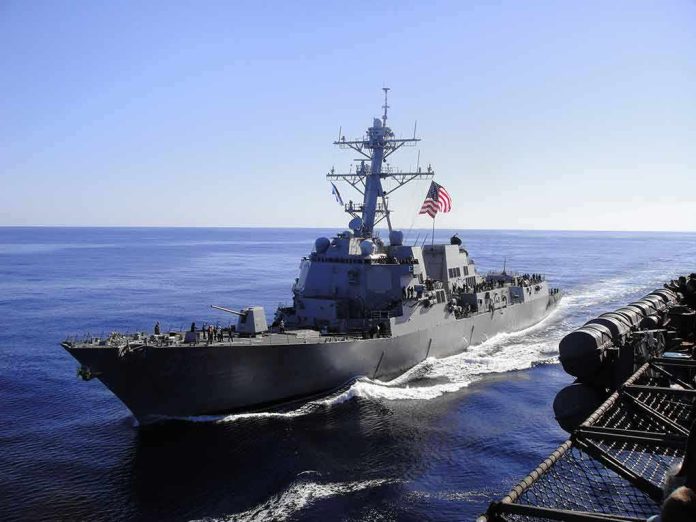
The Black Sea just delivered a watershed: a Ukrainian uncrewed surface vessel engaged and destroyed a Russian uncrewed surface vessel at sea, an all-robot duel that marks the arrival of drone-on-drone naval combat as an operational reality rather than a thought experiment.
At a Glance
- Ukraine’s Navy says a Sargan-3000 sea drone detected and destroyed a Russian unmanned surface vessel (USV) in the Black Sea using a remote 12.7mm weapon station.
- Officials framed the encounter as the first-ever naval battle between drones, shifting USVs from strike tools to counter-USV hunters.
- The engagement fits a broader pattern: uncrewed systems are reshaping Black Sea operations and pushing traditional fleets to adapt or withdraw.
- Ukraine’s maritime drone record—documented attacks on larger Russian vessels—sets the precedent for credible offensive capability at sea.
What Happened: A Robotic Intercept Turns Lethal
According to the Ukrainian Navy, a Sargan-3000 uncrewed surface vessel located a Russian USV in the Black Sea and destroyed it with a remotely operated 12.7mm weapon station—essentially a stabilized, networked machine-gun turret integrated into the drone’s fire-control suite. The operation was described as a coordinated effort with Ukraine’s Defense Intelligence, implying a sensor-to-shooter chain that fused spotting, target classification, and intercept into a single, rapid sequence. Multiple outlets carried the same core account, including the platform type, the weapon used, and the all-uncrewed nature of both combatants. The War Zone’s technical summary echoed the Navy’s claims and emphasized the novelty of a USV configured not just to strike crewed ships but to hunt and kill another USV.
The “first-ever” framing matters less as a headline flourish than as a doctrinal milestone. Until now, naval USVs were best known for kamikaze attacks against larger hulls; here, a gun-armed USV executed a counter-USV kill, a different mission profile with different demands on sensors, stabilization, and fire control. It signals that drone boats are expanding their portfolio from asymmetric strike to sea-control and area denial against robotic threats.
How It Works: From Remote Sensor to Remote Weapon
A USV-on-USV engagement compresses the kill chain. Detection can come from offboard assets—airborne ISR, coastal radar, electronic support measures—or onboard electro-optical and infrared sensors mounted on the USV itself. To prosecute a small, fast, often low-signature boat, the shooter must maintain track continuity through sea clutter and maneuver, then stabilize a weapon—here a 12.7mm (0.50-caliber) remote weapon station—against pitch and roll to put accurate bursts on target. Remote weapon stations couple gyrostabilization with fire-control algorithms; on a USV, they depend on a robust data link to an operator ashore or on another platform and on autonomy layers that hold course and aim while human operators make engagement decisions. The Sargan-3000’s configuration, as reported, reflects an emphasis on precision and persistence rather than one-way explosive payloads.
That choice is strategically telling. Gun-armed USVs can intercept and attrit opposing drone swarms at lower cost per shot than missile-armed platforms, and without the logistics of explosive-laden suicide craft. They can loiter, screen high-value assets, and sanitize approach lanes—missions closer to traditional patrol and picket roles, now performed by expendable robots. It is sea keeping and marksmanship turned into software and servos.
How We Got Here: The Black Sea as a Drone Laboratory
Since 2022, Ukraine has iterated rapidly on maritime drones, first to threaten and then to dislocate portions of Russia’s Black Sea Fleet. These systems—low-signature, low-cost, networked—have imposed disproportionate risk on larger warships, contributing to a recalibration of Russian naval posture away from exposed anchorages and toward safer waters. Reuters and others have chronicled the visible consequences: ad hoc anti-drone fittings on commercial and naval hulls, altered patrol patterns, and a defensive crouch that reflects the new economics of sea denial.
The record of successful Ukrainian sea-drone strikes, including high-profile attacks against Russian patrol ships like Sergey Kotov, built the credibility scaffold for claims of new capabilities; confirmed or widely reported incidents demonstrated that uncrewed platforms could navigate long distances, evade defenses, and deliver lethal effects. Against that backdrop, the Sargan-3000’s shift from strike to counter-swarm duty feels like a natural next step in a theater where initiative belongs to the side that iterates faster.
Why This Engagement Matters: From Asymmetry to Counter-Swarm Doctrine
Calling this the first naval battle between drones is not just branding. It marks the moment uncrewed vessels move from adjuncts of sea denial to protagonists in sea control. A USV able to detect, classify, and gun down another USV introduces a layer of robotic picket defenses that can screen coastlines, ports, and shipping lanes without risking crews. It also compels the adversary to harden its own drones—better sensors, evasive behaviors, countermeasures—kicking off an offense-defense cycle that will look familiar from the evolution of aerial drones over the last decade.
For navies, the implications are concrete. Surface combatants will need organic counter-USV capabilities—short-range guided munitions, programmable airburst rounds, directed-energy prototypes, and their own escorting USVs. Command-and-control architectures must accommodate mixed human-machine teams where autonomy handles station-keeping, sensor fusion, and ballistic stabilization, while human operators arbitrate fires. Logistics, too, will shift: ammunition, spare parts, and data links become as decisive as hull steel.
Where the Real Debate Is: Scaling, Survivability, and Rules
The most consequential questions now pivot from can to how fast. First, scaling. Gun-armed USVs can be mass-produced and networked; the winning side will field not one Sargan-like craft, but layered constellations acting as mobile tripwires and interceptors. Second, survivability. Small robot boats must operate amid jamming, spoofing, and physical interception by helicopters, fast attack craft, or their robotic peers. Expect countermeasures—from low-cost decoys to dazzlers and loitering munitions—baked into future designs.
Third, rules and risk. Maritime law and rules of engagement lag behind. When uncrewed platforms engage near commercial traffic or straits, attribution and escalation control become harder. Civil shipping has already adapted with improvised protections and routing changes in response to drone threats; the spread of counter-USV patrols will add another variable to maritime risk calculations for insurers and operators. One brief caveat belongs here: the “first-ever” label is presented by Ukrainian sources and widely echoed by media; in a domain where covert incidents can remain unpublicized, historians may someday unearth antecedents.
What Comes Next: A New Baseline for Naval Operations
The decisive change is psychological as much as technical. Once navies accept that uncrewed boats will fight each other as a matter of course, they will plan around robotic picket lines, autonomous escorts, and machine-speed skirmishes that shape when and where crewed combatants dare to sail. Procurement will follow: stabilized guns and precision fuzes tuned for low-profile surface targets; compact sensors that can survive salt, shock, and jamming; and software that turns a handful of drones into a coherent screen.
The Black Sea remains the proving ground. Ukraine’s claim that a Sargan-3000 hunted and destroyed a Russian USV sets the baseline: robots are now doing at sea what they already do in the air—finding, fixing, and finishing their robotic adversaries. In naval warfare’s next chapter, the first contact may be sensor glare on a remote console, and the first shot a stabilized burst from a boat with no one on board.
Sources:
newscientist.com, pbs.org, newsukraine.rbc.ua, kyivindependent.com, pravda.com.ua, maritime-executive.com, cnn.com, yahoo.com