

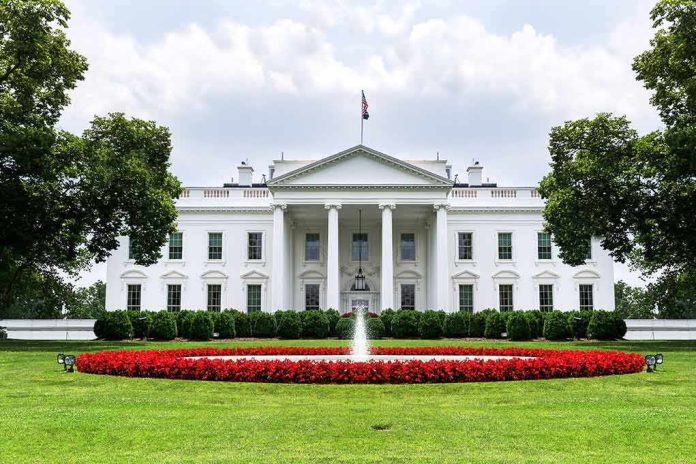
State visits are instruments, not ornaments: when a U.S. president extends full honors to a rival power’s leader, the choreography itself communicates hierarchy, intent, and red lines before a single communique is drafted.
At a Glance
- President Trump will host China’s President Xi Jinping and Madame Peng Liyuan at the White House for an official state visit anchored by a full-honors arrival, bilateral talks, and a State Dinner.
- The itinerary includes Trump greeting Xi at Joint Base Andrews, a protocol flourish reserved for select guests to underscore relationship management at the highest level.
- Substantive talks are expected to cover trade and tariffs, technology and AI guardrails, supply-chain security (including rare earths), and strategic stability across flashpoints.
- State visit protocol—arrival ceremony, troop review, and State Dinner—functions as strategic signaling and fits a long historical template for U.S.–China summits.
What is set and why it matters
The White House has designated Xi Jinping’s Washington trip as an official state visit, naming the Chinese leader and his wife, Peng Liyuan, as guests of President Trump and First Lady Melania Trump for a Thursday program that includes a full-honors welcome and a State Dinner in the East Room. Officials have also previewed a rare gesture: Trump greeting Xi at Joint Base Andrews upon arrival, a choice that elevates ceremony into strategy by signaling priority and personal investment at the outset of negotiations. Beijing, for its part, has confirmed the visit’s dates across the same window, reinforcing the formal, reciprocal character of the engagement.
The symbolism is not theater for its own sake. In great-power diplomacy, the grammar of a state visit—sequencing, visuals, who meets whom and where—shapes expectations, controls atmospherics, and can unlock or foreclose options once principals sit down to talk. In other words, the optics are also policy work, executed in public view.
The mechanics of a U.S. state visit, and why protocol is policy
Under U.S. diplomatic practice, a state visit is the apex format for head-of-state engagement: a South Lawn arrival with military honors, review of troops, restricted and expanded bilaterals, and a State Dinner hosted by the president. The Chief of Protocol orchestrates each element to convey parity, respect, and agenda seriousness as perceived by both domestic and foreign audiences. The difference between a “working visit” and a “state visit” is not semantic; it is the hierarchy that tells allies and adversaries how Washington ranks this relationship in the current strategic moment.
When China is the counterpart, the template is well established. From Deng Xiaoping’s 1979 official visit through Hu Jintao’s and Xi Jinping’s prior U.S. state visit in 2015, the United States has used pageantry to bracket hard talks—linking ceremony to substance as a deliberate tool of statecraft. The result is a hybrid event: part theater, part negotiation frame, and wholly consequential, because each staged moment socializes elites and publics to the idea of managed rivalry rather than unconstrained confrontation.
The agenda beneath the pageantry
Summit agendas between Washington and Beijing move on predictable rails because the structural issues are durable. Trade and tariff architecture remains the front door; even modest adjustments can transmit price signals across global supply chains. Reports ahead of the visit flagged the potential for tariff recalibration as negotiators explore relief on targeted lines to dampen consumer-price pressure while preserving leverage in strategic sectors. The most complicated file is technology—semiconductors, AI, export controls, and data regimes—where both sides are testing the boundaries between de-risking and decoupling. Expect any discussion of AI to blend principle-setting (notification and incident protocols) with domain-specific guardrails around dual-use applications that could destabilize crises if misused or misunderstood.
Resource security is another load-bearing topic. China’s command of rare earth processing—the chokepoints that convert ore into usable inputs for everything from smartphones to fighter jets—remains an asymmetry that Washington is trying to blunt through diversification, stockpiling, and allied industrial policy. In summit-speak, this shows up as “resilient supply chains,” but the underlying mechanics are coercion resistance: reducing single-point vulnerabilities while keeping markets open where interests align. Finally, the strategic layer girds it all: cross-Strait stability, maritime incidents avoidance, and crisis communications. The most successful summits don’t issue grand bargains; they produce practical habits of contact that avert miscalculation when a bad day arrives.
Why a rare airport greeting matters
Presidential greetings at the airport are not routine; they are a high-signal gesture traditionally deployed to telegraph exceptional regard or to recalibrate tone ahead of a difficult conversation. For a relationship as freighted as the U.S.–China rivalry, Trump meeting Xi at Joint Base Andrews places personal diplomacy up front, with the intended effect of “banking” goodwill and compressing the distance from protocol smiles to hard bargaining across the table. Coverage has correctly emphasized the rarity of this move because it fits the long American practice of using ceremony to manage competitive coexistence—affirming status while contesting behavior.
Comparing to prior U.S.–China state visits
Xi’s 2015 state visit with President Obama followed the same backbone—arrival honors, bilaterals, State Dinner—set against a different balance of issues: cybersecurity, climate, and maritime risk topped the docket then, and produced discrete deliverables such as cyber-theft understandings that, while imperfect, created reference points for enforcement and naming-and-shaming. The continuity here is not cosmetic. State visits create repeatable venues in which each side learns the other’s domestic constraints and diplomatic red lines, knowledge that lowers friction in subsequent crises. From Deng’s 1979 Washington debut to today, the format has proved resilient precisely because it is both spectacle and structure.
The State Dinner as convening power
The guest list for a State Dinner is a policy instrument wearing a tuxedo. Seating arrangements and invitations draw in corporate chiefs, financiers, researchers, and cultural figures whose presence signals the sectors Washington wants engaged. Reporting indicates that top U.S. technology leaders are among the invitees for this dinner, a choice that spotlights the contested frontier—AI, chips, platforms—where competition is fiercest and cooperation, if any, must be tightly defined. In this sense, the East Room becomes an extension of the negotiating table, with the soft influence of peer conversation complementing the formal exchanges earlier in the day.
Chinese President Xi Jinping and President Donald Trump will meet at the White House Thursday during the first state visit by a Chinese leader to Washington in 11 years.https://t.co/V4j8edJs8V
— The Well News (@TheWellNews) September 21, 2026
What to watch after the motorcades leave
Outcomes worth attention are rarely encapsulated in a single headline. Look for: narrowly tailored tariff moves that relieve pressure without abandoning leverage; the articulation of AI risk-notification channels or expert working groups; language on supply-chain resilience that translates into specific joint, allied, or parallel investments; and, above all, crisis-communications commitments that reduce the odds of escalation in the Western Pacific. If the visit accomplishes these bounded aims, it will have validated the enduring logic of a state visit: use carefully staged respect to create room for clear-eyed negotiation inside a rivalry that demands both steadiness and steel.
Sources:
humanevents.com, forth.news, unn.ua, briefs.co, indiatoday.in, thestar.com.my, ua.news, wtop.com, chosun.com, nsarchive.gwu.edu, en.wikipedia.org