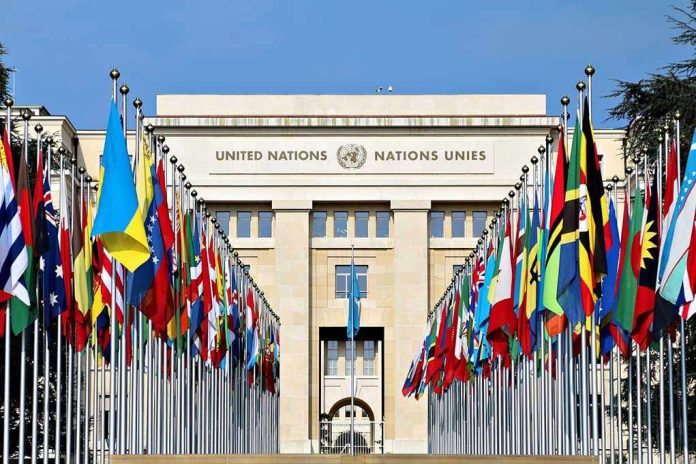
At the United Nations, Iran’s leaders have cast their war posture in the oldest legal language available to a state under fire: self-defense. The significance is not rhetorical flourish but legal positioning. In conflicts where both sides invoke Article 51 of the UN Charter, the argument turns less on who shouts “aggressor” loudest and more on whether force answered an armed attack and stayed within the boundaries of necessity and proportionality. Iran’s UN case plants its flag there, with defiance calibrated to diplomacy, and invites judgment against that standard.
At a Glance
- Iran’s president used the UNGA to claim Iran is responding in self-defense to U.S. and Israeli attacks, rejecting the “terrorist” label.
- Tehran’s message paired refusal to surrender with an explicit insistence that diplomacy remains the preferred path.
- Washington’s legal position likewise invokes Article 51, asserting both individual and collective self-defense with Israel.
- The real test lies in international law’s criteria: armed attack, necessity, proportionality, and timely Security Council reporting.
Iran’s UN Message: Defiance anchored to a legal theory of self-defense
In his General Assembly address, President Masoud Pezeshkian distilled Tehran’s line into a few hard sentences: Iran has been attacked, Iran is not a terrorist state, and Iran will defend itself without asking permission. He displayed photographs he said were victims of U.S. and Israeli strikes, including children, to drive home that Iran’s actions answer unlawful violence against civilians. He framed the public stance as resilient but not maximalist—Tehran “would not surrender,” yet diplomacy “remained the way forward.” That pairing matters: it is the signature of a government staking a legal claim while keeping channels open to negotiate its way out of escalation.
This rhetoric did not appear out of thin air. Before traveling to New York, Pezeshkian promised to “firmly defend” Iran’s positions in international forums and to use the UN to present “the plight of the Iranian nation.” That pre-brief foretold a speech that would reject capitulation, reject the terrorist label, and reject the idea that Iran requires external leave to respond to attacks—an argument designed to fit within the Charter’s architecture of defensive force, not outside it.
How self-defense claims are judged: armed attack, necessity, proportionality, and process
International law on the use of force is crisp in text and fraught in application. Under Article 51 of the UN Charter, states may use force in self-defense only “if an armed attack occurs,” and any defensive measures must be necessary and proportionate to that attack; they must also be reported to the Security Council. Where states disagree is in applying those tests to complex fact patterns: what counts as the triggering armed attack, how imminent a threat must be to justify anticipatory moves, which targets and magnitudes of response remain “proportionate,” and whether reporting obligations are met in good faith and on time.
Iran’s UN posture is built to satisfy that template: characterize incoming attacks as unlawful and indiscriminate, present responsive force as strictly defensive, and argue that larger regional violence—especially in Gaza—provides context for Iranian measures against those enabling harm to Iranian civilians. The United States advances an equally formal claim, asserting it acts both in its own defense and in collective self-defense of Israel, and that Israel was already exercising its lawful right of self-defense against Iran. In other words, both sides are inside the same legal frame; they disagree on which facts trigger it and how far it extends.
The evidentiary gap: a legal frame without the documentary spine
A claim of self-defense stands or falls on evidence. That means incident-level documentation: dates and coordinates, munitions attribution, casualty lists, chain-of-custody forensic analysis of fragments, and timely Article 51 letters that map specific strikes to specific threats. In the public record around this UN speech, what is strongest is the message discipline—Tehran’s insistence it is answering attacks, not initiating them—and what is thinnest is published, independent corroboration of each cited incident and its legality. Photographs of victims, while powerful, are not the same as an investigator’s report tying a blast pattern to a platform and a chain of command.
This is not unique to Iran. In high-velocity conflicts, governments habitually race ahead of verification. The result is a familiar asymmetry: grand claims at the podium, granular evidence lagging behind. For Tehran to move its argument from politically resonant to legally authoritative, it would need to surface Security Council filings, incident reports, and third-party forensics that connect asserted attacks on civilians to identifiable U.S. or Israeli systems and then show that Iran’s responses remained necessary and proportionate to those attacks.
Diplomacy as instrument, not afterthought
One overlooked feature of Pezeshkian’s UN line is that openness to diplomacy is not a softening so much as a tactic consistent with self-defense doctrine: when the law confines you to force that repels and stabilizes rather than punishes or coerces, negotiations aren’t a concession; they are the logical end-state of lawful defense. Saying “we will not bend the knee” while affirming talks signals that Tehran reads endurance and bargaining as complementary, not contradictory. That framing was foreshadowed by Iranian messaging ahead of the UNGA and reinforced on the floor: the door remains open, but Iran will not suspend what it calls its right to defend its people in the meantime.
For outside observers, the practical test of that stance is concrete: Do channels stay open? Do retaliatory cycles narrow rather than widen? Do statements of defensive intent track with verifiable choices on target selection and restraint? Those are the markers that separate a defensive strategy from a maximalist campaign dressed in defensive language.
Competing legal narratives, same Charter
Washington’s case is equally Charter-grounded: the United States says it responds to ongoing attacks and threats emanating from Iran and acts alongside Israel in collective self-defense. That position relies on a theory of continuity—that prior and current hostilities constitute an ongoing armed attack—and on the permissibility of assisting an ally already under attack. The State Department’s legal adviser has explicitly mapped that logic to the UN framework, emphasizing that Israel’s actions originated as self-defense and that U.S. measures meet the same standard.
When two adversaries both speak Article 51, the decisive questions become empirical. Which incidents count as armed attacks attributable to a state? Which responses matched the scale and nature of those attacks? Were Security Council notifications timely and sufficiently specific? Until those are answered by documentary records or credible investigations, the legal contest remains contingent—each side fluent in the Charter, each staking legitimacy on facts not yet fully adjudicated.
Trump: annihilate Iran
Pezeshkian at the UN: we won't bend the kneesame week: 3-hour shuttle talks
same week: Hormuz still lockedthreats for midterms
defiance for Tehrandiplomacy with the volume maxed 🚨 pic.twitter.com/HPdC9CFwhF
— rishabh (@rishabhxAi) September 23, 2026
What would settle the argument
Three categories of proof would transform assertion into judgment. First, the Security Council docket: Article 51 letters, annexes, and timelines that show who reported what, when, and on what evidentiary basis. Second, independent, incident-level forensics—satellite imagery, crater analysis, weapons remnants, and geolocated media—tying attacks on civilian objects to specific actors and munitions. Third, proportionality assessments that match each retaliatory strike to a concrete military objective linked to the initiating attack rather than to broader punishment or coercion. Without those, the debate remains high law over thin record.
Sources:
yahoo.com, cnbc.com, ground.news, indiatoday.in, pbs.org, en.mehrnews.com, gulfnews.com, idahostatejournal.com, abcnews.com, ynetnews.com