

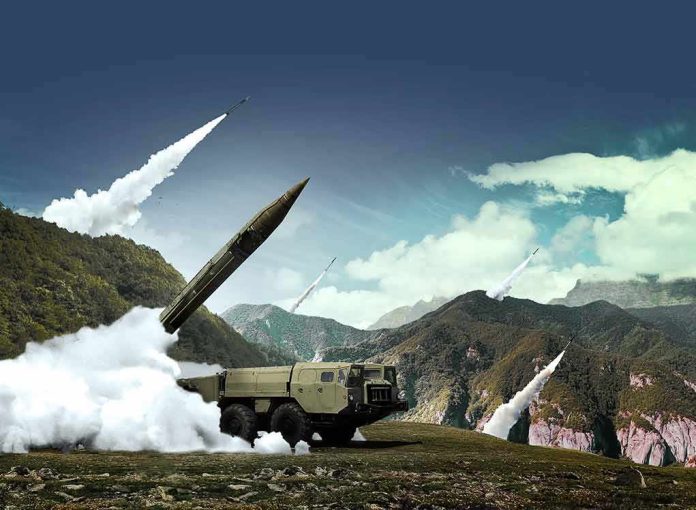
In the Gulf, missiles and oil prices move on the same logic: deterrent signaling that stays just short of catastrophe, yet reliably taxes the world’s most vital commodity with a premium for risk that never fully disappears.
The Short Version
- Iran’s large April 2024 strike on Israel was publicly framed as retaliation and bounded in scope; most projectiles were intercepted, underscoring a signaling function more than a bid for mass destruction.
- Tehran’s messaging promised conditional de-escalation if Israel did not respond in kind, consistent with a deterrence logic rather than open-ended war.
- Regional governments and international leaders still labeled the volleys destabilizing, warning of spillover and a widening war—language that markets heed when pricing oil risk.
- This dance—retaliate, calibrate, warn—keeps oil sensitive to headlines, but the structural risk resides in chokepoint exposure, layered missile defenses, and proxy reach around the Strait of Hormuz.
How the strike–response pattern actually works
When Iran launched hundreds of drones and missiles at Israel in April 2024, it declared the operation retaliation for an Israeli strike on Iranian commanders in Damascus; its UN mission called the salvo “closed” unless Israel escalated further. Much of the wave was intercepted, including by U.S. and regional partners, with only light damage reported to one Israeli military site—evidence that the operation was calibrated for strategic signaling more than mass-casualty effect. Iran’s armed forces chief then warned of a larger response only if Israel retaliated, which embeds a conditional de-escalation ladder directly in the public messaging.
Markets read these episodes through probabilistic lenses. A bounded strike lowers the immediate expectation of runaway war, yet it also affirms a new normal: long-range exchanges can be mounted quickly and publicly justified as “retaliation,” with room for either side to pause or climb. That two-way optionality is precisely what traders pay for in the form of a persistent geopolitical premium on crude futures.
Oil’s real vulnerability: chokepoints and system-wide spillover
Price spikes seldom come from single barrages; they come from credible threats to infrastructure or transit. Roughly a fifth of globally traded oil flows through the Strait of Hormuz, alongside critical LNG volumes. Even when missiles never approach tankers, each escalation forces shipowners, underwriters, and charterers to re-price voyages that traverse Iranian littorals and Gulf export terminals. Parliamentary and think-tank assessments over the past decade converge on a simple truth: crisis signaling around the Gulf is inseparable from maritime risk, and preemptive or retaliatory launches can increase miscalculation at sea, exactly where insurers and captains are most conservative.
Layer in the proxy map—Yemen’s Houthis astride the Red Sea approaches, Iranian-aligned militias with reach into Iraq and Syria, and Hezbollah’s arsenal hemming the Levant—and you get multiple avenues for second-order disruption. None requires a direct attack on a tanker; a credible threat to ports, pipelines, or patrol craft can change routing decisions overnight. That is why even “contained” Iran–Israel exchanges register in crude curves.
Signals, not slogans: retaliation, deterrence, and market interpretation
States rarely admit to “coercive bargaining,” but the public record around April 2024 fits a well-studied pattern in Middle Eastern crisis management: governments couch long-range strikes as retaliatory and defensive, yet design them to shape an adversary’s expectations about future pain. Iran’s line—whoever harms us, we will harm them—puts deterrence logic in plain sight, while the “matter is closed unless” clause sketches a ladder for stand-downs. The low realized damage, thanks to layered interceptions by Israel, the U.S., Jordan, and others, is consistent with calibrated signaling that still risks error and overshoot.
For energy, what matters is not a legal label—retaliation vs. aggression—but how much the action perturbs expectations of uninterrupted flow. The more episodes normalize high-tempo strike–defense cycles across multiple theaters, the more the average risk premium embeds in forward prices, irrespective of any single night’s outcome.
What the counter-voices get right—and where they overreach
Neighbors condemned Iranian launches as destabilizing and violative of sovereignty; Jordan reported intercepting inbound missiles and the UN chief warned of broader war risks. Those are not mere talking points; they map directly onto the mechanisms by which risk spreads: overflight, debris, nervous rules of engagement, and the possibility of drag-in. Markets have to price not just intent but friction—the way one misread radar return can cascade into a shipping advisory.
Where commentary sometimes runs ahead of evidence is in asserting a clean either/or: that strikes are either pure escalation or overture to peace. The public record around April 2024 is clear on retaliation and deterrence; it does not show a documented Iranian offer or a structured de-escalation trade tied to the launches. Nor does it prove a drive for territorial expansion. The prudent read for energy is agnostic about ultimate aims and focused on capacities, habits, and ladders of response—the things that repeat and therefore can be priced.
Implications for oil: near-term shocks, long-term premiums
Short run, the market scrutinizes three questions each time missiles fly. First, does the episode threaten a chokepoint or a major export terminal—in the Gulf, the Red Sea/Suez chain, or the Levant? Second, do insurers and navies alter posture in ways that slow loadings, add ballast days, or reroute around Africa? Third, does political rhetoric remove rungs from the de-escalation ladder, raising tail-risk of sustained conflict? When the answers trend yes, spot prices and nearby futures jump; when interceptions are high and messaging signals “bounded and done,” the spike fades but rarely to the prior baseline.
Longer term, three forces harden the geopolitical premium. One, missile and drone proliferation has outpaced classic area-defense economics; saturation attacks are cheaper to launch than to defeat, guaranteeing recurrent stress on air and missile defenses. Two, proxy entanglement means more actors can trigger episodes while principals claim restraint, complicating deterrence. Three, strategic ambiguity around red lines—consulates, senior commanders, infrastructure—keeps each tit-for-tat novel enough to unsettle insurers and desks anew.
What to watch next: signals that truly change the calculus
Several developments would move oil beyond the familiar whipsaw. A verified, third-party–mediated understanding that pairs limits on direct long-range exchanges with guarantees around maritime traffic would compress the premium; absent that, any documented broadening of target sets to energy facilities would expand it. Evidence that interceptions are degrading—whether from munitions quality, numbers, or defender fatigue—would raise the frequency and amplitude of spikes. Conversely, persistent, high-confidence interception across multiple fronts would teach markets that even headline salvos leave flows mostly intact, trimming the edge off each scare.
Finally, watch how governments talk after they shoot. When a state declares retaliation complete, links any further action to the other side’s next move, and avoids hitting energy infrastructure, the market hears bounded risk. When officials promise more “crushing” blows regardless of the adversary’s restraint, or when neighbors report spillover into their airspace, the market hears a ladder with rungs sawed off—and prices accordingly.
Sources:
youtube.com, reuters.com, researchbriefings.files.parliament.uk, aljazeera.com, cnn.com, theguardian.com