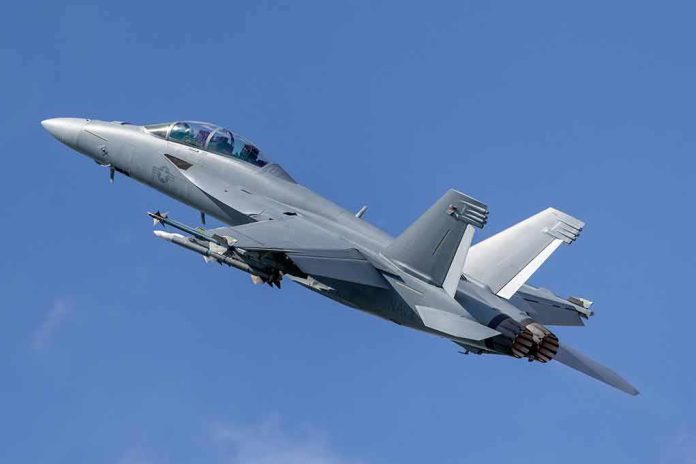
Canada’s first F-35 finally left the ground on September 23, 2026 — and the near-silence that greeted it says as much about the state of the program as the flight itself did.
Key Points
- The first Canadian F-35A, construction number AR-1, completed a roughly 90-minute maiden flight from Lockheed Martin’s Fort Worth, Texas plant on September 23, 2026, escorted by an F-35C chase aircraft.
- The jet will carry the designation CF-35A in Royal Canadian Air Force service, but this flight was a production and flight-test milestone, not a delivery to Canada.
- No ceremony or formal statement accompanied the event from Lockheed Martin, the RCAF, or the Prime Minister’s Office, even as defense outlets confirmed the flight occurred.
- The milestone lands inside an 18-month-old federal review of whether Canada should complete its planned 88-jet F-35 order, scale it back, or diversify toward alternatives like the Saab Gripen.
- It is Canada’s first new fighter aircraft type in 44 years, since the CF-18 entered service — a fact that raises the stakes of how the broader acquisition is ultimately resolved.
What Happened Over Fort Worth
Just before sunrise on September 23, AR-1 — the tail number assigned to Canada’s first production F-35A — lifted off from Naval Air Station Joint Reserve Base Fort Worth, the sprawling final-assembly complex where Lockheed Martin builds every variant of the Lightning II. The sortie lasted about 90 minutes, a standard duration for a first flight designed to validate flight controls, engine performance, and basic handling qualities before a jet is cleared for the more demanding test regime that follows. An F-35C, the Navy’s carrier variant, flew as chase plane, a routine safety practice on maiden flights that lets a second pilot visually monitor the new airframe for anything a cockpit sensor might miss.
The aircraft landed back at Fort Worth, exactly where it took off — a detail that matters more than it might seem. This was not a delivery flight to Canadian soil, nor a ferry flight to a training squadron. It was the manufacturer’s own verification step, the moment an airframe stops being a collection of subassemblies and becomes a flying weapons system. From here, AR-1 is expected to proceed through further test and acceptance work before eventually moving into the pilot-training pipeline that has typically routed Canadian F-35 crews through Luke Air Force Base in Arizona ahead of any transfer to a home station such as Cold Lake, Alberta.
The Program’s Long, Contentious Runway
To understand why a single test flight carries this much weight, you need the program’s backstory. Canada has been trying to replace its aging CF-18 fleet — itself now more than four decades old — since at least 2010, when the government’s initial sole-source plan to buy F-35s collapsed under cost-estimate controversy and a scathing Auditor General finding that National Defence had underestimated the jet’s full life-cycle costs. A competitive process eventually re-selected the F-35 anyway, and in 2023 Canada finalized an agreement to acquire 88 aircraft at an estimated cost of roughly $19 billion. Sixteen jets, including AR-1, were funded outright; work had begun on components for a further 14 before the politics shifted again.
That shift came in March 2025, when Prime Minister Mark Carney ordered a formal review of the entire acquisition, questioning whether the remaining 72 aircraft were still the right choice given deteriorating trade relations with Washington. Reuters reported in August 2025 that Canadian defence officials internally argued for sticking with the full F-35 order rather than splitting the buy, and the Auditor General’s own account of the file flagged cost growth since 2022, schedule risk, and gaps in risk management that could jeopardize the CF-35A’s timely introduction. Eighteen months later, that review has produced no published conclusion, leaving Canada’s most consequential defence procurement in years suspended between commitment and reconsideration.
Why the Official Silence Is the Real Story of the Week
A milestone like this would ordinarily draw a press release, a photo op, perhaps a minister’s statement about modernizing NORAD and NATO commitments. None of that happened. Lockheed Martin, the RCAF, and the Prime Minister’s Office all declined to mark the flight with any formal announcement, even as the RCAF confirmed to reporters that the test had taken place. That absence isn’t evidence the flight didn’t matter — it plainly did, as a genuine engineering and production milestone inside an active contract. But it does reflect the awkward political position Ottawa occupies: celebrating a fighter jet whose future order size remains an open question risks prejudging a review the government itself launched.
Canada’s first F-35A has taken to the skies 🇨🇦✈️
The RCAF first CF-35 aircraft, AR-1, completed its maiden flight on September 23 in Fort Worth, Texas — a major milestone as Canada prepares to replace its CF-188 Hornet fleet
📷 Eric Kilpatrick#RCAF #F35 #CAF #CanadianDefence pic.twitter.com/16chlCckj5
— Esprit de Corps Magazine (@edc_magazine) September 24, 2026
What Comes Next
The debate ahead is not about whether AR-1 can fly — it clearly can. It’s about how many more will follow it off the Fort Worth line for Canadian service. Advocates for staying the course warn that pivoting toward a mixed fleet or a 4.5-generation alternative like the Gripen would leave the RCAF flying a less capable platform into an era increasingly defined by fifth-generation stealth competition, even as Gripen’s backers tout domestic industrial jobs and reduced dependence on a single foreign supplier. Whichever way Ottawa ultimately decides, the sight of a Canadian-flagged F-35 climbing over Texas has made the choice concrete in a way years of budget debate never quite managed: the aircraft Canada is arguing about now actually exists, and it flies.
Sources:
theaviationist.com, europesays.com, ctcnews.ca, thenews.com.pk, defensehere.com, ctvnews.ca, militarnyi.com, armyrecognition.com, aviationnews.eu, defence-blog.com