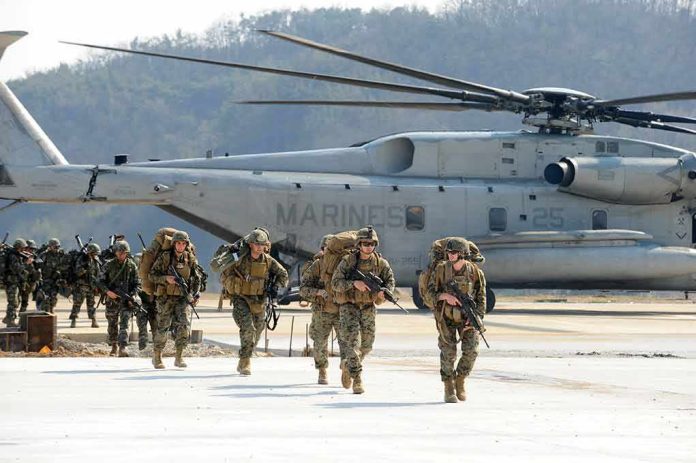
Strategic exits define a nation’s use of force as much as decisive entries do; the United States’ full withdrawal of troops from Iraq marks the close of a two‑decade military chapter and the start of a fundamentally different U.S.–Iraq relationship built around diplomacy, intelligence cooperation, and narrowly tailored security ties rather than a standing U.S. presence.
At a Glance
- President Trump publicly declared that the last American forces were leaving Iraq, framing the departure as an orderly, deliberate end to the mission and a shared U.S.–Iraq victory.
- U.S. military statements and major outlets reported the withdrawal was completed the same day, ending the residual mission that followed the ISIS war and transitioning to a bilateral defense relationship.
- The exit fits a recurring pattern: a prior full withdrawal in 2011 was followed by a return to counter ISIS in 2014, underscoring that Iraq policy evolves with threat dynamics.
- What comes next is not a vacuum by default; it is a test of Iraqi security institutions, regional deterrence, and whether targeted cooperation can replace a permanent U.S. footprint.
What happened and why it matters
On September 30, 2026, President Trump said the United States was “getting the hell out” of Iraq and announced that the last American forces were leaving. He cast the moment as a culmination: the ISIS caliphate that drew the United States back into Iraq has been defeated; the mission is over; troops go home. His language was emphatic and prosaic—he claimed he had pressed for an orderly exit down to “every screw”—but the operative point was strategic, not rhetorical: the United States was ending a residual, advisory-and-enabling mission and shifting to a non-basing relationship with Baghdad. Independent reporting the same day reflected that reality; wire services and public radio described the U.S. military’s confirmation that the withdrawal was complete and the mission in Iraq had ended.
Trump also framed the departure as a dual victory: for the United States, which avoids open-ended commitments, and for Iraq, which reclaims full day-to-day security primacy. The messaging tracked with his long-standing position against “endless wars,” while aligning with Pentagon statements that the next phase would be a bilateral security relationship—cooperation without a permanent troop presence.
How the withdrawal was structured
Modern U.S. drawdowns are logistics operations before they are political events. They unfold through sequenced unit departures, materiel retrograde (the organized return or transfer of equipment), base turnover, and airfield handoffs coordinated with host-nation forces. Reports noted the departure of U.S. forces and equipment from Erbil Air Base and signaled that a transition to a bilateral defense architecture would follow. That sequencing matters: it indicates the exit was planned to minimize stranded assets, mitigate risk during the vulnerable drawdown window, and leave Iraqi counterparts with clear custodial responsibility for facilities and airspace.
Operationally, the U.S. mission in recent years relied on a leaner presence—advisers, intelligence fusion, air and ISR (intelligence, surveillance, reconnaissance) support—rather than large maneuver formations. Ending that presence required careful deconfliction with Iraqi security forces, coordination with the Kurdish Regional Government where coalition infrastructure was concentrated, and closure of sustainment pipelines. The emphasis Trump placed on not abandoning equipment echoes the after-action critiques of the 2021 Afghanistan exit; the Iraq timeline and posture allowed commanders more latitude to move gear and personnel in lockstep.
How we arrived here: the cycle of intervention and exit
The United States has now executed two major troop departures from Iraq. The first, in 2011, followed the expiration of the Status of Forces Agreement (SOFA) and was carried out amid intense Iraqi political resistance to legal immunities for U.S. personnel. Within three years, ISIS’s ascent forced a U.S. return—initially airpower and advisers, then a sustained campaign under Operation Inherent Resolve. The 2026 exit closes out that ISIS-focused mission and returns the relationship to state-to-state cooperation without embedded U.S. units. Historical memory matters: the 2011 exit was widely judged complete, then partially reversed by events; this time, both sides are signaling a durable shift even as they preserve channels for training, intelligence sharing, and episodic exercises.
Presidential rhetoric also sits within a broader domestic arc. Since 2003, every administration has had to justify either presence or departure to a public that has borne the costs in lives, treasure, and attention. Trump’s claim that he chose to leave and did so on his terms is consistent with his broader critique of open-ended commitments. The institutional military’s corroboration that the withdrawal finished when he said it did gives the moment procedural finality, not merely political emphasis.
What changes on the ground: capability, risk, and cooperation
With U.S. troops gone, Iraq’s security institutions—army brigades, counterterrorism service units, federal police, and intelligence services—hold the ring. The practical question is whether their current mix of capabilities—ground maneuver, counterterror raids, border security, and air policing—can suppress ISIS remnants and deter militia adventurism without routine U.S. enablers. European and regional analysts have flagged two classes of risk after a U.S. exit: operational gaps (ISR, precision strike, air defense integration) and political pressure from non-state militias aligned with regional powers. Both are manageable if Baghdad consolidates command-and-control, continues professionalization of elite units, and taps external partners through structured, time-bounded programs rather than open-ended basing.
For Washington, the absence of a garrison does not preclude influence. Intelligence liaison, defense sales with training packages, and multilateral maritime security in the Gulf can sustain deterrence without land basing. That is the logic of a “bilateral defense relationship” in practice: targeted cooperation where it counts, not a general military presence across Iraq’s provinces. Properly designed, it can reduce the political friction that a foreign footprint generates while preserving critical capabilities for both sides.
Competing narratives versus the record
Iraq withdrawals always attract grand narratives: vindication for those who opposed the 2003 invasion; vindication for those who see the ISIS war as concluded; validation, for critics, of the proposition that U.S. staying power has limits. The durable facts are narrower and sturdier. Trump said the last American forces were leaving and that the United States was ending its Iraq mission. Major outlets reported, based on U.S. military statements, that the withdrawal completed that day and the mission ended. The Pentagon signaled a transition to a bilateral security relationship, not a hidden residual force. Those are the load-bearing elements of the event; they hold even as analysts debate second-order effects.
Context helps explain why those effects are contested. The 2011–2014 whiplash—exit, then return to fight ISIS—left policymakers attuned to how quickly an ungoverned space can metastasize. At the same time, two decades of on-the-ground experience taught Iraqi leaders that sovereignty claims ring hollow if they coexist with indefinite foreign garrisons. The present arrangement tries to reconcile both truths: end the garrison; keep the channels.
In the Oval Office, President Donald Trump reflected on the United States leaving Iraq after two decades.
He said the exit was done "with dignity and respect," adding the U.S. "should have never been there."
This deal to withdraw troops from Iraq is being carried out by… pic.twitter.com/EEc7C7I29f
— KTAR News 92.3 (@KTAR923) September 30, 2026
What to watch next
First, whether Iraqi forces sustain pressure on ISIS remnants without routine U.S. enablers. Second, whether militia groups test red lines and whether Iraqi command structures—and courts—enforce accountability. Third, the quality of U.S.–Iraq security cooperation in the absence of basing: responsiveness of intelligence sharing, cadence of joint training, and integration of U.S.-origin systems into Iraqi doctrine. Finally, the regional layer: Gulf maritime security, cross-border smuggling networks, and Syria’s unresolved conflicts will continue to shape Iraq’s threat environment. The withdrawal closes one chapter; the measure of its wisdom will be written in how effectively both governments execute the partnership that replaces it.
Sources:
washingtontimes.com, npr.org, apnews.com, nbcrightnow.com