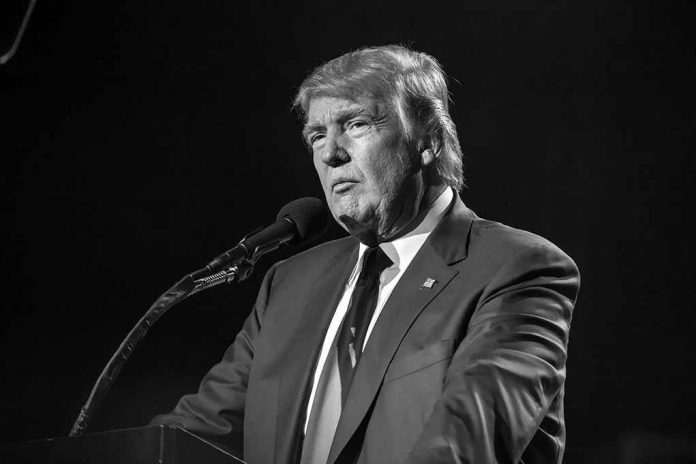
Presidential travel in a midterm is not a photo-op; it is a deliberate effort to nationalize local contests, concentrate attention and money, and transfer the president’s brand to allies—especially where control of Congress may hinge on narrow margins.
At a Glance
- President Trump personally campaigned for Republican candidates in competitive states, including a headline rally in Wasilla, Alaska, for Sen. Dan Sullivan and support for Rep. Nick Begich.
- The Alaska stop was an officially organized Republican campaign rally drawing multiple GOP candidates, part of a coordinated party operation.
- Republican leadership deployed nationally—while Trump stumped elsewhere, Vice President JD Vance rallied Alaska voters for Sullivan and Begich, signaling a unified turnout strategy.
- Outside groups aligned with Trump poured nine-figure sums into advertising across states, reinforcing the on-the-ground push.
What Happened: A Coordinated Presidential Midterm Push
President Trump’s midterm itinerary included direct support for down-ballot Republicans in battlegrounds and red-tilting states facing real competition. The most emblematic stop: a rally in Wasilla, Alaska, headlined to boost Sen. Dan Sullivan and aligned House candidates. Trump himself framed the trip as a targeted assist—“I’m right now going to Alaska to try and help Dan Sullivan”—underscoring the national leadership’s willingness to spend time and political capital on a race framed as close enough to warrant intervention.
The Alaska event was not a drop-by. The Republican National Committee announced the rally, scheduled it at a major venue, and multiple GOP campaigns confirmed attendance, including those of Sullivan and Rep. Nick Begich—evidence of a formal party mobilization effort rather than a candidate-only stop. In parallel, Vice President JD Vance held an Alaska rally of his own urging support for Sullivan and Begich, while Trump campaigned in other states, signaling a divide-and-cover strategy by the ticket’s top figures to maximize reach across competitive terrain.
Mechanism: How Presidential Appearances Aim to Move Midterm Contests
Presidential midterm campaigning operates on two flanks: message amplification and resource concentration. First, it nationalizes local races—press attention, fundraising windows, and activist energy all spike when a sitting president anchors an event. Second, it compresses organizational focus: a single rally can recruit volunteers, fill canvassing shifts, and generate voter-contact lists through RSVP pipelines, which campaigns then leverage for GOTV. The Alaska rally fit this pattern: a centralized event featuring multiple candidates builds a shared turnout apparatus for final weeks, at lower marginal cost per candidate than separate events.
Outside spending completes the circuit. Ad buys and digital blitzes laid down by aligned super PACs keep the message in-market before and after the presidential visit, sustaining salience after the plane wheels up. Between September 1 and late September, three Trump-aligned groups reportedly spent more than $163 million on ads and airtime, including over $63 million in states and districts Trump had carried by at least 10 points—an unmistakable attempt to shore up defenses while contesting swing zones.
Why Alaska, and Why Now: Targeting Under Midterm Headwinds
Sending a sitting president to Alaska—historically safe for Republicans—signals triage and prioritization. Coverage at the time framed the Sullivan race as competitive, effectively tied in perception if not in public polling releases, and therefore worthy of presidential attention. In midterms, presidents face structural drag; the president’s party typically loses vote share and often seats as voters rebalance power between elections. Political science has cataloged this “midterm penalty” across eras: after World War II, the president’s party lost House seats in 17 of 19 midterms—a base rate that conditions strategy even before candidate-specific dynamics enter.
Against that backdrop, Alaska looks less like an anomaly and more like early-warning mitigation. When a race in a friendly state tightens, a visible national push can deter complacency among base voters, reframe the contest as urgent, and concentrate resources where the marginal return may be highest. The companion tactic—deploying the vice president to the same state while the president appears elsewhere—extends coverage without splitting production capacity, a common choice when windows for absentee and early voting compress the calendar.
What We Know Versus What We Can Infer
The public record firmly establishes the facts of the stop: Trump headlined a rally for Sullivan in Wasilla; the event was an RNC-organized campaign rally with multiple Republican candidates committed to attend; and national party leaders, including Vice President Vance, were simultaneously mobilizing Alaska voters. Reporting contemporaneous to the trips also documented Trump’s travel to other midterm battlegrounds, including North Carolina, while aligned organizations committed substantial paid media to protect and promote the party’s map. Those are settled matters.
What the record does not and need not do in real time is isolate causal effects. Rally-to-turnout translation is notoriously difficult to parse without precinct-level postmortems and controlled comparisons. Strategically, however, campaigns act under probabilities and base rates: when the midterm environment imposes headwinds, presidents amplify allies where late money and presidential attention can make the margin. The Alaska swing, supported by coordinated vice-presidential travel and large aligned ad budgets, fits that playbook.
With three weeks until the midterm elections, President Donald Trump said Republicans face a “tremendous disadvantage” with a sitting president in the White House, but claimed enthusiasm for the party is rising.
Trump said he’s holding about one rally a day and plans to… pic.twitter.com/TaNd3sBxnS
— The National Desk (@TND) October 13, 2026
How This Fits the Modern Midterm Playbook
Three features define contemporary presidential midterm engagement. First, targeted nationalization: presidents concentrate appearances in districts and states where their presence moves fundraising and volunteer energy fastest. Second, integrated field and media: rallies are scheduled alongside television, digital, and mail to sustain message density after the motorcade leaves. Third, redundancy at the top: presidents, vice presidents, and marquee surrogates divide the map to maximize earned media without saturating a single market. The Alaska sequence—RNC-organized rally featuring multiple candidates, vice-presidential reinforcement, and synchronized outside spending—illustrates all three.
Campaigns make these choices because midterms reward intensity and efficiency. Attention is the scarcest commodity in the final weeks; a presidential visit buys front-page placement and lead-story airtime that individual campaigns could never purchase outright. In a year when Senate control may pivot on a handful of races, a single high-impact stop can alter the budgeting of independent expenditures, opponent field allocation, and donor psychology. That is why the itinerary sprawls across competitive and defensive terrain alike—and why an Alaska trip, distant as it is, can be rational, even necessary.
Bottom Line
Strip away the theatrics of a presidential rally and what remains is a disciplined, party-wide mobilization exercise. Trump’s Alaska appearance for Sen. Dan Sullivan—paired with Vice President Vance’s rally and backed by heavy outside spending—demonstrates a coordinated Republican strategy to harden defenses and press advantages in the closing stretch of the midterms. The mechanics are straightforward: concentrate attention; integrate field with media; deploy leadership where the map demands. In a midterm environment historically unfavorable to the president’s party, that is not a flourish. It is the job.
Sources:
youtube.com, wbtv.com, sfchronicle.com, pbs.org, independent.co.uk, adn.com