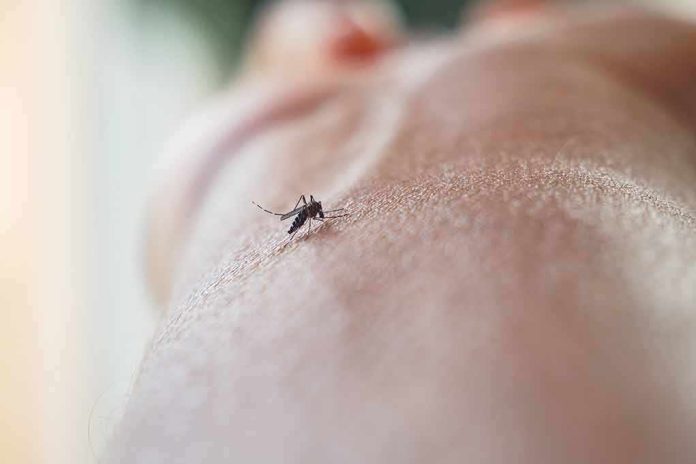
Los Angeles County’s West Nile surge was not a social-media exaggeration but a measurable disease event: human infections, infected mosquitoes, and dead birds all rose together in 2026, the clearest signature of an elevated transmission season in nearly a decade.
The Short Version
- County officials documented an early-season spike: 100 human infections and five deaths by September 21, with totals later revised upward as surveillance caught up.
- Ecological indicators moved in the same direction: hundreds of positive mosquito pools and dozens of infected birds signaled widespread viral amplification.
- Heat and unusual humidity coincided with the surge; higher humidity extends mosquito lifespan, increasing the window for transmission.
- The 2026 season exceeded recent baselines, according to county epidemiological summaries, confirming it was not a routine fluctuation.
What made 2026 different: a multi-signal West Nile season, not just louder anecdotes
Public health surveillance caught the turn early. By September 21, Los Angeles County reported 100 West Nile virus infections and five deaths, a level of activity county leaders described as the highest that early in nearly a decade. As the season progressed and reports were reconciled, the county’s arboviral summary listed 216 infections and 10 deaths, reflecting the typical lag between illness onset, testing, and data finalization. These are not abstract numbers. They are the leading edge of a larger ecological story that includes infected vector populations and avian hosts—signals that moved in tandem in 2026.
Vector and wildlife surveillance corroborated the human case counts. The San Gabriel Valley Mosquito and Vector Control District documented 384 West Nile–positive mosquito pools and 78 infected dead birds by late September, compared with just 104 positive pools and two infected birds at the same point in 2025—an order-of-magnitude rise in avian infections and nearly quadruple the positive mosquito detections. When human case curves rise in step with infected mosquito pools and dead birds, the interpretation is straightforward: transmission intensity in the enzootic (bird–mosquito) cycle was elevated, and spillover to people followed.
Mechanism: how heat and humidity tilt the odds toward transmission
West Nile virus is maintained primarily by Culex mosquitoes feeding on birds; people are incidental hosts. Two biological levers matter most within a single season: how many mosquitoes survive long enough to bite repeatedly, and how quickly the virus replicates inside them. Heat accelerates viral replication and mosquito development; humidity reduces desiccation stress, extending adult lifespan. Longer-lived, infected mosquitoes have more opportunities to transmit the virus—an effect summarized bluntly by a vector-control official: “Their lifespan is determined by humidity, so if you have humidity, the infected mosquitoes will live longer and infect more people”. Southern California’s 2026 mix—extreme heat coupled with El Niño–related moisture—created precisely those favorable conditions, and local reporting tied the warm winter and anomalous humidity to the active season that followed.
Timing matters as much as magnitude. A warm winter can advance the first appearance of infected mosquitoes; a humid, hot summer can lengthen the period during which mosquitoes survive long enough to become infectious, then remain alive to pass the virus with successive blood meals. That seasonal scaffolding helps explain why Los Angeles’ risk typically crests from late summer into fall and can persist into November—an established pattern that makes a late-season rise consequential but not unprecedented.
Evidence hierarchy: why 2026 qualifies as an anomalously active year
Epidemiologists resist single-metric stories. The strongest claim is one supported independently by human cases, vector infection, and avian infections, then judged against recent baselines. On that score, 2026 clears the bar. County officials stated plainly that infections were above the five-year average during the same period, anchoring the “higher than normal” characterization in their own surveillance history. The simultaneous jump in positive mosquito pools and infected birds argues against a mere reporting artifact; you don’t quadruple positive pools and increase dead-bird infections by an order of magnitude simply by testing a few more specimens in the same neighborhoods.
Numbers also carry real-world weight: county alerts announced the first human case in mid-July and the first death by late August, marking an early and serious season start that matched what field biologists were seeing in traps and necropsies. While later data revisions increased totals—an expected feature of passive surveillance—those reconciliations did not blunt the central conclusion: the 2026 season was unusually active for Los Angeles County by multiple, convergent measures.
Where causation is strong, and where it is still correlation
Within-season mechanics—heat speeding viral replication, humidity extending mosquito survival—are well grounded in entomology, and local practitioners underscored those links in plain language in 2026. The district data are equally clear that the enzootic cycle intensified. What the public record does not do is apportion precise shares of the human-case increase to each driver: anomalous humidity versus hot spells, warm winter versus urban water management, changed mosquito-control effort versus human outdoor behavior. That level of attribution requires integrated time-series models tying daily meteorology, trap effort, mosquito infection prevalence, first-positive dates, and human onset together. The county’s summaries focused—appropriately for operations—on detection and response rather than formal causal partitioning. One sentence of caution suffices: surveillance totals evolve as cases are confirmed and attributed, and not all infections are diagnosed or reported.
Operationally, however, perfect apportionment is not necessary to act. West Nile systems reward early warning. Public health practice relies on composite indicators—positive mosquito pools, infected birds, and sentinel geography—to anticipate human risk two to four weeks before illness onset, then surge larval control, habitat reduction, and public messaging accordingly. In 2026, those indicators were flashing.
Los Angeles is facing a significant public health challenge as West Nile virus cases surpass 180. Officials report that record-breaking heat and environmental conditions have created a breeding ground for a surge in Aedes mosquito populations across the pic.twitter.com/PdtWWunW5J
— Azat TV (@azattelevision) October 11, 2026
Practical implications for residents and agencies
For residents, the basics still move the needle: eliminate standing water weekly, repair screens, use EPA-registered repellents, and be particularly vigilant at dusk and dawn when Culex are most active. These are not symbolic gestures. They shorten the chain of transmission by cutting mosquito emergence and reducing successful bites during the short window when a locally infectious mosquito is alive and seeking blood.
For agencies, the 2026 season argues for three investments. First, maintain high-resolution, shared situational awareness—trap effort, pool positivity, and avian infection by week and by microbasin—so operational decisions can be targeted, not countywide bludgeons. Second, link meteorology to response thresholds explicitly; when humidity and temperature cross locally derived risk bands, pre-position larval control and outreach before the human curve bends upward. Third, reconcile surveillance quickly and transparently. When early-season totals are revised upward—as they were from 100 to 216 infections—spell out why in weekly bulletins so the public understands the mechanics of case confirmation rather than mistaking normal data maturation for inconsistency.
The broader pattern, without the hype
Los Angeles in 2026 was not “taken over by mosquitoes.” It experienced a West Nile season in which the ecological gears—heat, humidity, mosquito survival, and bird infection—meshed in a way that produced more opportunities for human spillover. The county’s own summaries, local vector-control data, and contemporaneous field reports line up on that point. The lesson is durable: watch the system, not just the headlines. When birds, mosquitoes, and people all start lighting up the same map, it’s time to move from worry to action.
Sources:
feedpress.me, lacounty.gov, latimes.com, publichealth.lacounty.gov, mynewsla.com, dailynews.com