
The sharpest weapon in a midterm campaign is rarely a policy paper; it is a label, and the label Trump has chosen for Democratic nominees in 2026 — communists, jihadists, anti-American radicals — is engineered to do something no spreadsheet can: make voters feel the stakes before they read a single bill.
Key Points
- Trump has repeatedly, on the record, called 2026 Democratic nominees the “most extreme and dangerous” slate ever to seek office, tying the label to border policy, voter ID, and transgender sports rules.
- The sweeping language — “communists,” “jihadists,” “anti-American lunatics” — is not matched in the available transcripts by nominee-specific voting records or documented statements proving hostility to the United States.
- Named Democratic candidates have directly rebutted the characterization, describing their own service records and defining patriotism in constitutional and civic terms.
- Trump’s France comparison, used to warn of American unrest under Democratic rule, is disputed by data showing the unrest there tracked economic grievance more than immigration.
- Political science research on negative campaigning finds it reliably shapes attention and memory but carries no consistent, proven advantage at the ballot box.
What Trump Has Actually Said, and Where
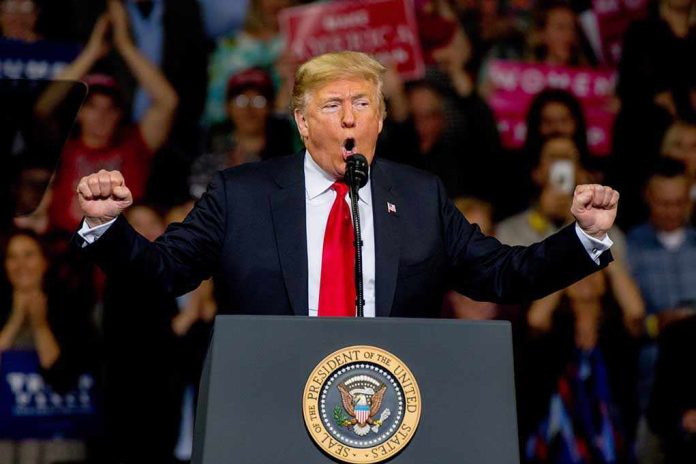
The record here is unusually well documented because Trump’s remarks were delivered in formal, transcribed settings rather than off-the-cuff asides. At the September 2026 RNC Midterm Convention in Dallas, he told delegates that Democrats had nominated “the most extreme and dangerous group of candidates for the House and Senate ever to seek office,” adding that “these people are radical left communists, many of them, not all of them”. Five weeks later in Kansas, the language escalated further: a Democratic win, he warned, would let “a small and dangerous group of extremists” hold Americans “hostage,” grouping opponents under the banner of “communists, jihadists, and the corrupt anti-American lunatics”.
This was not a single rhetorical flourish but a sustained campaign theme, repeated with variations across South Carolina, Kansas, North Carolina, and a Virginia tele-rally through the late summer and fall of 2026. Trump anchored the broader label to specific, arguable policy disputes — opposition to voter ID laws, resistance to proof-of-citizenship requirements, support for transgender athletes in women’s sports, and disagreement with his border-security approach. Those are genuine, contestable policy fights. The trouble, examined closely, is the distance between those narrow disputes and the civilizational language built on top of them.
The Gap Between the Label and the Record
A label like “anti-American radical” is a conclusion, and conclusions require evidence proportionate to their size. The transcripts and campaign materials available — including a White House release cataloguing “Ten Times Extreme Liberal Democrats in Congress Put Their Dangerous Agenda Ahead of the American People” — identify policy positions and name a handful of high-profile figures, among them Ilhan Omar, Rashida Tlaib, and Alexandria Ocasio-Cortez. What they do not supply is a candidate-by-candidate accounting: no roll-call citations, no bill numbers, no voting records tying the broader field of House and Senate nominees to the specific charges leveled against them. Even Trump’s own Dallas remarks carried a built-in qualifier — “many of them, not all of them” — an acknowledgment, buried inside the rhetoric itself, that the label does not travel evenly across the entire slate.
That matters because the claim’s power depends on its breadth. A charge that a dozen named progressives hold positions well outside the American mainstream is a debatable, researchable assertion. A charge that an entire party’s nominees are “anti-American” is something closer to a mobilization device — effective at drawing a battle line, much harder to substantiate with the specific nominee-level documentation a skeptical reader would want to see before accepting it at face value.
How Democratic Nominees Have Answered the Charge
The rebuttal here is not vague indignation; it is specific and on the record. Democratic veterans running for Congress, including Nancy Lacore and Matt Maasdam, have explicitly reclaimed the patriotism frame, with Lacore stating, “I am a patriot. I love this country. It’s why I joined the military”. Fellow candidate Taylor argued that “questioning government” is itself “the most patriotic duty you have,” inverting Trump’s framing rather than simply denying it. Democratic pollster Anna Greenberg offered a parallel definition — patriotism as “upholding the Constitution and caring about the nation’s well-being” rather than a “macho” nationalist posture.
On substance, several targeted candidates pushed back on the premise that extremism, rather than affordability, defines their campaigns. Michigan’s Abdul El-Sayed, responding to scrutiny of past remarks, told voters, “You can talk about my tweets if you want to, but you can’t afford your health care, you can’t afford your groceries, you can’t afford your housing” — attributing those pressures to Trump’s own policies rather than conceding the “radical” framing. Maine’s Troy Jackson has run on an avowedly economic-populist platform — affordability, higher taxes on large corporations, expanded health coverage — rather than the revolutionary program implied by the “communist” label. None of this proves the broader charge false across every nominee; it does establish that named candidates have offered specific, documented counter-statements the rhetoric does not account for.
The France Comparison, Tested Against the Data
Trump’s warning that a Democratic win would bring American unrest resembling the riots in France rests on a causal claim: that immigration and radical politics, not economic strain, produced the chaos. That causal story runs into specific, sourced counter-evidence. French Ministry of Justice data cited in subsequent reporting found that nearly 90 percent of those arrested during the unrest were minors — a pattern more consistent with youth economic frustration than with the “migrants, jihadists, and communists” framing Trump invoked. Analysts pointed instead to France’s pension strain, a youth unemployment crisis, and a public-spending burden consuming nearly 57 percent of GDP, with roughly 30 percent of citizens unable to pay their bills. The unrest also involved white French protesters and attacks on immigrant-owned businesses — details that complicate a single-cause, immigration-driven narrative.
President Trump traveled to Florida to boost support for Republican gubernatorial candidate Byron Donalds and GOP Sen. Ashley Moody, warning rallygoers that the Democrats have nominated "the most extreme anti-American radicals ever to seek office." https://t.co/aeXIki7OmY
— The Washington Times (@WashTimes) October 23, 2026
What the Research on Negative Campaigning Tells Us
This fight over labels is not new, and the broader political-science literature offers a useful corrective to both sides’ confidence. A widely cited meta-analysis of negative campaigning found no reliable electoral advantage for attack-driven messaging and no consistent turnout-suppressing effect either — though it did detect modest erosion in political trust and public mood. Other reviews describe the evidence as genuinely mixed: some studies find attacks demobilize disengaged voters, others find they mobilize partisans, and still others find no measurable effect at all. The honest conclusion is that apocalyptic rhetoric reliably commands attention and shapes memory of a campaign; it does not reliably decide elections, and it should not be mistaken for documented proof of the claims it carries.
Sources:
foreignpolicy.com, democrats.senate.gov, edition.cnn.com, foxnews.com, whitehouse.gov, washingtonexaminer.com, abcnews.com, cnn.com, npr.org, politico.com, link.springer.com