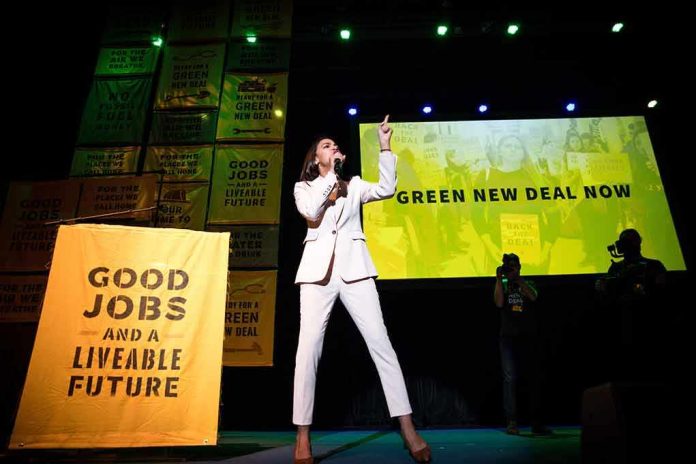
Alexandria Ocasio-Cortez has done what no cycle-watcher could manufacture for her: she said, on the record, that a 2028 presidential run is under active consideration, and she framed the decision as a once-in-a-career window she may not get again.
Key Points
- In a September 2026 New York Times interview, Ocasio-Cortez said a presidential bid is “within consideration” and that she personally thinks about running.
- She described 2028 as a potentially “unique political window,” noting that in politics “you do only get one shot” and that “life just makes things ready for you.”
- She has tied her decision to the 2026 midterms, weighing the White House against a Senate run or staying in the House.
- Progressive organizations, including Justice Democrats, already treat her ongoing campaigning as groundwork for a future national run.
- No campaign committee, exploratory filing, or formal announcement exists yet — the decision remains hers to make after the midterms.
What Ocasio-Cortez Actually Said
The news here is not speculation generated by pundits; it is Ocasio-Cortez’s own words. Speaking with Times national correspondent Shane Goldmacher, she acknowledged that “every element of this is something that’s within consideration,” confirming that a 2028 presidential campaign sits on her personal list of options rather than being a media invention. That distinction matters. Plenty of politicians get drafted into speculation they never touch; Ocasio-Cortez instead engaged the question directly, discussing not just whether she might run but why the timing could be unusually favorable.
Her reasoning is worth sitting with because it reveals strategic thinking, not just ambition. “There’s an argument that some make that this is a very unique political window and, oftentimically in politics, you do only get one shot,” she said, adding that “sometimes life just makes things ready for you”. That is the language of someone calculating opportunity cost — weighing whether waiting for a supposedly better moment actually produces one, a lesson both parties’ bench players have learned the hard way when a rising talent waited and watched the opening close.
A Decision Point, Not a Launch
Ocasio-Cortez has structured this as a post-midterm decision with three live branches: run for president, run for the Senate seat held by Chuck Schumer, or remain in the House. That framing is important because it keeps the story honest. She has not filed anything, formed an exploratory committee, or delivered a launch speech — the strongest documented fact remains her own statement of consideration, not a declared candidacy. The caveat is brief but necessary: this is deliberation on the record, not a campaign in motion.
What makes the deliberation consequential is the apparatus already forming around it. The Bulwark reported that Ocasio-Cortez’s current political activity — the travel, the coalition-building, the visibility — could double as foundation-laying for a 2028 bid, and quoted Justice Democrats communications director Usamah Andrabi on the centrality of progressives to the Democratic coalition. That is the activist infrastructure a serious national campaign eventually needs: an organized constituency that already knows how to mobilize volunteers, raise small-dollar money, and generate media attention without waiting for permission from party leadership.
Why Early Positioning Is Normal, Not a Tell
History offers useful ballast here. Across more than two hundred Democratic and Republican presidential bids between 1972 and 2020, the average candidate announced 519 days before the general election — nearly a year and a half of runway. Exploratory chatter, activist draft movements, and trial-balloon interviews routinely precede actual campaigns by years; John F. Kennedy did not formally declare until eleven months out in 1960, and Bill Clinton waited just over a year in 1992. Measured against that pattern, an AOC-2028 conversation surfacing in late 2026 is neither early nor unusual — it is simply the stage every modern presidential bid passes through before it becomes one.
That history cuts against two opposite errors. One is dismissing the talk as empty because no filing exists yet; the record shows filings almost always come later than public deliberation. The other is treating an interview as equivalent to a campaign; the same record shows early visibility converts into a viable bid only when it is followed by money, organization, and support beyond a candidate’s base — exactly the gap that currently separates Ocasio-Cortez’s comments from a functioning national campaign.
The Headwinds She Named Herself
Ocasio-Cortez did not present the decision as a formality. Reporting on the same interview indicates she discussed the specific headwinds of running as a woman and as a Latina, and the broader reality of being a nationally polarizing figure — obstacles she raised herself rather than ones imposed by critics. That self-assessment is notable for its candor; it suggests she is weighing electability questions with the same rigor she brings to the “unique window” argument, not simply assuming progressive enthusiasm scales to a general electorate.
Mamdani Campaign Guru Spilled the AOC 2028 Takeover Plan to a Belgian Newspaper https://t.co/TsWoSqidBr
— Mark Richards (@MidCentMondern) November 5, 2026
What Would Turn Consideration Into a Campaign
The gap between where things stand now and a credible national run is measurable, not mysterious. It would show up in Federal Election Commission filings and disclosed fundraising totals, in named state directors and field offices in early nominating states, in transparent polling that tests her standing against the broader Democratic electorate rather than just its progressive wing, and in endorsements reaching beyond the activist organizations already in her corner. None of that currently exists in documented form — what exists is a candid acknowledgment of ambition, an organized progressive base ready to mobilize, and a self-imposed deadline tied to the 2026 midterms. Whether that foundation becomes a campaign is a decision Ocasio-Cortez says she intends to make herself, in the open, once the votes are counted.
Sources:
nypost.com, pennlive.com, cnn.com, independent.co.uk, newser.com, yahoo.com, ropercenter.cornell.edu, americanhistory.si.edu