
When a single line from a stage set celebrates the death of a named political figure, it stops being just another edgy joke and becomes a stress test for the boundaries of political comedy, public norms around violence, and the obligations of performers who traffic in provocation.
The Short Version
- A leaked attendee clip captured Dave Chappelle saying he felt better after conservative activist Charlie Kirk was murdered, drawing immediate backlash.
- A second circulating line placed Kirk “looking up at us,” reinforcing that the segment extended beyond a stray phrase and landed as a death bit, not an aside.
- The set was at Madison Square Garden before a large live audience; reports describe crowd laughter as the lines landed.
- Erika Kirk publicly condemned the material as treating political assassination and the destruction of human life as entertainment.
What happened on stage, and why this joke hit differently
The core facts are straightforward. During a Karmageddon tour stop at Madison Square Garden, a leaked attendee video captured Dave Chappelle referencing Charlie Kirk’s killing and saying, in substance, that he felt better since it happened; reports also quote him extending the riff by placing Kirk “looking up at us,” a line that reads as gallows humor about damnation. Context from the clip indicates he framed the thought while talking about the hazards of being a public speaker, then pivoted into the Kirk material. The audience response—laughter—matters because it shows the bit worked as a joke in the room, which is precisely what angered critics outside of it.
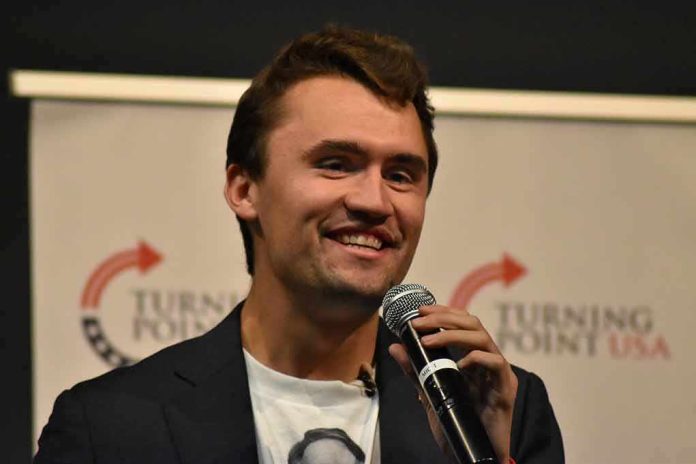
The subject of the joke was not abstract. It referenced a named activist who, according to reporting, was assassinated the prior year, leaving a widow who then watched the moment become internet spectacle. Erika Kirk called the routine “beyond disgusting,” arguing that political assassination is not fodder for applause lines. Her objection landed with force because it came from the closest circle of harm and because the material made the victim’s identity central to the laugh mechanics rather than incidental.
Comedy’s mechanism: ambiguity, persona, and the hazard of viral decontextualization
Stand-up’s craft license rests on ambiguity—exaggeration, role-play, reversal, and persona let a comic juggle taboo content without endorsing it literally. Political comedy, in particular, can deepen attention to public life and stiffen in-group resolve; the same traits that make it energizing also make it polarizing, because laughs often come from affirming your side’s moral map against theirs. A 40–second clip compresses all that into a single shock line, which is why these moments metastasize online: the bit’s most combustible sentence detaches from the scaffolding that might mitigate or complicate it.
That dynamic does not dissolve responsibility. When a punchline locates relief or joy in the killing of a political antagonist, the laugh is coded, and the code—whether read as satire, provocation, or plain endorsement—travels wide. Research on violent metaphors and incendiary rhetoric is mixed about direct causation but clear that rhetoric can sharpen aggression among already aggressive audiences and heighten fear among targets; in contentious climates, that matters.
The three distinct questions people are actually fighting about
Debates like this blur together intent, social harm, and legality, but those are distinct questions with different standards. First, intent: without a contemporaneous statement from Chappelle clarifying whether he meant literal approval, persona-driven dark humor, or a satirical inversion, critics defaulted to the most direct reading. Silence from a performer of his stature tends to harden that reading, because the viral version sets the frame.
Second, social harm: even absent a causal line from a joke to an act, public celebration of a named opponent’s killing can normalize glee at elimination, which is corrosive to shared civic ground. Research on political comedy’s affective effects finds it can mobilize and bond an in-group—useful if your aim is solidarity, riskier when the bonding moment is another citizen’s death. Sponsors and adjacent creators react to that risk calculus in real time, as illustrated by brand withdrawals in a parallel controversy where laughter about Kirk’s killing triggered a rapid retreat.
Where the legal boundary sits—and why this set didn’t cross it
The First Amendment’s “true threats” doctrine, as articulated in cases like Virginia v. Black and refined in Counterman v. Colorado, carves out unprotected speech that communicates a serious expression of an intent to commit unlawful violence; the law demands more than offensive or even dehumanizing talk. A comic saying he felt better after a killing, or quipping that the deceased is “looking up,” is vile to some and cathartic to others—but it is not an exhortation to imminent violence or a directed threat as those terms are understood in constitutional doctrine. In other words, the line can be condemned as ethically bankrupt without being legally proscribable.
That divide—moral sanction without state sanction—is how a pluralistic speech regime is designed to work. Citizens, patrons, and sponsors are free to penalize speech they abhor; the government is not free to jail the speaker for it. Much of the fallout therefore plays out in cultural markets rather than courtrooms, where the relevant questions are taste, judgment, and risk, not mens rea and imminence.
My favorite comedian just lost his funny.
I Saw Dave Chappelle Joke About Charlie Kirk. Here's What Happened. https://t.co/CNBl0R6TrE
— Christopher (@G_Male_Baby) November 9, 2026
Audience, amplification, and the platform problem
What happened in the room and what traveled online are different phenomena. Reports described a sold-out crowd and laughter in the moment; what the internet received was a short, illicit clip that preserved the shock and the laugh while stripping out any surrounding material. Engagement-driven platforms reward that decontextualized jolt—moral outrage and political content rank high in the feedback loop—so the most incendiary read becomes the motion picture of record.
What this means going forward
For comedians: when you move death from abstract to named and recent, you’re not just “edgy”; you are drafting a real person’s family and a live political wound into your bit. That can harden your in-group and alienate everyone else. For audiences and sponsors: the power you wield is ex post—tickets not bought, podcasts not underwritten—so you will often arbitrate norms faster than institutions do.
And for the broader culture: the line here is not complicated. You can defend Chappelle’s right to say it and still judge the choice as destructive. The evidence shows he made the joke, in a room that laughed; the widow objected; the clip spread. That story stands on its own, and it tells you something plain about where our comedy, and our politics, now meet.
Sources:
youtube.com, seattletimes.com, nysun.com, jacksonville.com, thedailybeast.com, complex.com, sfchronicle.com, nine.com.au, supremecourt.gov, pmc.ncbi.nlm.nih.gov, firstamendment.mtsu.edu, assets.carnegieendowment.org, brookings.edu