

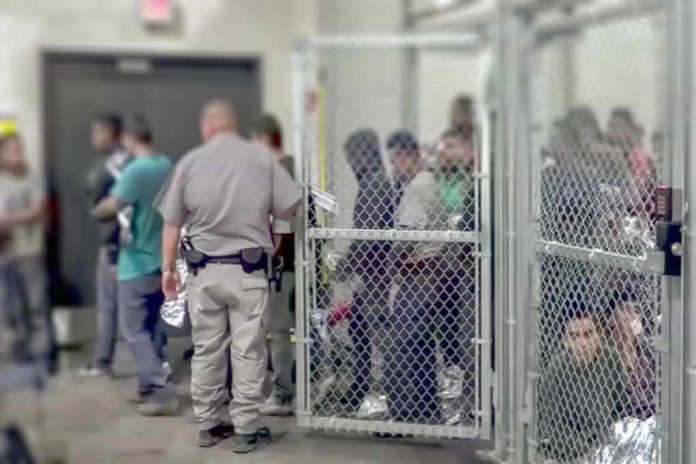
The core risk raised by Rachel Maddow’s warning is not rhetorical excess; it is the collision between expanding, high-capacity immigration detention infrastructure and a legal system that has repeatedly had to intervene when custody outstrips due process. That history makes the scenario she sketched worth understanding on the merits: what these facilities are, what authority governs them, where the real constitutional guardrails sit, and how past litigation maps the boundary between lawful civil detention and unlawful imprisonment.
At a Glance
- Maddow described a concrete scenario: seven to ten large detention sites, each around 10,000 capacity, used to hold people indefinitely without trial or access to lawyers.
- Reporting on proposed “mega-facility” concepts, including a warehouse-style site in Georgia, ties her warning to real procurement and siting efforts—not just abstractions.
- Federal courts have repeatedly ordered releases and bond hearings in immigration detention cases, underscoring that prolonged or opaque custody triggers due-process limits.
- The historical pattern is expansion followed by litigation and partial correction; the documented risk is mistaken or unlawful detention of citizens, not proof of a policy to detain citizens in new mega-sites.
What Maddow Actually Claimed, and Why It Resonates
On a November 2026 appearance, Maddow moved past generic alarm to outline a specific capacity-and-authority scenario: seven to ten prisons of roughly 10,000 beds apiece, used to hold people “without trial, without access to lawyers, indefinitely,” and a warning that such power would not remain confined to immigrants. Her formulation matters because it is falsifiable—capacities, locations, custody rules, and due-process access can all be documented—and because it links rhetoric to an identifiable buildout of large-scale detention facilities reported in recent years. In short, she named the mechanism, not just the fear.
That mechanism is not theoretical procurement-speak. Public reporting described proposals for warehouse-like detention installations capable of holding thousands, including a site in Social Circle, Georgia, that drew scrutiny as emblematic of a “mega-facility” model. Whether every proposal advanced or was canceled, the design logic—large, centralized intake and custody at scale—anchors the plausibility of Maddow’s capacity claims even as specific blueprints shift.
How the Legal Authority Works—and Where It Breaks
Immigration detention is civil, not criminal; the government holds noncitizens to ensure removal or manage border processing. Civil custody does not create a blank check. The Fifth Amendment’s Due Process Clause imposes substantive and procedural limits, which federal judges enforce through habeas corpus. That is not a theoretical safeguard. In case after case, courts have scrutinized prolonged detention, ordered release, and required bond hearings when the government’s justification waned or process stalled. Those rulings delineate the current envelope of lawful detention, and they show how quickly constitutional guardrails become load-bearing when detention scales up.
Consider three recurring outcomes the courts have imposed: orders for immediate or time-limited release; mandates for advance notice and a bond hearing before re-detention; and admonitions that civil detention demands “special justification” that outweighs the liberty interest in avoiding restraint. Each remedy flows from the same premise—civil custody is bounded by due process—and each demonstrates that design choices or staffing bottlenecks that degrade access to counsel or hearings do not survive judicial review for long.
The Capacity Question: From Proposals to Practice
Maddow’s numbers—tens of thousands in aggregate—draw heat because they imply something near-industrial in scale. The record supports two firm points. First, large facilities have been seriously contemplated: reporting on warehouse-scale sites, with figures “five, six, seven, ten, 14,000” beds, shows that capacity planning at that magnitude has been on the table. Second, proposals and cancellations do not cancel the model; they relocate or reconfigure it. Procurement and siting in this domain are iterative, often shifting among jurisdictions, leases, and private contractors, with the operating concept—large centralized detention—remaining intact across iterations.
Scale is not a neutral choice. High-throughput, high-capacity facilities concentrate risks: attorney access can be throttled by distance and logistics; individualized custody reviews can lag under docket spikes; and mistaken identity or contested status can take longer to unwind. The case law confirms that when those frictions harden into prolonged detention without adequate process, courts step in. The temptation in any mass-custody system is to rely on throughput math; the Constitution insists on individualized justification.
Citizens, Noncitizens, and the Line that Matters
Here, precision is essential. The documented, non-hypothetical risk is mistaken or unlawful detention of U.S. citizens—people misidentified, ensnared by error, or trapped in verification limbo. Government watchdogs, litigation records, and investigative reporting have traced such episodes across decades and administrations, an uncomfortable throughline in a complex system built for speed. That is distinct from the prediction that newly built mega-facilities would be used to hold citizens as a matter of policy. The former is evidenced; the latter is a warning. Treating them as the same obscures both the genuine legal problem and the standard by which any future overreach would be judged.
The habeas docket illustrates the boundary. Cases ordering release from immigration-processing centers show due process at work: when custody loses its legal mooring—because removal is not reasonably foreseeable, hearings are delayed, or conditions impede access to counsel—judges do not hesitate to grant relief. Those outcomes are incompatible with a scheme of true indefinite detention without counsel, and they explain why any attempt to formalize such a regime would run headlong into constitutional litigation—and likely fail.
It's just me, but if she truly believes this fantasy, she needs to see her therapist a LOT more often. I suspect she's just throwing more gasoline into the verbage war but then again, she believes a lot of idiocy.
"Rachel Maddow fears Trump migrant detention centers may be used…
— Dr. Chauncey Herrington (@Herrin1Ch4214) November 11, 2026
Where the Real Disagreement Lives
The live policy dispute is not whether courts can police excess—they can and do—but whether the front end of the system is designed to minimize constitutional strain or to treat litigation as a pressure-release valve after rights have already been burdened. Advocates point to structural fixes—hard timelines for custody reviews, enforceable attorney-access standards, real-time error correction for citizenship claims—arguing that scale without safeguards guarantees recurring violations. Proponents of expanded capacity counter that throughput requires centralization and that existing legal remedies suffice when errors occur. The evidence to date shows a pattern: expansion first, lawsuits second, partial recalibration third. That cycle is costly—to liberty in the short term and to institutional legitimacy in the long term.
What to Watch to Separate Alarm from Reality
The testable indicators are clear. On infrastructure: solicitations, contracts, and site plans that specify capacities in the five-figure range, custody categories, and attorney-access logistics. On authority: Office of Legal Counsel opinions, DHS and DOJ directives, and interagency agreements that define who can be held, for how long, under what review. On process: hearing timelines, bond standards, and real-world counsel-access logs. And on error correction: documented protocols—backed by metrics—for rapidly verifying and releasing citizens and others not lawfully subject to immigration custody. Each is an on-ramp for the courts if it fails, but each is also amenable to public scrutiny before litigation is the only remedy.
Bottom Line
Maddow put a sharp edge on a real policy knife: scale plus weak safeguards equals constitutional risk. The country has a long record of expanding immigration detention and then relying on courts to sand down the roughest edges. The record also shows that when detention drifts toward prolonged custody without adequate process, judges order people out. The prudent response to her warning is not to argue over analogies; it is to insist on the documents that govern capacity, authority, access to counsel, and error correction—and to measure the system against the constitutional floor the courts enforce every time detention tries to outgrow due process.
Sources:
thegatewaypundit.com, supreme.justia.com, law.justia.com, supremecourt.gov, govinfo.gov, foxnews.com, foxwilmington.com, silive.com, warren.senate.gov