Active-shooter language is an operational signal, not a headline flourish; in Washington’s Logan Circle, it meant police were confronting a live threat at a gym-and-residential complex while casualties mounted and a suspect barricaded himself upstairs.
At a Glance
- D.C. police responded to an active shooting centered on VIDA Fitness at 15th and P Streets NW, with tactical teams deployed and a suspect barricaded in an apartment above the gym.
- Authorities confirmed five victims: one deceased and four injured, as the incident shifted from the gym floor to the street before the barricade.
- City leaders warned residents to avoid Logan Circle, citing gunfire at and outside the gym and an ongoing police operation.
- Early details on sequence and suspect identity evolved as the scene stabilized, consistent with how active-shooter investigations unfold.
What Happened: A Live Threat at a Gym-Residential Hub
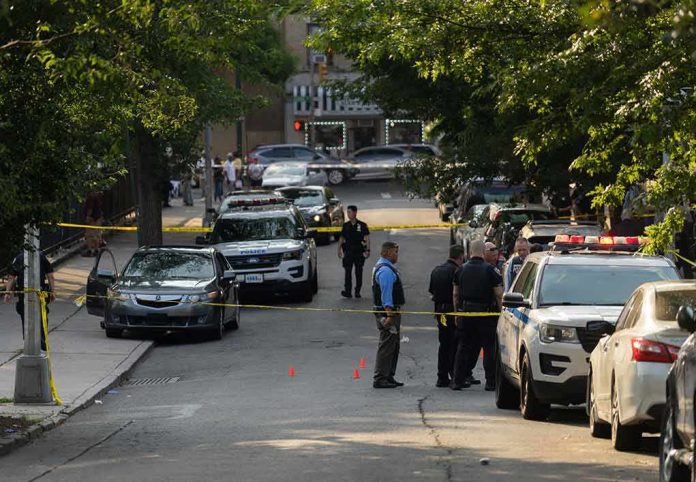
D.C.’s Metropolitan Police Department declared an active shooter at the intersection of 15th and P Streets NW, mobilizing its Emergency Response Team and cordoning the Logan Circle area as reports of multiple victims arrived. Police communications described an armed assailant and a barricade situation inside a building associated with VIDA Fitness, a high-traffic gym integrated into a condominium complex; a local councilmember’s contemporaneous alert placed gunfire “at and outside” the gym and urged the public to steer clear of the zone. The initial count—at least four shot—was later refined to five victims, with one person dead and four injured, a tally multiple outlets attributed to police confirmation as the scene stabilized.
Independent reporting converged quickly on the same core picture: gunfire erupted in or around the gym, additional shots rang out on the street, and the suspected shooter withdrew to an upper floor of the residential building above the facility. Local television and national desks cited law-enforcement sources for the barricade location on a high floor, describing an apartment above the gym as the focus of the standoff. VIDA management told a regional outlet the facility was locked down with officers inside, aligning with what nearby witnesses described as a fast, forceful tactical response.
How Active-Shooter Incidents Are Managed—and Why Terminology Matters
“Active shooter” is a term of art in public safety. The FBI defines it as one or more individuals actively engaged in killing or attempting to kill people in a populated area; it does not hinge on a minimum casualty count, a single indoor location, or early clarity about motive. The definition guides immediate law-enforcement posture—rapid interdiction, public warnings, and area control—while investigators work in parallel to establish sequence, victim locations, and legal charges once the threat is neutralized.
This distinction explains the communications cadence around Logan Circle. Police warned of an active shooting and a barricaded suspect, prioritized containment, and then refined the casualty count. That is how complex scenes mature into reliable public records. In the FBI’s annual assessments, active-shooter events regularly span mixed-use spaces—fitness centers, shops, streets—and often involve movement between connected interiors and sidewalks before a perpetrator is stopped or holes up. Those patterns map onto what unfolded here: an initial burst of violence, a spillover onto adjacent public space, then a barricade upstairs.
Sequence and Setting: From Gym Floor to Street to Barricade
Logan Circle’s built environment is central to understanding the timeline. VIDA Fitness sits within or alongside a condominium property in a dense corridor of retail and residential units. Witness accounts reported a first shot on the gym floor and additional gunfire outdoors as patrons and staff evacuated. Management confirmed shots outside the business and an ongoing lockdown, while police restricted movement around the 1500 block during the barricade operation. Multi-outlet reporting, citing police and federal sources, placed the suspect in an upper-floor apartment above the gym, sharpening the geometry of the threat and justifying the heavy tactical footprint.
By late morning, the victim count settled on five—four injured, one deceased—an alignment across local and national outlets drawing on police confirmation. Early variability in counts, especially during evacuations and triage, is common. What distinguishes this episode is how quickly separate newsrooms synchronized around the same numbers and architecture of the incident: a mixed-use building, gym-level violence, gunfire migrating to the street, and a barricade above the point of origin.
Why Early Numbers Shift—and What Truly Resolves a Case
Large urban responses move fast by design: officers push to contact, secure stairwells and elevator cores, and clear adjacent businesses, while medical teams stabilize and transport the wounded. Amid those tasks, casualty counts and victim locations are fluid. That does not imply uncertainty about the fact pattern; it reflects the operational priority of ending the threat before building a minute-by-minute log. In the hours and days after a scene like Logan Circle’s, the record hardens through a familiar evidentiary stack: dispatch audio and CAD logs, body-worn camera video, surveillance footage from the gym and lobby, shell-casing and ballistic mapping, and, in fatal cases, the medical examiner’s determinations.
The public-facing label—active shooter—persists only as long as the risk does. Once the suspect is in custody or otherwise neutralized, investigators reframe the event in legal terms: homicide, assault with a dangerous weapon, unlawful discharge, and related firearm counts, each tied to evidence and charging standards. The FBI’s reporting series underscores that while “active shooter” is an operational category, the prosecutorial narrative rests on discrete forensic anchors: cartridges connected to a recovered firearm, wound-path analysis, and video or eyewitness evidence fixing time and location. That is the path from a citywide alert to a courtroom-ready timeline.
Community and Urban-Policy Implications
Incidents that span a gym and the residential floors above it force cities to stress-test building security, tenant communication, and interoperability between private property managers and police. Mixed-use density increases the speed at which violence can propagate across thresholds—doorways, stairwells, sidewalks—before responders can create distance and containment. The Logan Circle response demonstrated the right playbook: swift tactical entry, a tight perimeter, and real-time direction to shelter or avoid the zone. It also spotlights the value of pre-existing data-sharing arrangements: floor plans in responder databases, camera registries, and common radio channels across municipal and federal partners that frequently converge downtown.
For businesses like gyms, recurrent drills and staff decision rights—who hits the alarm, who shepherds patrons to exits that do not channel them toward sound of fire—often determine whether chaos compounds harm. For residents, building associations and managers serve as a parallel command structure during a barricade: moving people off vulnerable lines of sight, accounting for units, and coordinating with police on stairwell or HVAC shutdowns when fire or smoke complicates the scene. Cities that codify these practices in their building codes and emergency ordinances are better positioned to compress response times and reduce exposure in the first ten minutes, when most casualties occur in active-shooter events.
One Person Killed, Four Injured in Logan Circle Gym Shooting
A gunman opened fire Thursday morning at VIDA Fitness in Washington, D.C.'s Logan Circle neighborhood, killing one person and injuring four others before dying by suicide.
Metropolitan Police Department interim Chief… pic.twitter.com/vJfXzdaAmi
— American Voice Rising (@amvoicerising) November 12, 2026
What Endures After the Headlines
Strip away the sirens and the location chatter, and the essential contours are clear. Police confronted an active shooter linked to a gym-and-condo complex in Logan Circle. Five people were shot; one died. The suspect retreated to an upper-floor unit and barricaded, prompting a full tactical operation and building lockdown. Those facts, established across independent outlets and anchored to police confirmations, are the durable core of this case. The finer-grained narrative—exact shot sequence, weapon type, and evidentiary chain—will be set by the standard suite of forensic and documentary records. The category lesson, however, is already plain: in a dense urban fabric, an “active shooter” label is not semantics. It is the doctrine that saves lives.
Sources:
nbcwashington.com, kpic.com, cbsnews.com, fbi.gov