When a technical failure forces a nationwide ground stop, the real test of leadership isn’t a microphone appearance—it’s whether the system contains the failure safely and whether officials level with the country about vulnerabilities that could happen again.
The Short Version
- The FAA ordered a rare, nationwide ground stop lasting over four hours; thousands of flights were canceled or delayed.
- Cabinet officials, not President Trump, publicly briefed the country during the disruption; they said he was engaged behind the scenes.
- Officials attributed the failure to overloaded, aging air-traffic-control infrastructure and could not guarantee non-recurrence.
- The episode spotlights two separate issues: visible presidential crisis communication vs. long-running, underfunded modernization.
What actually happened: scope, safety, and who spoke for the government
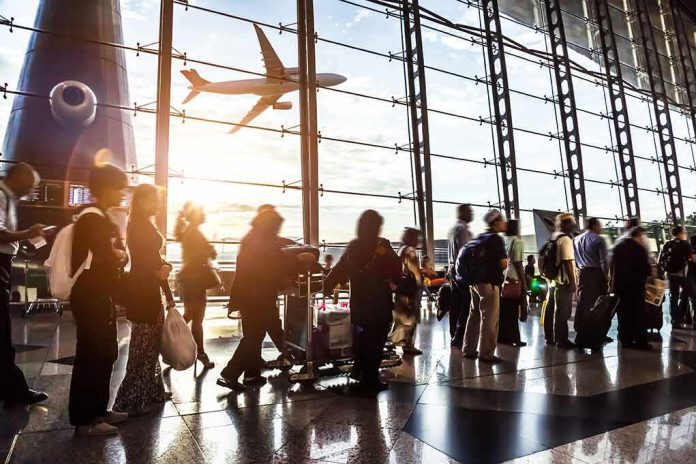
The Federal Aviation Administration imposed a nationwide ground stop on the afternoon of November 13, halting departures “for reasons of safety” amid a widespread failure affecting telecommunications, radar, and communications systems. Transportation Secretary Sean Duffy announced the lifting of the stop a little after 8 p.m., after traffic managers had landed thousands of aircraft in a controlled sequence and began reopening departures. Reporting tallied more than 7,000 cancellations and extensive delays across the system, the predictable signature of an event on this scale.
Public-facing crisis communications came from Homeland Security Secretary Markwayne Mullin and Secretary Duffy at the White House, not from President Trump. They told reporters that, while the investigation into root cause continued, there was no indication of a cyberattack and that the failure tracked to an overloaded, outdated segment of the air-traffic-control infrastructure. Both emphasized safety: procedures kicked in, planes were brought down in an orderly fashion, and the system would be restored methodically. They also said Trump had been briefed and was in communication with the principals during the event.
The mechanics: what failed and why “old tech” keeps surfacing
On the technical merits, the administration framed the outage as a stress failure in legacy communications architecture. Duffy pointed to an analog time-division multiplexing (TDM) layer—an older signal-carrying method in the network path—overloaded by data and interacting poorly with newer components. In other words, the mixed fleet of legacy and modern systems behaved as mixed fleets often do under load: brittle at the seams, especially when the old backbone is asked to carry traffic profiles it wasn’t designed for. He coupled that diagnosis with a call for significant modernization funding.
This isn’t a one-off talking point. For decades, auditors and safety investigators have documented the FAA’s struggle to replace aging equipment and software while keeping the world’s busiest airspace safely running. After a separate national disruption in 2023, the FAA’s systemwide risk review classified dozens of core systems as unsustainable or at risk, a finding reiterated to Congress in 2025. The pattern is clear: modernization is necessary but complex; bolt-on upgrades can relieve pressure locally yet expose new failure modes at integration boundaries.
Leadership optics vs. operational substance: two different yardsticks
Critics focused on presidential visibility—why the President didn’t take the podium mid-crisis. That criticism speaks to an important civic expectation: in a nationwide disruption, the Commander-in-Chief is the voice many Americans expect to hear. But visibility and operational performance are not the same metric. The operational playbook—ground stop, controlled sequencing to land aircraft, stepwise restoration—was executed by the FAA and the transportation enterprise. By the time the stop was lifted, officials had landed thousands of flights without a mass-casualty safety event, which is the core duty of air traffic management during a system upset.
On the record, Mullin and Duffy said Trump had been briefed and was actively engaged by phone; several outlets reported the same. Those statements don’t prove granular decision-making by the President—no call logs or directives were released—but they do rebut the claim that nonappearance equals noninvolvement. In short, there is no documented presidential decision that worsened the event; the documented problem was technological brittleness and incomplete modernization.
What we know, what we don’t, and what actually matters going forward
We know the outage was national, sustained for hours, and required invoking the heaviest tool in the FAA kit—a ground stop—to preserve safety margins. We know the cabinet, not the President, briefed the public; we also know those principals acknowledged that the precise technical trigger was still under investigation even as they diagnosed a systemwide deficit in aging infrastructure. We do not have a public, minute-by-minute presidential action log, nor do we have a completed, fully transparent engineering incident report in the record cited here. That gap is not unusual in the first 24–48 hours of a complex failure—and it is why final judgments about technical root cause should rest on the after-action record, not a press rostrum.
The more durable lesson isn’t about podium choreography. It’s that the national airspace is running on a patchwork of legacy and modern components with well-characterized sustainment risks. The FAA’s modernization efforts have been multi-decade, multi-billion-dollar projects; progress is real, but so are integration hazards when old and new coexist under rising traffic demand. As long as this architecture persists, leaders—of any party—will face the same two obligations in a crisis: execute the safety playbook flawlessly and speak to the public with technical candor about what failed, why it failed, and what’s being done to prevent recurrence.
How to judge the response the next time this happens
Use two scorecards. On operations: Did the system quickly default to safety—ground stop or flow restrictions as needed—land aircraft in sequence, and restore services without compounding errors? Were controllers, technicians, and airline operations centers synchronized by established protocols? On transparency: Did officials avoid overpromising, share what they knew and the bounds of that knowledge, and commit to a credible timeline for root-cause analysis and mitigations? By those standards, this event delivered a competent safety response and a candid, if incomplete, diagnosis of aging infrastructure risk—while leaving open questions about presidential stagecraft that, however politically salient, did not change the physics of the network under strain.
Sources:
twitchy.com, transportation.gov, dhs.gov, whitehouse.gov, abcnews.com, nbcnews.com, abc13.com, trump-archive.com, ntsb.gov