

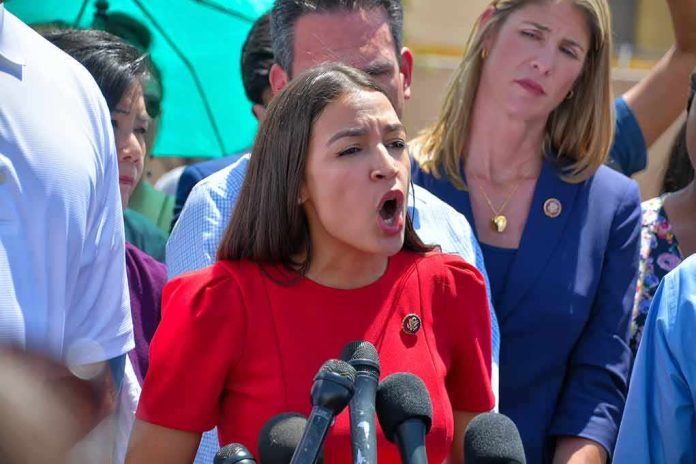
When politicians step behind a church lectern to speak about LGBT dignity, the controversy that follows is not simply about one speech; it is about how American Catholic life manages the tension between pastoral welcome and doctrinal boundary, between the liturgical space and the civic square.
At a Glance
- Ocasio-Cortez has repeatedly cast LGBT and especially transgender inclusion as a moral obligation grounded in faith, not a deviation from it.
- Progressive Catholic commentators argue her emphasis on human dignity and justice coheres with Catholic social teaching’s core commitments.
- Conservative Catholic voices counter that her broader policy agenda conflicts with Catholic doctrine on life, marriage, and sexual ethics, and warn about religious liberty risks.
- Parishes operate in a deliberate gray zone: they may host civic discussions yet must avoid even the appearance of partisan endorsement, which leaves room for both sides to claim the moment.
What the appearance represents: a contest over moral framing
Set aside the predictable social media ricochet and look at the essential move: Ocasio-Cortez has long articulated LGBT acceptance as a faith-anchored duty. In earlier public remarks, she rejected the use of Scripture to rationalize discrimination and argued that denying medical care on the basis of identity is incompatible with what is holy, placing equality and care within a moral—explicitly religious—frame. That is the fulcrum on which reactions pivot. For supporters, it is a retrieval of Catholic social tradition’s language of the person—dignity, solidarity, the common good—applied to a community historically pushed to the periphery. For critics, it is a category error that smuggles contested policies under the banner of faith.
Progressive Catholic commentary has not just welcomed the tone; it has read it as consonant with the Church’s best instincts toward human dignity. Writers in the Catholic left have argued that Ocasio-Cortez’s vocabulary of reconciliation and respect reflects a pastoral imagination they hope to see more widely, with some going so far as to cast her style of moral concern as a sign of what the Church’s future must look like if it is to persuade younger Catholics. That is not a magisterial endorsement; it is a claim about persuasion and witness in a plural society.
Why hosting in a parish is so easily misread
American Catholic entities are instructed to avoid endorsing candidates or parties and to steer clear of activity that could reasonably be construed as partisan. Yet they are also permitted to convene civic conversations within IRS and diocesan guidelines, especially in educational formats or when all candidates are offered a platform. This is not bureaucratic hair-splitting; it is a well-worn attempt to keep the Church engaged in public life without becoming a campaign arm. The result is a durable ambiguity: when a parish hosts a public figure, some will read welcome as approval, and others as ordinary hospitality in service of dialogue. The guidelines try to prevent conflation, but in practice, silence from a parish or diocese about intent leaves interpretation to partisans.
Layer onto that the Church’s own evolving pastoral landscape. Pope Francis has widened space for accompaniment—think of the authorization of blessings for couples in irregular unions while upholding sacramental norms—which many interpret as an institutional signal to welcome without collapsing doctrine into policy. That complex “both/and” is exactly the kind of context in which civic appearances by polarizing figures will be read through different lenses, particularly on questions of gender identity and law.
The conservative critique: conflict with doctrine and religious liberty
Conservative Catholic writers make two main claims. First, they argue that Ocasio-Cortez’s broad policy commitments—abortion rights, a redefinition of marriage, and gender-identity frameworks—are irreconcilable with Catholic moral teaching; therefore, framing those policies as “Catholic” is misleading. Second, they warn that statutory changes such as adding sexual orientation and gender identity to civil-rights law could narrow conscience protections for religious institutions, forcing Catholic hospitals, schools, and charities into legal conflict over services, hiring, or facility use. Taken together, they see her message as catechetically confusing and juridically risky for ministries that depend on clear religious-exemption boundaries.
Those warnings rest on concrete debates. Civil-rights expansions often trigger litigation over where anti-discrimination ends and religious freedom begins; Catholic entities have repeatedly defended conscience-based limits on procedures or policies they hold to be immoral. From that vantage point, applause lines about inclusion can sound like prefaces to mandates. Whether a particular bill or regulation would, in fact, erode protections is a matter for statutory text and courts, but the line of concern is not imagined; it is the predictable friction wherever pluralism meets institutional identity.
The progressive Catholic case: dignity language and the Church’s public witness
Proponents on the Catholic left argue that the Church’s own social doctrine supplies the tools—human dignity, preferential option for the marginalized, and solidarity—to speak credibly about LGBT inclusion in civic life, even as sacramental theology and moral teaching remain what they are. They hear in Ocasio-Cortez’s language a rebuttal to weaponized religion and a call to protect access to care and basic civil standing. That tone rhymes with pastoral initiatives that have emphasized listening and accompaniment, the broad thrust of synodal conversation, and recent Vatican moves that broaden blessing practices while stopping short of doctrinal change on marriage or anthropology.
In this register, a parish that opens its hall to a discussion of LGBT dignity is not endorsing a partisan platform; it is modeling encounter in a polarized culture. The wager is evangelical: that hospitality does more to hold a complicated flock together than gatekeeping does—and that a credible public witness requires the Church to be seen as defending the vulnerable first, even when it must also explain limits that conscience requires.
How to read events like this, going forward
Three practical filters help. First, separate the frame from the program: was the event explicitly devotional or liturgical, or was it a civic talk hosted in parish space? The former raises direct pastoral questions; the latter belongs to prudential judgment under well-known guidelines that avoid partisanship while allowing engagement. Second, look for institutional speech: did the pastor, parish council, or diocese issue clarifying language about non-endorsement and scope? Silence invites projection. Third, map claims to consequences: are we dealing with theological disagreement, legal-risk forecasting, or both? The Church can maintain doctrine while advocating non-discrimination in housing or employment; the friction appears when statutory language collides with conscience-based practice, which is why careful legal drafting and robust exemptions matter.
Bottom line
Ocasio-Cortez’s use of explicitly faith-shaped language to champion LGBT and transgender dignity is not an outlier in American public life; it is part of a recurring struggle over who gets to claim the moral grammar of Catholicism in contested civil terrain. Progressive Catholics hear resonance with social teaching and pastoral accompaniment. Conservative Catholics hear a misappropriation of Catholic identity and a warning shot at religious liberty. Parishes inhabit the middle, trying to welcome without endorsing, and thereby leaving space for partisan interpretation. None of that will resolve soon; it is structural. The wisest reading of any such appearance starts with the text of what was said, the format in which it was said, and the explicit guardrails the host put in place.
Sources:
newwaysministry.org, ncregister.com, ukiahdailyjournal.com, grandmageri422.me, catholicworldreport.com, ncronline.org