

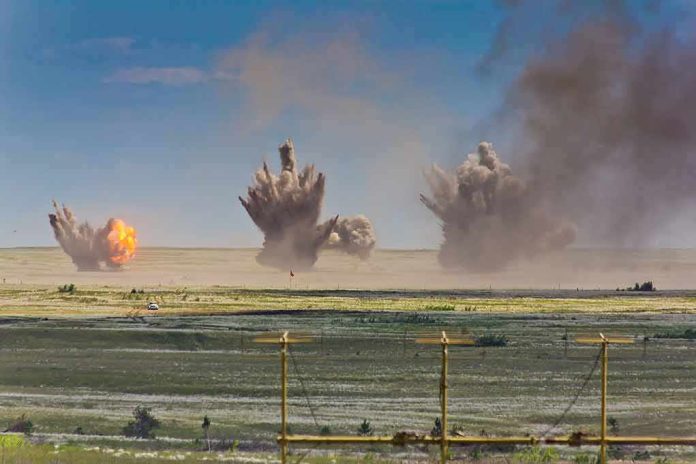
When high explosives age into hair-trigger instability, the safest option can be the counterintuitive one: destroy them where they sit, fast, before they destroy themselves. That is the logic behind the U.S. Army’s controlled detonation of nearly five tons of degraded lead azide at the Iowa Army Ammunition Plant — a rare, tightly regulated intervention designed to preempt an uncontained blast and manage lead dispersion with layers of engineered mitigation.
At a Glance
- The Army determined stored lead azide had degraded into an unstable, shock-sensitive state that could not be moved safely; in-place destruction was chosen to prevent an uncontrolled explosion.
- The EPA issued an emergency permit under RCRA, authorizing on-site storage and treatment by detonation based on an “imminent and substantial endangerment” finding.
- Public health agencies and neighboring states coordinated protective actions, with the Army deploying water curtains, foam blankets, and other controls to suppress airborne lead.
- Courts reviewed challenges to the EPA’s emergency authorization during the run-up; emergency authorities specific to explosives were also invoked in the record.
What the Army did — and why the plan centered on detonation in place
Lead azide is a primary explosive — a compound designed to detonate from modest stimuli and used to initiate larger charges. In storage, it can desensitize with careful formulation and packaging; over time and with environmental stress, it can do the opposite, recrystallizing and embrittling into a powder that responds violently to friction, shock, or static. At the Iowa Army Ammunition Plant (IAAAP), the Army reported just that: unstable, degraded, crystallized material stored in aging containers that could no longer be safely handled or transported. Their public advisory was blunt about the purpose: to protect the public from an uncontrolled, spontaneous explosion by executing a controlled, mitigated detonation on site.
That choice sits squarely within emergency munitions practice. When experts judge an explosive too sensitive to move, the risk calculus flips — every additional touch, lift, mile of roadway, or minute of delay increases the chance of an accidental detonation. Federal hazardous waste rules recognize this class of circumstance. The EPA issued an Emergency Hazardous Waste Management Permit under the Resource Conservation and Recovery Act (RCRA) allowing IAAAP to store and treat the degraded stock by detonation, after finding an “imminent and substantial endangerment to human health and the environment”.
Mechanics of a “controlled, mitigated detonation” — containment by layers
Detonation in place is not a synonym for “open detonation without controls.” The engineering brief for Iowa stacked multiple suppression methods precisely to keep lead particulate out of the air column. Public health guidance from Iowa HHS summarized the protective design: large-capacity water curtains to arrest and wash down particulates; heavy tarps and containment screens to interrupt line-of-sight ballistic ejection; and a thick blanket of aqueous film-forming foam over the shot area to bind dust and speed deposition. State and local agencies translated that design into practical protective actions — temporary sheltering, movement of livestock and equipment indoors in the projected plume sector, and coordinated environmental monitoring.
The experience base for an operation of this scale is thin — by design, because such emergencies are rare. Army experts and independent reporting pointed to a 1977 Colorado operation as the last major U.S. open-air disposal of comparable magnitude, when an estimated 7,000 pounds of lead azide was destroyed and a substantial share of lead remained on-site. The Iowa plan aimed to far exceed that containment performance by using modern suppression tactics and real-time air monitoring. The goal was straightforward: keep airborne lead concentrations at community monitors at or below detection thresholds and drive the bulk of deposition back onto the prepared shot pad.
The regulatory lane for explosive emergencies
RCRA normally channels hazardous waste to permitted treatment technologies and requires alternatives analysis; explosives emergencies live in a narrower lane. EPA policy and case guidance have long recognized that when trained explosive ordnance experts determine a device or stockpile poses an immediate safety threat, emergency authorities allow for rapid removal and destruction — often by controlled detonation — rather than routing the material through ordinary waste-handling infrastructure that would entail more touch points and time.
In Iowa, the EPA’s emergency permit formalized the storage and treatment authorization and documented the endangerment finding. During the run-up, petitioners challenged the permit in the Eighth Circuit; the docket also reflects EPA’s notice that the Army intended to invoke RCRA’s emergency exclusion specific to munitions and explosives — a separate, longstanding mechanism that allows immediate response outside the standard permitting structure when necessary to abate imminent hazards. The legal interplay mattered for timing and oversight; it did not substitute the technical judgment call embedded in the Army’s selection of detonation as the least-risk option for an increasingly unstable stockpile.
Risk comparison: why “don’t move it” can be safer than “handle it carefully”
To a layperson, burning or detonating a toxic energetic seems inherently worse than trying to package and haul it away. Professionals compare risks differently. With degraded primaries, the dominant hazard is accidental initiation triggered by handling or transit. Every rotation of a drum, every lift, every road seam compounds that chance. Conversely, a single, choreographed shot consolidates risk into one event at a controlled time and place, behind engineered mitigation and an exclusion zone. Regulators and emergency doctrine treat that consolidation as a safety feature, not a shortcut, when the material has crossed the instability threshold.
That doctrine does not dismiss environmental risk; it addresses it through design and monitoring. In Iowa, agencies planned around wind fields, humidity, and mixing height; they used water and foam to bind particles; and they arrayed air monitors in and beyond the projected plume to quantify performance. Neighboring states were looped in, and health agencies issued practical guidance for farms and residences downwind — all aimed at minimizing exposure pathways while resolving the initiating hazard swiftly.
🚨 UPDATE: We're now 1 HOUR past the lead azide detonation, and ALL EPA live air monitors are still reading 0.0 µg/m³
NO LEAD DETECTED in the air in Iowa.
EPA is giving updates every 5 minutes. https://t.co/RY1uWWUquC pic.twitter.com/DyS6jBZpnz
— Nick Sortor (@nicksortor) November 25, 2026
How we got here: consolidation, aging stock, and a narrow window
The Iowa stockpile was not an orphan cache discovered by chance; it was the nation’s consolidated reserve of lead azide, staged at IAAAP over years. As with many legacy energetics, calendar age is only a crude proxy for stability; packaging integrity, temperature cycling, and moisture ingress matter more. The Army’s assessment concluded that deterioration of containers and material condition had crossed into an operational no-go — the point at which moving the stock risked more than destroying it in place. Once that determination is made, the window for safe intervention can narrow rapidly: cooler temperatures, vibration from weather fronts, or further crystal growth can all elevate sensitivity from bad to worse.
The Army announced the controlled, mitigated detonation in coordination with EPA, FEMA, and health agencies, framed explicitly as a public-protection action; state partners in Iowa, Missouri, and Illinois synchronized public advisories and monitoring. Newsrooms captured the unusual scale and the cadence of delay-and-go decisions as agencies synchronized legal authority with operational readiness. The end state was a single, time-boxed operation that resolved the detonation hazard while subjecting environmental dispersion to active control and measurement.
What this means going forward
Three lessons persist beyond Iowa. First, aging energetic stockpiles are an engineering problem before they become a public controversy. Inventory discipline, container maintenance, and environmental controls lengthen the safety tail; lapses shorten it. Second, emergency authority exists for a reason, but it carries a reciprocal duty to maximize transparency — to publish the technical basis for instability findings, articulate alternatives considered, and share monitoring data in near real time. EPA’s emergency permitting and the Army’s public safety advisories model that posture when the clock is ticking.
Third, mitigation works when it is layered and tailored: water curtains, foam blankets, exclusion zones, weather windows, and multi-agency monitoring convert a binary “blast or not” into a managed operation with measurable performance. Communities reasonably demand proof that those layers do their job; the right answer is data — before, during, and after — coupled with clear lines of authority so that when unstable energetics cross the threshold from stock to threat, responders can act once, decisively, and as safely as physics allows.
Sources:
facebook.com, army.mil, apnews.com, epa.gov, ecf.ca8.uscourts.gov, cnn.com, federalregister.gov, rmb.reuters.com, rcrapublic.epa.gov