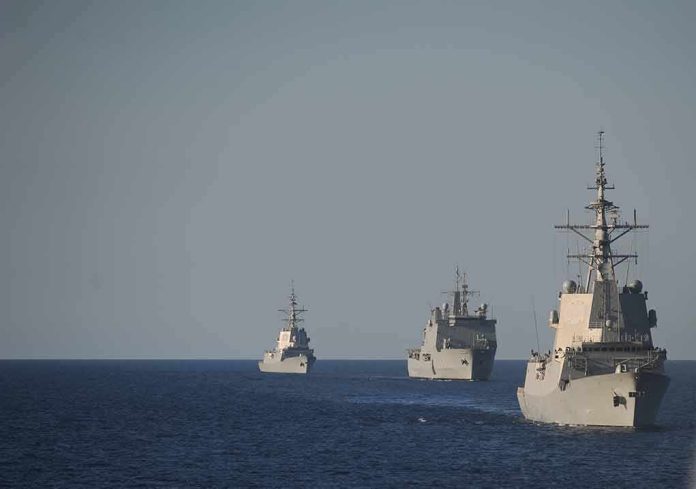
China’s latest naval drill with Russia matters less as a one-off event than as a recurring instrument of statecraft: it is a yearly ritual that blends operational learning, political signaling, and strategic reassurance, all under the cover of “maritime security.”
Intro Header
- The drill is being presented by Beijing as part of a routine bilateral cooperation framework, not as an exceptional mobilization.
- The exercise sits inside a long-running Joint Sea series that has existed since 2012 and has steadily grown more complex.
- The stated mission is maritime security, but the mechanics of the exercise also serve interoperability, deterrence signaling, and power projection.
- The strongest counter-reading does not refute the official explanation; it argues that the same drill, in geopolitical context, still functions as strategic alignment.
A Routine Exercise With Strategic Weight
The central fact is straightforward: China and Russia are holding another Joint Sea naval drill, and Beijing says it belongs to an annual cooperation plan designed to address maritime security challenges and preserve regional peace and stability. That framing is not invented for this cycle. Chinese and Russian officials have described Joint Sea as an annual series since 2012, and the exercise has become one of the clearest institutional habits in the bilateral defense relationship. In other words, the drill is routine in calendar terms even when its political meaning is anything but routine.
That distinction matters because too much commentary treats every Chinese-Russian military move as either proof of benign cooperation or proof of imminent aggression. The better reading is more exacting. The exercise is real cooperation, and it is also strategic signaling. Those are not opposites. Modern militaries use routine drills to build trust, rehearse command relationships, and normalize deployments; once a pattern hardens, the act of repetition itself becomes the message.
What the Drill Actually Trains
The operational design is more revealing than the headline. Reporting on the exercise describes a three-phase sequence: force assembly, port planning and coordination, and then at-sea operations. The tasks include joint maneuvering, submarine rescue, air defense, anti-ship operations, and other fleet-level activities that require discipline, communications compatibility, and a shared tactical vocabulary. These are not symbolic gestures. They are the work of making two navies operate as if they can understand one another under stress.
That is why analysts who study combined exercises treat them as a serious indicator of alignment. Combined drills require the sharing of tactics, techniques, and procedures; they create habits of cooperation that cannot be faked by diplomacy alone. Over time, they also broaden the range of what the partners can credibly do together. The Joint Sea series has moved through different theaters and task sets, from anti-piracy and rescue work to anti-submarine warfare, air defense, escort missions, and replenishment at sea. The result is a relationship that looks less like occasional coordination and more like a practiced operating system.
The Historical Pattern Behind Joint Sea
The current drill only makes sense against the longer arc. Joint Sea began in 2012, but Sino-Russian military cooperation goes back earlier and has become more frequent, more geographically expansive, and more complex over time. Institutional history matters here. The first maneuvers were relatively limited; later iterations spread from the Yellow Sea and Sea of Japan to the South China Sea, the Baltic, the Mediterranean, the Gulf of Oman, and the Pacific. That geographic widening is important because it shows the drills are not confined to safe, politically neutral waters.
Researchers who track these exercises argue that their location increasingly overlaps with sensitive maritime spaces and areas near rival powers or contested routes. That does not prove hostility by itself, but it does explain why outside observers read the drills as more than routine training. If a navy practices far from home, near strategic corridors, with a major partner, it is not just improving seamanship; it is rehearsing presence. And presence, in military affairs, is power before it is combat.
Why Beijing Calls It “Maritime Security”
Beijing’s official language is deliberate. China’s defense ministry says the exercise is meant to “jointly respond to security challenges and safeguard regional peace and stability,” while the Global Times describes the theme as a response to maritime security threats. That wording is broad by design. It gives the exercise flexibility, keeps the rationale politically defensible, and avoids naming an enemy. Song Zhongping, quoted in the Global Times, says the drills have become routine on an annual rotating basis and that one aim is to reduce threats to key maritime corridors while keeping sea lanes open.
But broad language has a cost: it makes the official explanation hard to test. No specific maritime threat was named in the announcement, and the public material does not provide a detailed threat assessment, an intelligence-sharing record, or measurable post-exercise outcomes showing that these drills have reduced piracy, smuggling, or other concrete risks. That absence does not make the rationale false. It makes it political. “Maritime security” is the most useful phrase available because it can encompass nearly everything and commit to almost nothing.
The Strongest Counter-Reading: Signaling, Not Innocence
The most serious challenge to the official framing is not that the drill is fabricated; it is that the drill functions as geopolitical signaling regardless of its stated purpose. The broader policy literature on China-Russia military cooperation describes a pattern of rising frequency since 2014, with more exercises, more patrols, and more activity in or near disputed or strategically charged waters. In that context, the drill supports a visible political relationship between two states that both have reasons to contest U.S. influence in the Indo-Pacific.
That is also why Western and other governments read these exercises skeptically, especially with Russia still under the shadow of its war in Ukraine. The criticism is not primarily that the drill cannot be defensive in form; it is that the same fleet movements can simultaneously train crews and broadcast alignment. Russia benefits from showing it is not isolated; China benefits from showing it can coordinate with a major nuclear power at sea. This is the deeper logic of such drills: they are military events with diplomatic intent baked into the maneuver package.
🚨 RUSSIA & CHINA START JOINT NAVAL DRILL 'SEA-2026' IN YELLOW SEA 🚨
Warships, subs & marines deployed. This solidifies the military alliance, threatening regional balance. $LMT $GD $NOC poised to benefit from rising tensions. #Geopolitics #DefenseStocks— GlobalFlash (@GlobalFlash_Cam) July 5, 2026
What to Watch Next
The key question is not whether Joint Sea is “peaceful” or “provocative,” because that binary is too crude to describe what is actually happening. The useful question is whether the drill is becoming a more integrated rehearsal for joint power projection. Evidence from prior exercises suggests the answer is yes: the partnership has moved from occasional training toward durable institutionalization, and recent reporting shows the two militaries are practicing more sophisticated tasks with greater regularity.
For policymakers, the implication is clear. Annual drills like this are not the same as a formal alliance, but they are what a de facto alignment looks like before any treaty is signed. For naval strategists, the significance lies in interoperability, theater familiarity, and the ability to coordinate under pressure. For everyone else, the lesson is simpler: when China and Russia train together at sea, they are not merely keeping their maritime options open; they are teaching each other how to use them.
Sources:
feedpress.me, english.aawsat.com, globaltimes.cn, apnews.com, youtube.com, facebook.com, legis1.com, mwi.westpoint.edu, everycrsreport.com, uscc.gov