Europe’s invitation to make Canada the European Union’s first “associate member” is not a curiosity; it is a strategic bid to hardwire a like-minded G7 economy into Europe’s economic-security architecture without opening the door to full accession—an experiment in 21st‑century alliance-building that extends far beyond trade.
At a Glance
- The European Commission President publicly proposed Canada as the EU’s first “associate member” in the State of the Union address, a top-tier policy venue.
- The initiative explicitly aims to deepen cooperation from CETA toward a broader economic and security alliance in tech, energy, defense industry, and the Arctic.
- “Associate membership” has no current basis in EU treaties; it would have to be created and defined by EU institutions and member states.
- Canada has welcomed deeper ties but emphasized a “unique alliance,” not any form of EU membership—signaling interest in substance over labels.
A formal invitation delivered at the EU’s policy apex
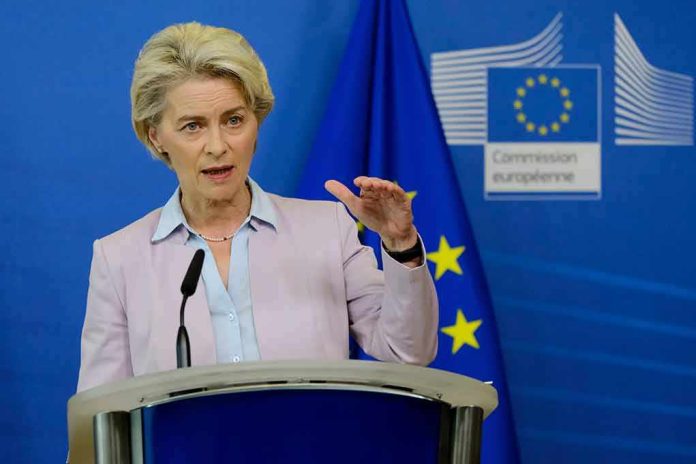
European Commission President Ursula von der Leyen used her State of the European Union address in Strasbourg to make a direct, on‑the‑record proposal to Ottawa: work together to open the door for Canada to become the EU’s first associate member. This was not an offhand remark or a background trial balloon; the State of the Union is the Commission’s marquee policy program for the year, and the language she used—“first associate member”—was categorical. Multiple independent outlets reported the same core phrasing and setting, underscoring that the overture was made publicly and deliberately in a forum designed to set strategic direction for the Union.
The timing and staging matter. Invitations floated in private tend to be provisional. Ones delivered in the EU’s central annual address are agenda-setting. Von der Leyen paired the label with a list of concrete cooperation domains—intelligent manufacturing, a tech alliance, integration of defense industrial bases, energy and critical minerals, batteries, AI, quantum, cybersecurity, and economic security—positioning the idea as an instrument for economic resilience and strategic alignment, not simply diplomatic branding.
What “associate membership” would and would not be
The label is new for the EU as a whole; there is no Treaty on European Union article that defines “associate member” of the Union. That absence does not make the offer symbolic. It defines the task ahead: to craft a bespoke legal framework that borrows from the EU’s well-worn association toolkit without conferring institutional membership privileges. The EU has decades of practice granting third countries near-equal participation in specific programs by agreement—most notably in research and innovation—while reserving decision-making rights for members. Canada itself is already associated to Pillar II of Horizon Europe, a status that gives Canadian entities access to calls and funding on terms very close to those of EU participants in that pillar.
This is the critical distinction. Sectoral association—what EU lawyers build under Article 217 TFEU association agreements and program-specific regulations—has a deep acquis. “Associate membership” of the Union does not; it would need to be designed, likely as a package spanning multiple policy instruments rather than a single constitutional act. That is why most reporting correctly describes the concept as novel and its terms as undefined. The Commission has made the strategic pitch; the legal engineering and member-state politics will determine its eventual shape.
Why the EU is courting Canada now
The impetus is not hard to trace. The EU wants more resilient supply chains, secure access to energy transition inputs, and trusted partners for dual‑use technology and defense industrial capacity—ideally in jurisdictions with democratic alignment and regulatory compatibility. Canada checks those boxes, with critical minerals deposits, a sophisticated tech base, a capable (if lean) defense-industrial footprint, and an Atlantic geography that dovetails with Europe’s maritime and Arctic concerns. Von der Leyen framed the relationship as moving “from CETA to an alliance for the future” specifically to create a “common prosperity and economic security space”—language that places economic security on par with market access.
There is also a signaling function. By inviting Canada as the first associate member, Brussels telegraphs a model for engaging advanced democracies outside Europe that want something more structured than ad hoc cooperation yet short of accession. In an era of economic coercion and contested standards, codified alignment on critical technologies, export controls, investment screening, and supply-chain finance is a form of strategic deterrence through interdependence. The overture to Ottawa is a test case.
Canada’s position: pursue substance, avoid the membership frame
Ottawa has welcomed the ambition to deepen ties while steering clear of membership terminology. Canadian leaders have emphasized a “unique alliance” rather than associate membership, making clear they are not seeking to enter the Union in any form. That stance is coherent: Canada wants privileged access and policy coordination without ceding sovereignty or importing EU decision-making into domestic competencies. Public remarks from Canadian officials reflect this calibration—open to a broader framework, careful on the label.
This does not dampen the practical agenda. A Canada–EU compact that accelerates co‑investment in battery value chains, locks in long-horizon critical mineral supply agreements, expands joint R&D in AI and quantum, and rationalizes defense industrial standards would move markets and shape trajectories in sectors where scale and regulatory clarity are decisive. If designed well, it would also de‑risk transatlantic supply lines without forcing Canada into binary choices among partners.
Precedent and mechanism: how a bespoke status could be built
The EU’s playbook for third‑country association is modular. Where the treaties don’t name a status, the Union builds it functionally: an umbrella political agreement, flanked by program association decisions (research, digital, space), regulatory cooperation committees, defense industrial instruments, and financing windows that collectively produce “membership‑like” participation in defined areas. Canada’s Horizon Europe association is instructive here; the Commission and Ottawa have already proven they can operationalize near‑parity participation in a complex program via a dedicated agreement and joint committee structure.
Extending that logic, an “associate membership” package could assemble: a framework pact for economic security cooperation; program association to digital and industrial initiatives; a critical minerals and clean tech compact with binding offtake and standards; reciprocal market‑surveillance and product‑safety cooperation; joint procurement or co‑development lanes in defense where export regimes are aligned; and interoperable cybersecurity certification. None of this requires inventing a new EU treaty category; it does require political will in capitals and meticulous legal drafting.
Politics and constraints inside the EU
No new status of this ambition becomes real without member-state assent. Some capitals will prioritize industrial reciprocity and budget contributions; others will scrutinize state-aid symmetry, dispute-settlement, and the integrity of the single market. A further layer is optics: several member states have yet to fully ratify CETA, and a more sweeping Canada framework will inevitably be compared to still‑pending trade politics. This is why the Strasbourg framing focused on an alliance for the future across security‑relevant domains rather than a classic market-access overhaul—it aligns the proposal with the EU’s economic security strategy and reduces exposure to trade‑only ratification battles.
One brief caveat is appropriate: the offer establishes a political direction, not a legally defined status; rights, obligations, and governance would need to be negotiated and approved through EU processes before any “associate member” label has concrete meaning. That said, the Commission’s public ownership of the idea—and the breadth of areas named—signal real intent.
What success would look like
Judge this project not by whether the Union ultimately coins the term “associate member” in statute, but by whether Europe and Canada lock in interoperable rules, shared capacity, and reciprocal market access in strategic sectors. A credible outcome would include: bankable investment and offtake in critical minerals; joint standards and testbeds in AI, quantum, and cybersecurity; program-level research association beyond Horizon’s current scope; expanded defense industrial cooperation with predictable export licensing; and a standing economic security dialogue with rapid response tools to address coercion or supply shocks. Those elements would deliver the function of association—privileged, rules‑bound integration—regardless of the final label.
Bottom line
The EU has put a bold, first‑of‑its‑kind partnership on the table for Canada, anchored in economic security and advanced industry rather than accession. The legal category is new; the mechanisms to build it are not. If Brussels and Ottawa keep the focus on interoperable rules, co‑investment, and defense‑relevant technology ties, “associate membership” can become more than a headline—an institutional template for how major democracies deepen alignment in a fractured world. The speech made the case. The next phase is engineering it.
Sources:
globalnews.ca, reuters.com, wsj.com, news10.com, indiatoday.in, research-and-innovation.ec.europa.eu, irishtimes.com, euronews.com
BRUSSELS — European Commission President Ursula von der Leyen's announcement that the EU will explore "associate membership" for Canada came as a surprise to member countries — and left governments concerned about the potential trade-offs.
During her annual State of the Union…
— 42NoClue (@CurroCircum) September 17, 2026