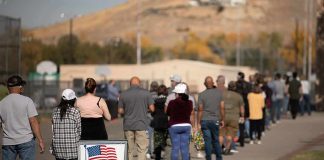

The real fight at Newark’s Delaney Hall is not just over a curfew or some burning tires, but over who gets to define “law and order” when the law is holding people in cages.
Story Snapshot
- Protesters say hunger-striking detainees face spoiled food, poor medical care, and retaliation inside Delaney Hall.
- Newark’s mayor answered nights of clashes with a half‑mile, 9 p.m. to 6 a.m. curfew around the immigration detention center.
- State leaders warn about masked agitators, weapons, and fires, while federal officials deny any mistreatment inside.
- The core question: when does “public safety” become a convenient way to drown out ugly truths behind the fence?
Why Delaney Hall Became A Flashpoint Overnight
Newark did not wake up one morning to random street chaos; the nightly crowds outside Delaney Hall began after immigrant advocates said detainees launched a hunger strike over poor living conditions inside the 1,000‑bed immigration detention facility.[1][2] Local television coverage describes allegations that people inside received small portions of often spoiled food and saw serious medical needs ignored, including claims of pepper spray and physical force used in apparent retaliation.[1][3] Those details, not just slogans, lit the fuse.
Advocates and several Democratic members of Congress touring the facility reported “dire” conditions, echoing detainees’ accounts of inedible food and unmet medical needs.[1][2] That kind of specific allegation—spoilage, portion size, ignored care—carries more weight than generic complaints because it looks measurable and verifiable. At the same time, the Department of Homeland Security (DHS) and the Trump administration flatly deny misconduct and even dispute that a hunger strike exists, a predictable institutional reaction from agencies that control access to the evidence.[1][3]
From Conditions Protest To Street Clash In A Week
Protests that started as nightly vigils and chants turned into something closer to a running street confrontation. Reports describe crowds growing as word of the allegations spread, with protesters facing off not only with immigration agents but with New Jersey State Police brought in by Governor Mikie Sherrill.[1][3] On multiple nights, law enforcement used tear gas and officers on horseback to push back demonstrators after barricades came down and objects were thrown.[2][3] At least several arrests followed claims of weapons being found in the crowd.[3]
Governor Sherrill publicly backed a tougher perimeter but tried to frame it as de‑escalation, not crackdown. She said masked people attacked barriers in a designated protest zone, hurled projectiles, used the barricades as weapons, and lit tires on fire in the street, putting both peaceful protesters and officers in danger.[2] From a conservative, common‑sense standpoint, any government that ignores people throwing projectiles at police is failing a basic duty. The harder question is whether that danger justifies restricting everyone within a broad radius.
The Curfew: Public Safety Tool Or Pressure Valve On Dissent?
Mayor Ras Baraka responded by imposing a nightly curfew for a half‑mile around Delaney Hall, effective from 9 p.m. to 6 a.m. “until further notice,” citing an escalating situation and an increasing need for police intervention.[2][3] The order does not shut down protest completely; it aims squarely at the overnight hours when tensions and tempers spike, and it focuses on a specific zone rather than the whole city. That tailoring lines up with the idea that government must keep order while still leaving space for speech and assembly.
Even so, the public record leaves gaps that ought to make any skeptic of broad government power uneasy. Reporting mentions multiple arrests and weapons but does not provide case‑by‑case arrest documents or body‑camera footage that show who did what, which makes it hard to separate committed agitators from people simply standing in the wrong place after dark.[3] There is also no released operational threat assessment explaining why a half‑mile radius, rather than a smaller perimeter or focused enforcement on actual offenders, was necessary.[2][3]
Inside Versus Outside: Competing Narratives And Conservative Skepticism
Both sides lean heavily on narrative rather than fully public evidence. Advocates point to on‑the‑record tours and detailed complaints about food and medical care; DHS simply says “no,” denies a hunger strike, and calls the protests disruptive.[1][3] State leaders emphasize fires, projectiles, and masked individuals; protesters highlight batons, tear gas, and curfew lines. For anyone who values restrained government and transparency, neither story should be swallowed whole without receipts.
New Jersey Governor Mikie Sherrill urged calm after violent clashes outside Delaney Hall detention center, as Newark imposed a curfew and state police secured protest zones https://t.co/knk8FetUFy pic.twitter.com/eYoqeEkGDK
— Reuters (@Reuters) May 31, 2026
Conservative values offer a clear lens here. The rule of law demands consequences for people who attack officers or use riots as cover. At the same time, a government that locks people up through a complex web of federal agencies and private contractors, then controls access to records, deserves no blind trust when it denies abuse in facilities shielded from regular public scrutiny. A curfew that quiets the streets but leaves questions inside Delaney Hall unanswered should not end the conversation.
Sources:
[1] Web – Mayor orders curfew at ICE facility that has seen violent protests, …
[2] Web – Delaney Hall protests: Newark Mayor Ras Baraka orders mandatory …
[3] Web – Sherrill, Newark mayor back partial curfew in New Jersey’s largest …