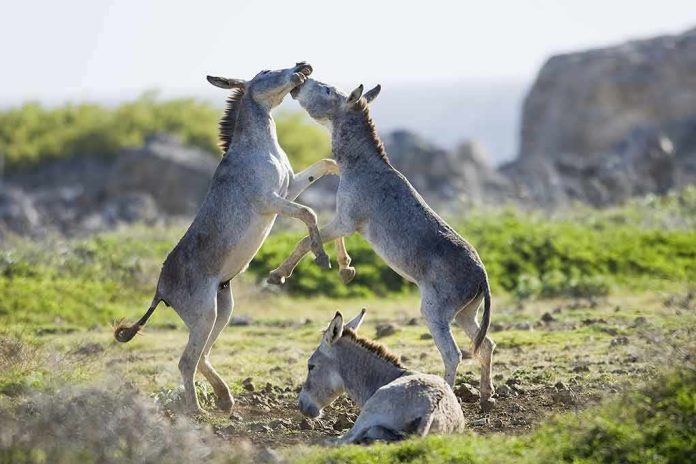
Precaution, not panic, is the right frame: UC Riverside’s advisory about wild burros is a textbook example of behavior-based safety for living with large, protected animals that now wander regularly through parts of campus.
At a Glance
- UC Riverside is telling students and staff to give wild burros space, never approach or feed them, and slow down near them on campus roads.
- The guidance is grounded in physiology and behavior: 500‑pound equids can kick, charge when threatened, and pose collision risks.
- Burro sightings occur near residence halls, parking lots, and campus roads, creating repeated human–vehicle interaction points.
- Regional incidents on nearby corridors show the consequence profile, while county rules and federal protections shape what the university can do.
What the university is actually advising and why
UC Riverside’s message is specific and behavioral, not theatrical: do not approach or touch burros, do not feed them, slow down near them, and report injured animals to authorities. The rationale is straightforward. These are wild equids with mass and power; a startled or defensive kick can be catastrophic, and the combination of large animals and cars on campus roadways carries obvious kinetic risk. The university’s materials also emphasize the knock-on effects of human contact—particularly feeding—because it can erode natural wariness and alter foraging behavior, increasing the odds of close approaches and conflicts over time.
That guidance mirrors standard best practice across wildlife management: manage the interaction, not the headline. Telling people exactly what not to do (no touching, no food, slow down) addresses the proximate causes of most adverse encounters with large, free-roaming animals. In equids, the triggers are predictable—territorial reactions, protective behavior around foals, and flight responses that become dangerous at close range. The Los Angeles Times captured those stakes plainly, noting the animals’ approximate 500‑pound mass and their capacity to charge when threatened, alongside the admonition to slow near them because collisions can be deadly for both animals and humans.
Where and how the animals are intersecting with campus life
These aren’t one‑off sightings on a remote periphery. Over the last several years, burros have been seen near residence halls, in parking areas, adjacent to student housing, and along campus roads. An Inside UCR report documented appearances near student residences and Watkins Road in 2021, while subsequent coverage and university communications describe routine sightings by 2023 and photos of animals near the Lothian Residence Hall. The pattern matters because the geography of encounter—places where pedestrians, bicyclists, and vehicles concentrate—drives the practical risk the university must manage.
It is also why the feeding prohibition features so prominently. Handouts from well‑meaning people may seem benign, but they reshape behavior: animals that associate humans with food approach more closely and more often, becoming less responsive to the cues—like an idling car or a raised voice—that otherwise maintain a safe buffer. UC Riverside’s published guidance links that mechanism explicitly to human safety and animal welfare, echoing language used by local jurisdictions managing the same herd complex in the Box Springs area.
Risk profile: what has happened nearby and what has not happened on campus
The region has already seen the grim arithmetic of vehicle–burro conflicts. In 2020, five burros died and a motorist was injured when a group entered the 215 Freeway; the following year, six donkeys were killed in a train strike in San Timoteo Canyon. Those incidents do not transform UC Riverside into a danger zone by themselves, but they establish the plausible consequence set when large animals and transportation infrastructure intersect—especially at night or in low‑visibility conditions.
Within the campus footprint, the university’s own magazine has said that, to date, no major problems have been tied to these visits. That is not a contradiction; it is a status report. The appropriate inference is not complacency, but prevention: a campus with recurring burro traffic through housing and parking zones should harden the system before the first serious collision or injury occurs. That is exactly what the current guidance aims to do.
Protected status and the policy envelope the university must operate within
UC Riverside’s caution also reflects the animals’ legal status. The university points to federal protections for wild burros and to Riverside County Ordinance No. 934, which makes certain interactions with untamed donkeys unlawful and punishable by fines. That framework steers management away from ad hoc “handling” and toward public education and non‑intrusive mitigation. In short, the university cannot and should not treat the animals as stray livestock to be herded or hazed at will; the right lever is human behavior, backed by clear legal lines.
This constraint often surprises campus communities, which may assume that a public safety office can simply remove wildlife. In reality, protected status, jurisdictional boundaries, and animal welfare considerations narrow the toolkit. That is why seemingly modest instructions—don’t feed, don’t approach, slow down—carry so much practical weight: they are both legally sound and behaviorally effective when widely adopted.
How coexistence can be improved from here
If the goal is to keep serious incidents at zero, a prevention strategy grounded in measurement will outperform slogans. Several lines of inquiry already proposed by UC Riverside researchers would sharpen campus risk management. First, mapping movement: camera traps or GPS collars can establish where and when burros traverse campus, identifying hotspots and times when traffic calming, temporary detours, or targeted signage would have the most effect. Second, population and habituation: a reproducible estimate of herd size, coupled with observations of flight distance and approach behavior near human activity, would show whether the campus animals are losing wariness compared with less‑exposed groups.
Third, transport risk modeling: even without collisions on record, near‑miss reports, speed studies, and volume counts can be combined to quantify exposure and to test interventions—lighting, rumble strips on approach to known crossings, or seasonal slow‑zones during predictable movement windows. Finally, governance clarity: publishing the text and enforcement history of county restrictions alongside campus policy would help the community understand why some interventions are off the table and what consequences attach to feeding or harassment.
The communication challenge: affection and caution can coexist
UC Riverside has embraced the burros as a piece of campus identity—an unofficial mascot, a frequent subject of selfies, and a point of local pride. There is nothing inherently contradictory about celebrating a charismatic species while insisting on distance and de‑feeding norms. The friction arrives when the affectionate framing overwhelms the practical admonitions. Students and visitors will follow rules more reliably when they are treated as part of a shared stewardship compact: protect the animals by keeping them wild; protect yourself by keeping your distance. That is the through‑line of the current advisory, and experience from other wild‑equid interfaces suggests it is the right one.
The deeper truth is that coexistence is a system property. When a campus sits at the edge of conserved habitat, wildlife will cross the boundary; the task is to design human behavior and campus infrastructure so those crossings remain uneventful. UC Riverside’s guidance—don’t approach, don’t feed, slow down—targets exactly the pressure points where good intentions can go wrong. It is not a one‑time message but a standing operating procedure for living next to large, protected animals.
What to do on campus, in plain terms
Give burros space. Never feed them—no handouts, no lures, no attempts to “help.” Keep pets leashed and away from the animals. If you are driving, slow markedly wherever they are present, day or night. If you see an injured animal, report it through campus channels rather than intervening yourself. Those simple behaviors are the difference between a beloved neighbor species and a preventable incident. They are also, by design, what the law and the biology both permit and reward.
Sources:
nypost.com, latimes.com, yahoo.com, news.ucr.edu, insideucr.ucr.edu