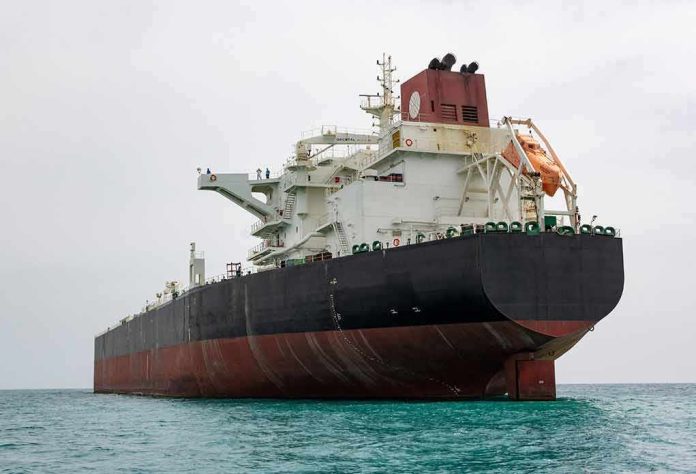
Two giant Saudi oil tankers just flipped around in the Red Sea after a single email warning from Yemeni rebels, showing how a small militia can jolt global energy markets without firing a shot.
Story Snapshot
- Two Saudi oil tankers bound for China and India made sudden U-turns in the Red Sea after Houthi threats.
- Yemen’s Houthi movement has declared a naval blockade on Saudi Arabia, using the Bab el-Mandeb chokepoint as leverage.
- Saudi Arabia claims it can keep exports flowing through other routes and its Yanbu port, but those workarounds have limits.
- The episode highlights how distant conflicts and “deep state” power games can raise energy costs and risk for everyday Americans.
Houthis Use Threats, Not Missiles, to Stop Saudi Oil
Yemen’s Iran-backed Houthi movement announced on July 20 that it was imposing a maritime blockade on Saudi Arabia, warning ships they could be targeted anywhere within reach if they loaded or unloaded at Saudi ports. The next day, two tankers that had loaded Saudi crude for China and India made abrupt U-turns in the Red Sea and headed back toward the Suez Canal, avoiding Houthi-controlled waters near the Bab el-Mandeb Strait. Maritime tracking showed the Xin Long Yang and Rodos carrying about 2.7 million barrels of oil when they reversed course.
The Houthis did not need to launch missiles to force those changes; they relied on emails and public warnings to shipowners. In their message, Houthi officials said any ship calling at Saudi ports or carrying Saudi oil could be attacked “in any location” within their reach. Analysts who have studied Red Sea incidents say this fits a pattern of asymmetric maritime coercion, where a weaker force uses geography and fear at major chokepoints instead of traditional naval power. Since late 2023, similar Houthi threats around the Red Sea have already pushed big shipping lines to reroute vessels.
Saudi Resilience and the Limits of Workarounds
Saudi leaders and energy officials are pushing a different message: that oil exports will continue despite Houthi threats. Earlier this year, crude loadings at the Red Sea port of Yanbu kept going even after an attack on the kingdom’s east–west pipeline, with Reuters reporting that shipments persisted from the port. Other reports say Yanbu has recently reached very high crude shipments and can operate near four to five million barrels per day in brief periods, suggesting some capacity to reroute flows when other routes are at risk.
Saudi Aramco has a record of diverting shipments and using spare capacity and overseas storage to soften shocks. When past threats hit the Strait of Hormuz, the company increased use of pipelines that bypass the waterway and drew on stockpiles abroad. Those steps can limit short-term disruption, but they do not erase the basic math: most Saudi crude exports still rely on seaborne routes that must pass either Bab el-Mandeb or Hormuz. If rebels or regional powers can threaten both chokepoints at once, even a rich state with strong energy firms faces hard limits.
Why Two Tankers Matter Far Beyond the Red Sea
The two U-turns are small compared with total global oil flows, but they matter because they show how fragile the system is. One rebel group in one poor country sent an email, and suddenly millions of barrels of oil changed route, traders bid up prices, and governments issued fresh warnings. The United States Maritime Administration’s guidance for Red Sea traffic now warns that ships with tracking systems on are at higher risk and may need to switch off those signals to avoid targeting. That kind of advice confirms the threat is real even as governments insist they have things under control.
Two oil tankers carrying Saudi crude to Asia reversed course in the Red Sea today after threats from Yemen’s Iran-aligned Houthis, as a widening Middle East conflict disrupted shipping through two of the world’s most critical energy chokepoints.
More: https://t.co/TDxu1lmfPl
— Star-Advertiser (@StarAdvertiser) July 21, 2026
For Americans watching from home, this is another sign that the global “rules” are not working for regular people on either the right or the left. Decades of wars, sanctions, and proxy fights have turned key trade routes into pressure points used by governments, militias, and energy giants. When a small militia can shake markets and a major ally like Saudi Arabia scrambles to adjust, it shows how much power sits in the hands of distant actors and how easily energy costs, inflation, and economic stress can be pushed onto families who have no say in these decisions.
Sources:
19fortyfive.com, straitstimes.com, youtube.com, en.wikipedia.org, marinelink.com, english.aawsat.com, theedgemalaysia.com, turkiyetoday.com, bloomberg.com, instagram.com, itf-oecd.org