

Large, highly publicized crackdowns can stop a dangerous street takeover in its tracks; the harder test is whether they change the calculus of organizers and crowds beyond one dramatic night.
At a Glance
- Operation Street Sweeper was a coordinated LAPD–LASD–CHP action that contained, rather than merely dispersed, a Harbor Gateway takeover involving more than 700 people.
- The operation yielded roughly 66–69 arrests, about 570 citations, and approximately 200 vehicle impounds; officers also recovered seven firearms, underscoring public-safety risk beyond nuisance conduct.
- Authorities deployed more than 150 officers with drones, tow fleets, and transport buses to hold the ground and deliver a visible deterrent message.
- The tactic aligns with research on police crackdowns that often achieve short-term deterrence; lasting effects hinge on sustained certainty of sanctions and complementary measures to prevent displacement.
What actually changed in the LAPD playbook
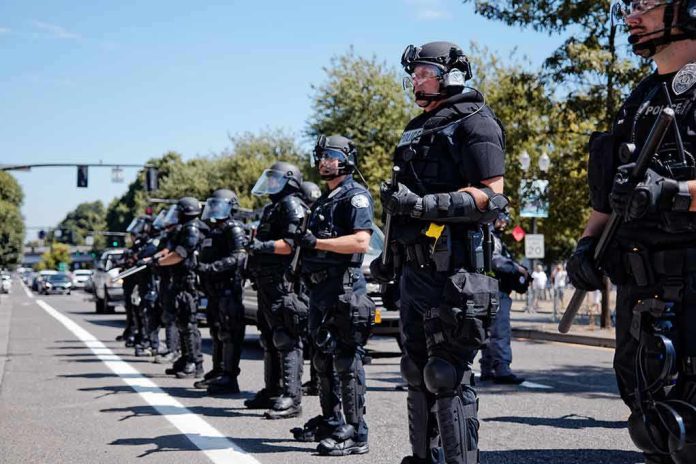
Street takeovers thrive on speed: a convoy arrives, blocks an intersection, spins tires, streams to social media, then vanishes as sirens approach. For years, enforcement struggled to keep pace; units rolled up, lights on, and the crowd scattered. Operation Street Sweeper in Harbor Gateway inverted that script. Intelligence teams tracked multiple converging takeovers and allowed the final crowd to coalesce at Figueroa and Alondra—then closed the exits simultaneously, using more than 150 officers, tow fleets, and buses to contain the scene for arrests, citations, and impounds. That shift—from chase-and-disperse to surround-and-hold—is the operational hinge here, and it explains both the volume outcomes and the deterrent posture.
Numbers convey the scale. Across outlets, counts vary slightly, a normal artifact of evolving tallies, but they cluster tightly: roughly 66–69 arrests, around 570 citations, about 200 vehicles impounded, and seven firearms recovered. The gun recoveries matter; they rebut the notion these gatherings are mere car culture exuberance, and they raise the stakes for neighbors who have long complained about noise, smoke, and property damage spreading into residential blocks.
Mechanics of a containment operation
Containment tactics are logistics-heavy. Commanders need real-time visibility on feeder routes, staging lots, and secondary meet-up points; unmanned aerial systems (drones) reduce blind spots and help time the closure. The ideal execution is quiet until it isn’t: traffic units and patrol cars hold perimeter positions, a tow caravan stands off, prisoner-transport capacity is cached, and arrest teams move only when the intersection is boxed. That sequencing explains the visual signature residents and attendees described—cruisers lighting up in multiple directions at once and alleyways suddenly blocked. The goal is certainty of sanction for the core behaviors that enable the spectacle: blocking lanes, aiding and abetting, and drawing the spectator ring that shields drivers.
Certainty, in deterrence theory, typically beats severity. Street-racing literature and problem-oriented policing guidance emphasize that when would-be participants believe arrest and impound are likely—and that the operation is designed to prevent easy flight—attendance falls, especially among casual spectators and drivers who can’t afford to lose their cars. That is precisely the message the department intended to send in Harbor Gateway: you may not escape, and your vehicle will not either.
Why the evidence supports immediate impact, not yet lasting change
Crackdowns are one of policing’s most studied tools. Across drug markets, traffic enforcement, and hot-spot patrols, meta-analyses and case syntheses consistently find strong initial deterrent effects that often decay without sustained follow-through or structural changes that raise the everyday risk of sanction. The research on displacement is mixed by design: some interventions push activity to adjacent blocks or later hours; others generate “diffusion of benefits,” where nearby areas also quiet down. The common thread is that temporary surges, by themselves, rarely reset offender expectations for long. Lasting change requires either continuous certainty—predictable enforcement presence, automated detection, or legal changes that simplify prosecution—or strategies that reduce the payoff of the behavior.
Applied here, the Harbor Gateway operation almost certainly reduced risk that night and likely dampened turnout for the immediate next meet-ups that feared a repeat. But the public record does not yet provide longitudinal incident data to show whether the frequency of takeovers, injuries, or weapons recoveries declined across subsequent months, or whether gatherings merely shifted to other intersections and jurisdictions. That evidentiary gap is normal in the first wave of coverage; it does not undercut the reported results, but it does set the boundary of what claims the evidence can carry today.
Where reasonable debate lives: proportionality, due process, and strategy mix
Containment raises predictable scrutiny. Boxing a crowd captures bystanders along with active participants; that is the point operationally, because spectatorship enables the ring where drivers perform. Legally and ethically, though, departments must show individualized probable cause for arrests and document the basis for citations and impounds—distinguishing drivers, aiders, obstructers, and curfew violators. Without after-action reports, arrest affidavits, and citation breakdowns, the public cannot audit those lines in detail. That transparency, plus data on injuries, complaints, and evidence handling, is what converts a show of force into a replicable, defensible template rather than a one-off flex.
There is also a strategic question. Residents and some safety commentators often applaud decisive enforcement but doubt the staying power of episodic surges. Critics are not disputing the Harbor Gateway facts; they are arguing that a sustainable solution blends targeted crackdowns with infrastructure and legal changes—cameras at chronic hot spots, automated enforcement of exhibition-driving statutes, enhanced penalties that attach to the act of organizing, and traffic-calming designs that make intersections harder to occupy. That combined approach maps cleanly to the street-racing problem-oriented playbook and to deterrence research on maintaining certainty without constant mass deployments.
𝐋𝐀𝐏𝐃 𝐒𝐌𝐀𝐒𝐇𝐄𝐒 𝐅𝐎𝐔𝐑 𝐒𝐈𝐌𝐔𝐋𝐓𝐀𝐍𝐄𝐎𝐔𝐒 𝐒𝐓𝐑𝐄𝐄𝐓 𝐓𝐀𝐊𝐄𝐎𝐕𝐄𝐑𝐒 — 𝟕𝟎 𝐀𝐑𝐑𝐄𝐒𝐓𝐄𝐃, 𝟓𝟕𝟎 𝐂𝐈𝐓𝐄𝐃, 𝐖𝐄𝐀𝐏𝐎𝐍𝐒 𝐒𝐄𝐈𝐙𝐄𝐃
Before dawn on Saturday, more than 700 people converged on the intersection of South Figueroa Street and West Alondra… pic.twitter.com/1SJgPcZRCj
— M.A. Rothman (@MichaelARothman) September 6, 2026
What an evidence-led next phase looks like
A credible path forward has four pillars. First, measurement: publish six- and twelve-month incident trends for takeover calls, collisions, arrests, and weapons recoveries in Harbor Gateway and analogous corridors, with displacement analysis to adjacent areas. Second, process integrity: release an after-action report summarizing the operation plan, criteria for arrest and impound, and complaint outcomes; include anonymized breakdowns by offense type and age. Third, structural deterrence: harden repeat intersections with remote cameras certified for evidence, rapid-deploy bollards where feasible, and clear signage of towing authority—so the perceived certainty of sanction persists even on ordinary weekends. Fourth, legal modernization: pursue narrowly tailored statutes that criminalize organizing and monetizing takeovers, coupled with calibrated vehicle sanctions that survive court scrutiny and do not depend on continuous surge staffing.
The bottom line
Operation Street Sweeper delivered what crackdowns are designed to deliver: immediate control of a volatile scene, demonstrable sanctions at scale, and a visible message that fleeing is no longer the default outcome. The recovered guns and the size of the impound roster justify the public-safety framing. Whether this becomes more than a compelling night of television depends on what comes next—transparent reporting, sustained certainty of consequences, and investments that make the next takeover harder to stage and less attractive to attend.
Sources:
abc7.com, stl.news, lanacion.com.ar, radioseoul1650.com